


Most apparel brands treat supplier onboarding like a hiring decision. You vet a factory, place a first order, and hope. If the first shipment lands clean, the vendor "passed." If it doesn't, you start firefighting.
The problem with that mental model is that onboarding isn't a moment — it's a lifecycle. A factory that nails a 200-unit sample run can still fall apart at 4,000 units. A vendor with perfect capability paperwork can miss every date once your PO is competing with someone else's on their floor. And a supplier that ramps cleanly in Q1 can quietly degrade six months later when their star line supervisor walks out.
What holds this together is a loop: capability vetting feeds into a monitored sample run, which feeds into a 90-day ramp with hard KPIs, which feeds into ongoing scorecards, which feed back into contract terms with actual teeth. Break any link and the whole thing leaks.
This is the system view of supplier onboarding performance for apparel — how the stages connect, where they break under scale, and how to write commitments that survive contact with a real production floor.
Why brands keep re-learning the same lesson
Onboarding fails so predictably because the criteria you use to pick a supplier are almost never the criteria you use to manage them.
Vetting tends to be front-loaded and document-heavy. You collect certifications, machine lists, a couple of reference clients, maybe a walk-through video. Then you sign. From that point, the relationship shifts to POs, dates, and defect complaints — a completely different vocabulary. The capability profile you built during vetting gets filed and forgotten.
That disconnect is where the damage starts. A typical pattern: a brand vets a factory on their ability to run stretch woven bottoms, confirms they have the right needles and a solid QC lead, and signs. Six weeks later the first bulk order arrives with wavy side seams. Nobody goes back to the capability matrix to check whether the factory ever demonstrated bulk-level consistency on that construction — because vetting and performance live in separate worlds, on separate spreadsheets, owned by separate people.
The fix isn't more paperwork upfront. It's making the vetting data live inside the performance system so it keeps being tested. The capability claim "we can hold ±0.5cm on stretch bottoms" isn't a checkbox at signing — it's a hypothesis you keep measuring for the first 90 days and beyond.
The lifecycle, stage by stage
Below is the full arc as one connected pipeline. Each stage produces an output that becomes the input for the next.
Eliminate delays in your fashion production cycle.
GoTailo helps you manage designs, orders, and inventory effortlessly, keeping production on schedule.
- Centralized order and inventory management
- Real-time supplier communication
- Integrated production scheduling
No credit card required
| Stage | Purpose | Key output | Feeds into |
|---|---|---|---|
| Capability vetting | Confirm the factory can do the work | Scored capability matrix per product class | Sample-run scope |
| MV (measured-value) sample | Prove it on a small, monitored run | Sample scorecard + defect log | Ramp targets |
| 90-day ramp | Prove consistency as volume climbs | Ramp KPI trend data | Ongoing scorecard baseline |
| Ongoing scorecards | Catch drift before it becomes a crisis | Rolling performance grade | Contract clauses & tier |
| Contract clauses | Enforce commitments with consequences | Ramp guarantees, exit rights | Next vendor decisions |
The mistake most teams make is running these as isolated events with different owners and no shared data. Sourcing owns vetting. Production owns samples. QC owns defects. Finance owns the contract. Nobody owns the thread connecting them, so a red flag in the sample stage never propagates to tighter ramp targets or a stricter clause.
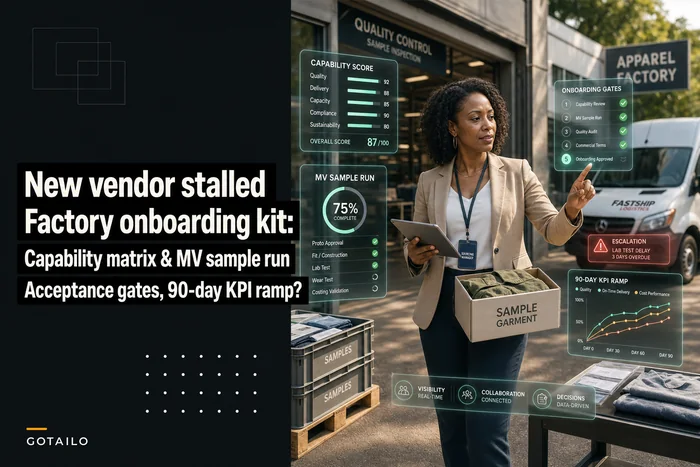
The front and back ends of this loop are covered in more detail elsewhere — the factory onboarding checklist, capability matrix and 90-day KPI structure and the scorecard and tiered remediation approach for suppliers that keep slipping. This article is about the connective tissue between them.
Here's a simple workflow view of the loop.
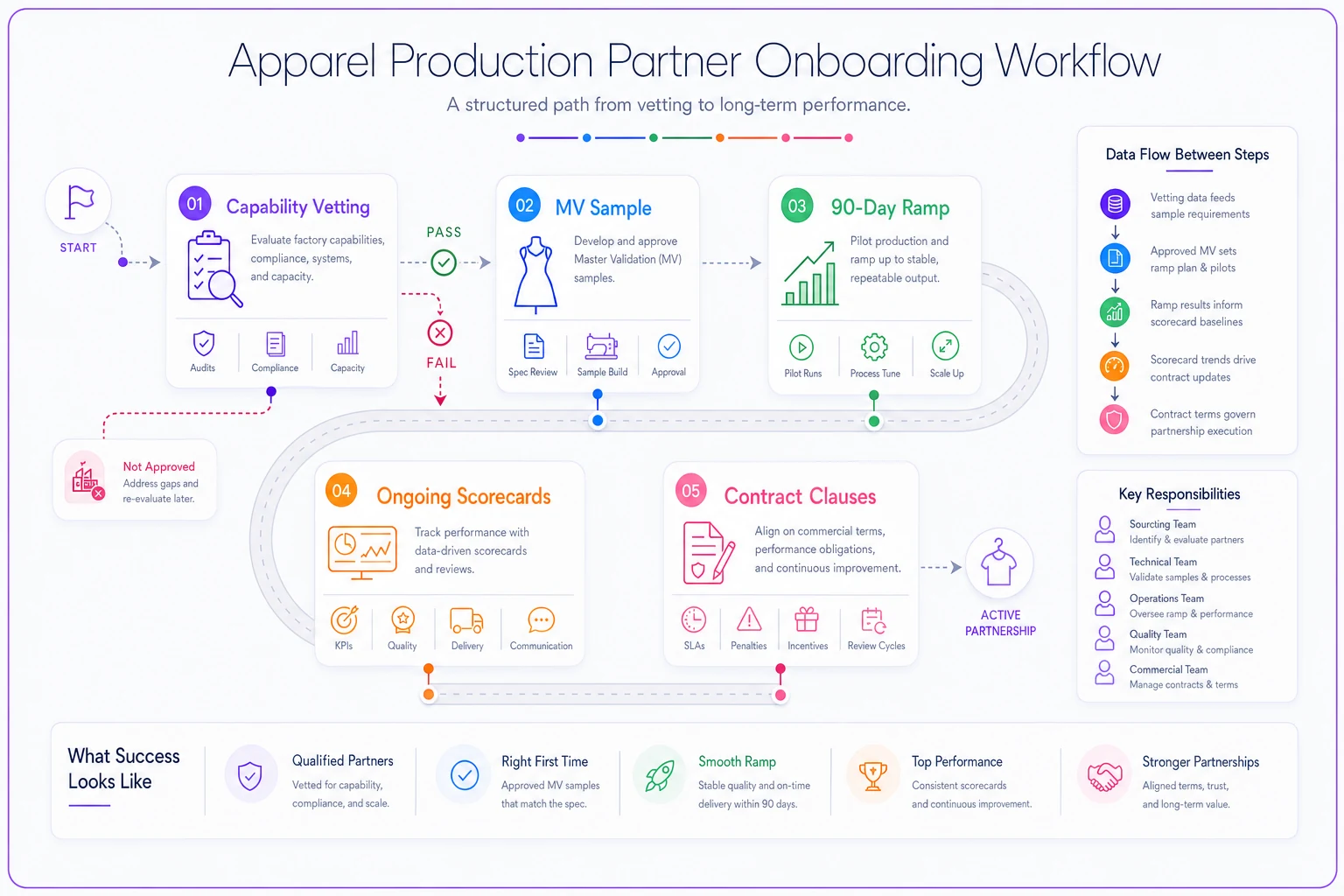
The diagram visualizes who owns each handoff and where data should flow so nothing gets lost between stages.
Capability vetting that doesn't lie to you
Most capability matrices are self-reported, which makes them close to useless. A factory ticks "yes" on knit outerwear, and you find out three months later that "yes" meant one bomber jacket run in 2021.
Vet by evidence class, not by claim. For every product category you plan to place, score the factory on:
-
Demonstrated construction — have they physically produced this exact construction type? Ask for the last unit they made, not a catalog photo.
-
Machine and attachment fit — not just "do you have flatlock" but "how many flatlock heads, and what's their current state."
-
Tolerance history — what measurement spec have they held on a comparable garment, and can they show a recent QC report proving it.
-
Volume ceiling — the largest single order they've run in this class, and what their defect rate was at that volume.
-
Capacity honesty — how much of their floor is already committed, and to whom.
That last point is the one brands skip and regret. A factory can be fully capable and still be a bad fit because your 3,000-unit order is competing against a 40,000-unit anchor client who always jumps the queue. Capability without dedicated capacity is just a scheduling trap.
Attach raw QC reports and dated photos to each capability score so evidence is auditable and clearly time-stamped.
Score each dimension 1–5, keep the raw evidence attached to the score, and set a minimum — anything below a 3 on tolerance history or volume ceiling means the first order stays small no matter how good everything else looks.
The MV sample: a measured-value run, not a "please make me a sample"
The sample stage is where most of the useful signal lives, and where most brands waste it. A single perfect sew-out tells you almost nothing about production behavior — factories put their best operator on your sample, so you're learning how good their best is, not their average.
A measured-value (MV) sample run is designed to expose the average. Instead of one unit, you run a small pilot — say 40 to 80 units — under conditions that resemble real production:
-
Specify a mixed size run. Ask for the full size range, not just a sample-size medium. Grading problems hide in the extremes.
-
Require the run go through their normal line, not a sample room. You want the operators who'll actually make your bulk order touching it.
-
Log every defect by type, not just a pass/fail count. A defect taxonomy turns "3 rejects" into "3 rejects, all skipped stitches on the same seam" — which points at a specific machine or operator.
-
Time the run. How long from cut to finished? This is your first real data point on throughput, and it anchors your ramp math.
-
Pull measurements on a sample of the batch, not one hero unit. You're looking for spread, not a single good number.
The output is an MV sample scorecard. A realistic one from a small woven-tops program might read: 62 units run, 7 defects (5 puckered collars, 2 misaligned buttons), measurement spread on chest ±0.9cm against a ±0.6cm spec, cut-to-finish time around 11 hours. That's a factory that can probably get there but hasn't yet — which tells you exactly what your first 30 days of ramp need to fix.
The MV sample isn't a gate you pass. It's a diagnostic that sets your ramp targets. A clean MV run earns a faster ramp. A messy-but-fixable one earns a slower, more supervised ramp. A run that's messy in ways tracing back to missing capability — not just early-run jitters — earns a "don't scale this yet," which is a much cheaper conclusion at 62 units than at 3,000.
Ramp KPIs: what to measure across the first 90 days
The 90-day ramp is where capability becomes reliability, or doesn't. The point isn't hitting perfect numbers on day one — it's watching the trend line move the right direction as volume increases.
-
First-pass yield (FPY) — percentage of units passing QC without rework. Should climb steadily. Flat or falling FPY as volume rises is your earliest warning sign.
-
On-time-to-plan — did each milestone (cut, sew, finish, ship) hit its committed date? Track the variance in days, not just yes/no.
-
Defect rate by category — falling total is good, but watch the mix. If puckering disappears and a new defect appears in its place, that's an unstable process, not an improving one.
-
Measurement conformance — percentage of audited units inside tolerance. This is the one that quietly kills you if you're only watching defect counts.
-
Communication latency — how long between raising an issue and getting a real answer. Slow response during onboarding never improves; it gets worse.
-
Volume vs. quality tradeoff — as order size increases across the 90 days, does quality hold? That's the whole point of the ramp.
A practical ramp cadence: order 1 at roughly 20–30% of intended volume, order 2 at 50–60%, order 3 at full volume. If FPY and on-time hold across all three, the ramp succeeded. If quality falls each time volume rises, you've found their real ceiling — and it's below what you need.
Where teams get this wrong: they run three full-volume orders back to back and call it a ramp. That's not a ramp, that's a gamble. The stepped volume is the entire mechanism — it lets the factory and you find problems at 800 units instead of 3,000.
Ongoing scorecards: catching the slow decline
Passing the ramp is not the finish line. The most dangerous supplier failures aren't the ones that show up in week two — they're the ones that appear in month seven, after everyone stopped paying attention.
Suppliers degrade for boring reasons: a key supervisor leaves, they take on a bigger client and your orders lose priority, a machine wears out and nobody flags it, their material sourcing quietly shifts to a cheaper mill. None of these show up as a dramatic failure. They show up as slow drift — FPY down two points a month, on-time slipping from 95% to 88% to 81% across a quarter.
Rolling scorecards catch drift. Keep the same core KPIs from the ramp, grade them monthly, and — this is the part that matters — compare against the supplier's own baseline, not just an absolute threshold. A factory running at 82% FPY isn't a problem if that's always been their number. A factory dropping from 94% to 82% is a problem even though the absolute figure looks acceptable.
The other half of scorecards is what they trigger. A grade shouldn't just sit in a report. It should map to an action: a green scorecard earns more volume or better terms, a yellow triggers a documented improvement conversation, a red triggers the remediation loop and, if the clause exists, a contractual consequence.
Keeping this data trustworthy over time is its own discipline — stale or inconsistent scorecard inputs quietly poison every decision downstream. The reconciliation and ownership habits in operational data governance for apparel teams are what keep a scorecard system honest once you're running more than a handful of suppliers.
Contract clauses that actually enforce the ramp
The gap that undermines every good onboarding process: the operational commitments live in your scorecard, and the legal document says nothing about them. So when a supplier misses their ramp targets, you have data but no leverage.
Ramp guarantee clause. "Supplier commits to achieving first-pass yield of no less than 92% by end of the second full-volume production order, measured by [Brand]'s inspection protocol. Failure to meet this threshold across two consecutive orders entitles [Brand] to [reduced order commitment / renegotiated pricing / termination without penalty]."
Capacity dedication clause. "Supplier commits to reserving [X units/month] of production capacity for [Brand] during the onboarding period, and to provide 30 days' notice before accepting new commitments that reduce available capacity below this level." This directly targets the queue-jumping problem.
Measurement conformance clause. "No less than 95% of audited units in any shipment shall fall within the tolerances specified in the approved tech pack. Shipments below 90% conformance may be rejected at Supplier's cost."
Scorecard-linked remediation clause. "A rolling scorecard grade of 'red' as defined in Appendix [X] triggers a mandatory 14-day corrective action plan. A second consecutive red grade entitles [Brand] to reallocate volume without penalty."
Continuity clause. "Supplier shall notify [Brand] within 5 business days of any change in senior production or QC leadership assigned to [Brand]'s programs." This catches the silent-supervisor-departure failure before quality does.
The point isn't to be adversarial. A commitment with no consequence is just a wish. Writing the ramp KPIs and scorecard grades directly into enforceable terms means your operational data and your legal leverage finally point at the same target.
When this full system makes sense — and when it's overkill
Running the complete loop — vetting, MV sample, staged 90-day ramp, monthly scorecards, ramp clauses — takes real effort. It's not always worth it.
When it makes sense:
-
New factory relationships where you're placing meaningful volume
-
Product categories with tight tolerances or complex construction
-
Suppliers you intend to scale into a core-vendor role
-
Any factory where a failure would blow a launch window
When it's overkill:
-
One-off capsule runs you'll never repeat
-
Tiny orders with a supplier you've already run 20 clean seasons with
-
Sampling-only relationships that never touch bulk
Very small brands running two or three orders a year probably shouldn't attempt the full version. If you don't have enough volume to run a staged ramp, a lighter version — solid vetting, one honest MV sample, a simple monthly check — will serve you better than a heavy process you can't feed with data.
The system scales with you. Early on it's a shared spreadsheet and discipline. Once you cross a dozen or more active suppliers, the manual version starts breaking — you can't hold twelve rolling scorecards and their baselines in your head, and drift slips through. That's when centralizing the loop in a proper workflow platform earns its keep, because the value isn't in any single stage — it's in the connections between them staying intact as the supplier count grows.
A real scenario
A mid-size activewear brand — roughly 40 SKUs a season, a couple hundred thousand units a year across four factories — kept getting burned by new suppliers. Their pattern was familiar: vet on paperwork, place a full-volume first order, eat the defects when it goes wrong. Over about a year they'd had two new-factory launches slip badly, with rework and air-freight costs somewhere in the $30k–$45k range combined.
They rebuilt onboarding as a loop. Every new factory now runs a 60-unit MV sample through the normal line, with a defect log and measurement spread — not a sample-room hero piece. The ramp moved to three stepped orders (roughly 25%, 55%, 100% of target). KPIs tracked weekly, and the ramp targets went into the contract as a guarantee clause with a two-strike exit.
The next two onboardings went differently. One factory's MV sample surfaced a grading problem in the largest sizes — caught at 60 units, fixed before bulk. The other showed FPY climbing cleanly across the stepped orders, so they scaled it faster than planned. Neither launch slipped. The one factory that started drifting in month six got flagged by the scorecard at a 6-point FPY drop and pulled into a corrective plan before it touched a shipment.
Nothing dramatic. No perfect numbers, no overnight transformation. Just a loop where each stage fed the next, and problems surfaced when they were still small and cheap to fix.
The thread that has to stay unbroken
Supplier onboarding usually fails not because of a bad factory, but because of a broken chain — vetting data that never gets tested, samples that flatter the supplier's best operator, ramps that skip the staged volume that makes them meaningful, scorecards nobody acts on, and contracts that don't mention any of it.
Treat onboarding as a connected performance loop instead of a hiring decision, and the failures stop being surprises. The capability claim becomes a measured hypothesis. The sample becomes a diagnostic. The ramp becomes proof. The scorecard becomes an early-warning system. The contract becomes the thing that makes all of it enforceable instead of hopeful.
That thread — vetting to sample to ramp to scorecard to clause — is the actual product of good supplier onboarding performance work. Keep it intact, and you spend far less of your season firefighting suppliers you should never have scaled in the first place.
Ready to tailor your apparel operations?
Join 500+ fashion brands using GoTailo to accelerate product launches, reduce waste, and improve supplier collaboration.