


Your design team updates a BOM in their spreadsheet. Production works off last week's version. The vendor ships based on an old PO. Three weeks later, you're air-freighting corrections that eat your entire margin.
This isn't a software problem. It's a governance problem — who owns what data, when it syncs, and how you catch misalignment before products ship.
Most apparel brands have data scattered across emails, spreadsheets, ERPs, and vendor portals. That's manageable at small scale. It compounds fast when you're running multiple collections, working with factories across time zones, and rotating hundreds of SKUs per season.
What breaks first is the connection between your canonical data sources and the working copies teams use day-to-day. Design maintains BOMs in one system, purchasing tracks POs in another, the warehouse references SKUs in a third. Without clear ownership and reconciliation habits, these drift apart until someone notices missing trims mid-run or wrong carton quantities at the dock.
Why apparel data governance breaks differently than other industries
Apparel has some quirks that make this harder than other product categories. Unlike electronics or CPG, where products stay relatively stable year to year, fashion is built around constant change. One style might have 12 colorways, 6 sizes per color, and component variations depending on factory capabilities. Multiply that across a collection and you're tracking thousands of interrelated data points.
The timeline pressure makes everything worse. Consumer electronics companies might have 18 months from concept to shelf. Apparel brands often have 4 to 6 months. Data problems discovered late in the cycle mean rush sampling, expedited shipping, or missing the selling window entirely.
Then there's the geography. Designer in LA, pattern maker in NYC, factory in Vietnam, trim supplier in China, fulfillment in Pennsylvania. Each person has their own interpretation of product data, their own systems, their own priorities. Without explicit governance, everyone builds local workarounds that seem reasonable in isolation but cause chaos upstream or downstream.
I watched a brand lose tens of thousands on a single production run because the factory's interpretation of "Navy" didn't match the design team's spec. The BOM said Pantone 19-4052. The PO just said "Navy." The factory used their standard dye lot. Nobody caught it until boxes opened at the warehouse.
Building your canonical data model without enterprise systems
You don't need a million-dollar PLM to run clean data governance. You need clarity on four things: what data matters most, who owns it, how often it syncs, and how you audit for drift.
Eliminate delays in your fashion production cycle.
GoTailo helps you manage designs, orders, and inventory effortlessly, keeping production on schedule.
- Centralized order and inventory management
- Real-time supplier communication
- Integrated production scheduling
No credit card required
Core data elements for apparel operations
-
1. Bill of Materials (BOM)
-
2. SKU Master
-
3. Purchase Orders
-
4. Vendor Master
-
5. Inventory Positions
1. Bill of Materials (BOM) This is your product truth — every component, trim, label, and packaging element that goes into a finished good. Specify exact material codes, not descriptions. "YKK #5 metal zipper, antique brass, 18cm" not "gold zipper."
2. SKU Master Your SKU structure needs to encode enough information for operations while staying manageable. Most brands land on something like: [Brand][Season][Category][Style][Color][Size]. The key is consistency — if you use "BLK" for black in one SKU, don't use "BLACK" somewhere else.
3. Purchase Orders POs translate BOMs into vendor instructions. Every PO should reference the specific BOM version it's based on. When BOMs change — and they will — you need to know which POs need updating.
4. Vendor Master Beyond contact info, track capabilities, minimums, lead times, and quality history. This prevents sending orders to factories that can't handle certain techniques or materials.
5. Inventory Positions Not just finished goods — materials, WIP, and in-transit quantities. Knowing you have 500 units in the warehouse doesn't mean much if 300 are missing buttons.
Assigning data ownership
Design owns:
-
BOM creation and updates
-
Material specifications
-
Size specifications and grading
-
Color standards
Production/Sourcing owns:
-
Vendor assignments
-
PO creation and modifications
-
Delivery dates
-
Cost negotiations
Merchandising owns:
-
SKU structure
-
Pricing architecture
-
Product descriptions
-
Season codes
Operations owns:
-
Inventory positions
-
Location assignments
-
Fulfillment rules
-
Return codes
Finance owns:
-
Cost validation
-
Margin calculations
-
Payment terms
-
Currency conversions
Notice the overlaps — design specifies materials but production sources them. Merchandising sets prices but finance validates margins. These handoff points need extra attention in your governance model.
Sync cadences that match apparel workflows
Different data types need different update frequencies. BOMs might lock weekly during development but need daily attention during sampling. Inventory positions need real-time updates during fulfillment but weekly checks during off-season.
A practical sync cadence for a typical apparel brand:
| Frequency | Data Type |
|---|---|
| Daily | Inventory positions (selling season), order status, production WIP reports |
| Weekly | BOM updates (development phase), PO modifications, vendor capacity, sample status |
| Monthly | SKU lifecycle status, vendor scorecards, cost roll-ups, quality metrics |
| Seasonal | SKU creation for new lines, vendor onboarding/offboarding, pricing updates, archive prior season |
The point is matching sync frequency to decision frequency. If you only review vendor performance monthly, daily vendor updates create noise without value. But if you're allocating inventory for flash sales, daily position updates matter a lot.
Reconciliation routines that catch problems early
Even with clear ownership and regular syncs, data drifts. Reconciliation routines catch these drifts before they turn expensive.
Three-layer reconciliation approach
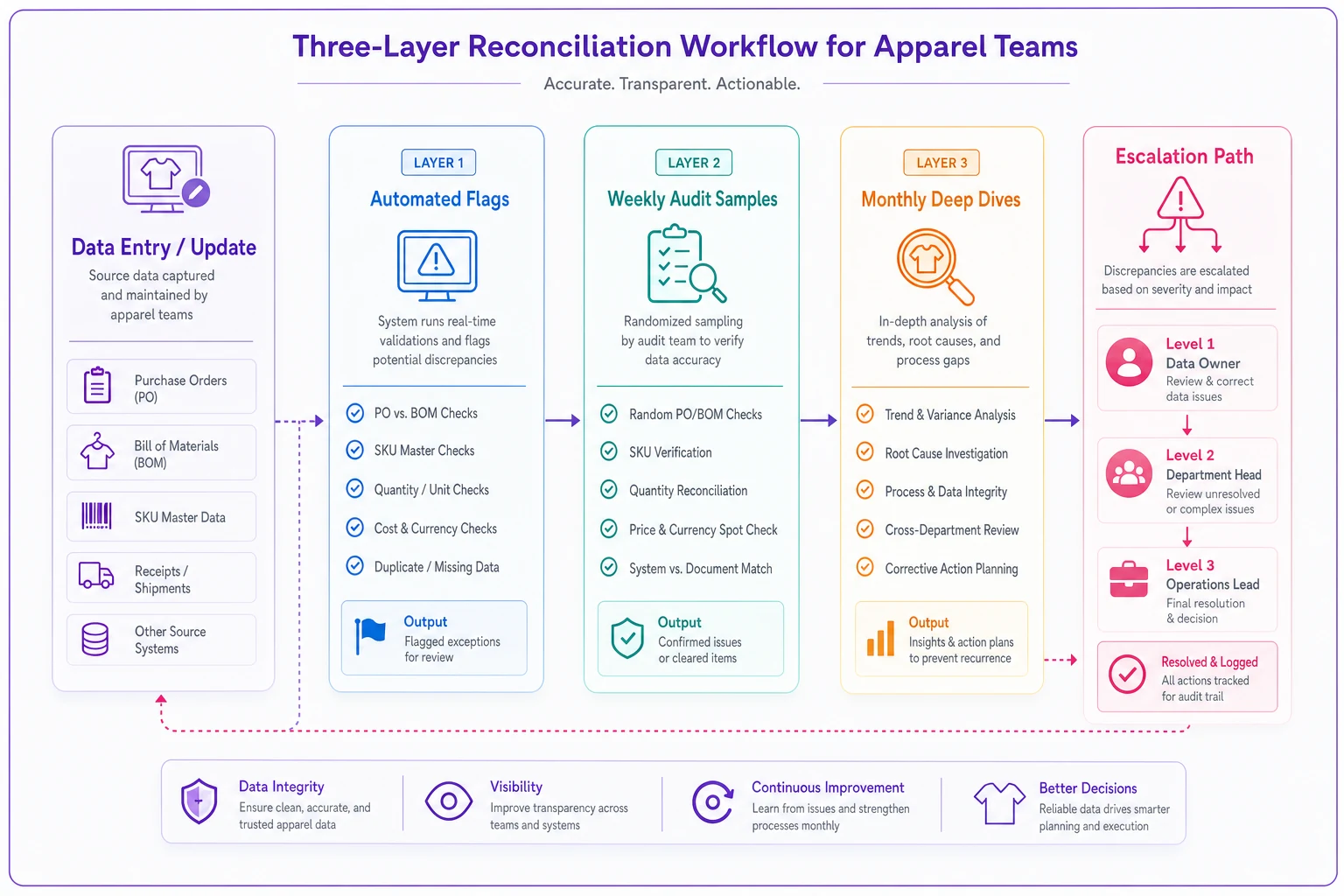
[Data Entry / Update] | v [Layer 1: Automated Flags] — PO vs BOM quantity checks, SKU count checks, lead time vs delivery checks | v [Layer 2: Weekly Audit Samples] — Random PO/BOM checks, SKU spot verification, vendor record validation | v [Layer 3: Monthly Deep Dives] — Rotating full reconciliation by data domain | v [Escalation if discrepancy found] — Impact-based routing to data owner, department head, or operations lead
Layer 1: Automated flags
-
PO quantities vs BOM requirements
-
SKU counts vs active style counts
-
Vendor lead times vs delivery dates
-
Price points vs margin thresholds
These don't fix problems, but they surface them quickly. A PO for 1,000 units when the BOM shows 1,200 units needed should trigger immediate review.
Layer 2: Weekly audit samples
-
5 POs checked against their BOMs
-
10 SKUs verified across systems
-
3 vendor records validated
-
20 inventory positions spot-checked
Sampling catches systematic issues that automated checks miss. Maybe all POs are consistently rounding down quantities, or SKUs are being created with inconsistent naming conventions.
Layer 3: Monthly deep dives
-
Month 1
All active BOMs vs all open POs
-
Month 2
SKU master vs inventory systems
-
Month 3
Vendor data vs actual performance
-
Month 4
Return to Month 1
These deep dives often surface process issues, not just data issues. Maybe the design team updates BOMs without notifying production. Maybe warehouse teams create "temporary" SKUs that never get cleaned up.
Here's a quick visual of the reconciliation workflow.
Practical reconciliation template for apparel teams
BOM to PO Reconciliation:
-
BOM version number matches PO reference
-
Material codes identical (not just descriptions)
-
Quantities align with size curve
-
Trim quantities include appropriate overage
-
Packaging specifications included
-
Label and hangtag requirements specified
-
Factory has confirmed all materials available
SKU to Inventory Reconciliation:
-
SKU exists in all systems (ERP, WMS, eCommerce)
-
Descriptions match across systems
-
Size and color codes consistent
-
Active/inactive status aligned
-
Pricing loaded correctly
-
Images linked properly
Vendor to Performance Reconciliation:
-
Contact information current
-
Capability matrix updated
-
Lead times match recent actuals
-
Minimum quantities verified
-
Payment terms confirmed
-
Compliance documents on file
These lists look simple. That's the point. The brands that actually run reconciliation consistently are the ones that kept it simple enough to do under pressure.
Real-world audit scenarios and what they reveal
Three audit scenarios that come up repeatedly across apparel brands:
Scenario 1: The seasonal colorway confusion
A brand launching their spring collection noticed inventory shortages on specific colorways despite production reports showing complete delivery. The audit found the design team had updated color names mid-production — "Sage" became "Eucalyptus" — but only in their master files. POs still referenced "Sage." The warehouse received items labeled "Sage." But the eCommerce platform expected "Eucalyptus." The result was phantom inventory that existed physically but was invisible to the selling platform.
Fix: Color codes now lock when POs generate. Name changes only affect customer-facing descriptions, not operational codes.
Scenario 2: The sliding delivery window
A manufacturer consistently missed delivery windows despite vendors confirming on-time shipment. Reconciliation found that purchase orders showed "delivery by" dates while vendors worked off "ship by" dates. The three-week transit time wasn't accounted for in either system. Design teams expected goods by their dates, vendors shipped by their dates, and operations scrambled to expedite everything.
Fix: POs now show both "ship by" and "arrive by" dates, with transit time explicitly calculated based on shipping method and origin.
Scenario 3: The multiplying SKU problem
An accessories brand found their SKU count had grown from around 200 to over 500 in six months, despite only launching 50 new styles. Warehouse teams created "temporary" SKUs for returns processing. Customer service created variants for special orders. The eCommerce team made duplicates for promotions. None of these synced back to the master SKU list.
Fix: Only merchandising can create permanent SKUs. Temporary SKUs auto-expire after 30 days. All systems validate against the central SKU master before accepting new entries.
These scenarios repeat because the root causes are process and ownership, not tooling.
Escalation routines when reconciliation fails
Even good reconciliation catches problems after they've started. You need clear escalation paths based on impact and urgency.
Impact-based escalation matrix
| Impact Level | Threshold | Response |
|---|---|---|
| Low | < $5K or < 1 week delay | Data owner fixes within 24 hours, documents root cause |
| Medium | $5K–$25K or 1–2 week delay | Data owner + department head, fix same business day, root cause required |
| High | > $25K or > 2 week delay | Immediate escalation to ops lead, war room within 2 hours, daily updates |
| Critical | Full production run at risk | All hands, CEO involvement, external resources authorized |
The dollar thresholds adjust based on your scale. The structure doesn't change: clear thresholds, defined owners, specific actions.
Communication templates for data issues
Initial Alert (within 1 hour of discovery): ISSUE: [Specific data discrepancy] IMPACT: [Products, quantities, and timelines affected] CAUSE: [If known, otherwise "Under investigation"] IMMEDIATE ACTION: [What's being done right now] NEXT UPDATE: [Specific time]
Update Communications (per escalation schedule): STATUS: [Contained/Spreading/Resolved] PROGRESS: [What's been done since last update] BLOCKERS: [What's preventing resolution] NEEDS: [Resources, decisions, or support required] NEXT STEPS: [Specific actions with owners] NEXT UPDATE: [Specific time]
Resolution Notice: RESOLVED: [Original issue] ROOT CAUSE: [What actually went wrong] IMPACT FINAL: [Actual cost, delay, or other metrics] FIXES IMPLEMENTED: [Immediate corrections] PROCESS CHANGES: [Permanent improvements] MONITORING: [How we'll prevent recurrence]
When data problems surface, clear communication prevents panic and focuses energy on solutions.
The real difference when governance actually works
A kids' apparel brand operating across six factories implemented this governance structure after losing roughly $200K on misaligned production runs. They started simple — assigned clear data owners, established weekly reconciliation for active POs, and created basic escalation thresholds.
Six months later, they'd caught and corrected around 40 potential issues before production started. Most were small — a trim quantity mismatch, a color code error — but three would have resulted in complete production runs with wrong materials. The early catches saved an estimated $150K in expedited shipping and rework costs.
On-time delivery improved from around 60% to 85%. Not because factories got better, but because data alignment meant everyone was working from the same specifications. When you combine this with proper visibility signals, you catch both data and operational issues before they cascade.
Technology acceleration without system overhaul
You don't need to replace your entire tech stack to improve data governance. Modern operational platforms can sit alongside existing systems, adding reconciliation and audit capability without disrupting current workflows.
The key is choosing tools that actually understand apparel. Generic project management or database tools force you to adapt your processes to their structure. Purpose-built apparel operations software comes with BOM templates, SKU structures, and reconciliation routines designed for fashion workflows.
AI automation helps most with the repetitive reconciliation work. Instead of manually checking every PO against its BOM, automated checks can run continuously and only escalate discrepancies that exceed your thresholds — letting your team focus on fixing problems rather than hunting for them.
Some brands layer these tools in gradually, starting with PO/BOM reconciliation and expanding from there. Others implement the full framework at once. The gradual approach tends to work better for teams already in production. Clean-slate implementations suit new brands or major system overhauls.
Building on your tech-pack governance with proper data ownership creates a foundation that scales. Add materials traceability and you've got visibility from design through delivery.
When data governance makes sense vs when it's overkill
Not every brand needs formal data governance. Under 50 SKUs per season with one or two vendors, spreadsheets and email might genuinely be enough. Adding governance overhead without enough complexity to justify it can actually slow you down.
You need governance when:
-
Multiple people update the same data
-
Production runs exceed $50K
-
You work with 3+ vendors simultaneously
-
Lead times stretch beyond 12 weeks
-
SKU counts exceed 100 active items
-
You're repeating successful styles across seasons
-
Mistakes are becoming expensive
You're not ready when:
-
One person manages all data
-
You're still in sampling or development only
-
Your entire catalog fits on one page
-
You change vendors every season
-
You're still testing market fit
The middle ground often works best — implement governance for critical data like BOMs and POs while keeping other data informal. Expand as you scale.
Making governance stick in resource-constrained teams
Designing a governance model is the easy part. Maintaining it when everyone's already stretched is harder.
Start with the highest-impact, lowest-effort wins. Usually that's PO/BOM reconciliation since mismatches there directly cost money. Don't try to govern everything at once — that's how governance programs die quietly after the first rough week.
Rotate audit responsibilities weekly to spread load and build cross-functional understanding.
Build reconciliation into existing meetings instead of creating new ones. Spend the first five minutes of your weekly production call reviewing reconciliation flags. Make it part of the rhythm, not an addition to it.
Rotate audit responsibilities so no single person owns all the checking. This week design audits SKUs, next week production audits vendor data. It spreads the load and builds cross-functional understanding over time.
Document decisions, not just data. When you change a BOM, note why. When you update a vendor record, explain what triggered it. This context prevents future confusion and helps new team members understand what happened and why.
Accept that perfect governance doesn't exist. Even large brands have data problems. The goal isn't perfection — it's catching problems before they get expensive. An 80% solution that people actually follow beats a theoretical 100% solution that only lives in a shared drive nobody opens.
From reactive firefighting to proactive operations
Most apparel brands discover data problems at the worst possible moment — when goods arrive wrong, when customers complain, when margins disappear. Proper data governance shifts that dynamic. Not through complex systems or big investments, but through clarity: who owns what, when it updates, how you check alignment.
The templates and routines here can be implemented with your current tools, whether that's spreadsheets, basic software, or a full ERP.
Start with one reconciliation routine this week. Pick your most painful data disconnect — probably PO/BOM alignment or SKU consistency — and implement a basic weekly check. Build from there as you see results.
The brands that scale successfully aren't the ones with perfect data. They're the ones with clear ownership, regular reconciliation, and fast escalation when problems surface. They catch the $5K problem before it becomes the $50K crisis. That's how operational discipline actually develops — not through perfect systems, but through consistent habits that improve with each cycle.
Ready to tailor your apparel operations?
Join 500+ fashion brands using GoTailo to accelerate product launches, reduce waste, and improve supplier collaboration.