

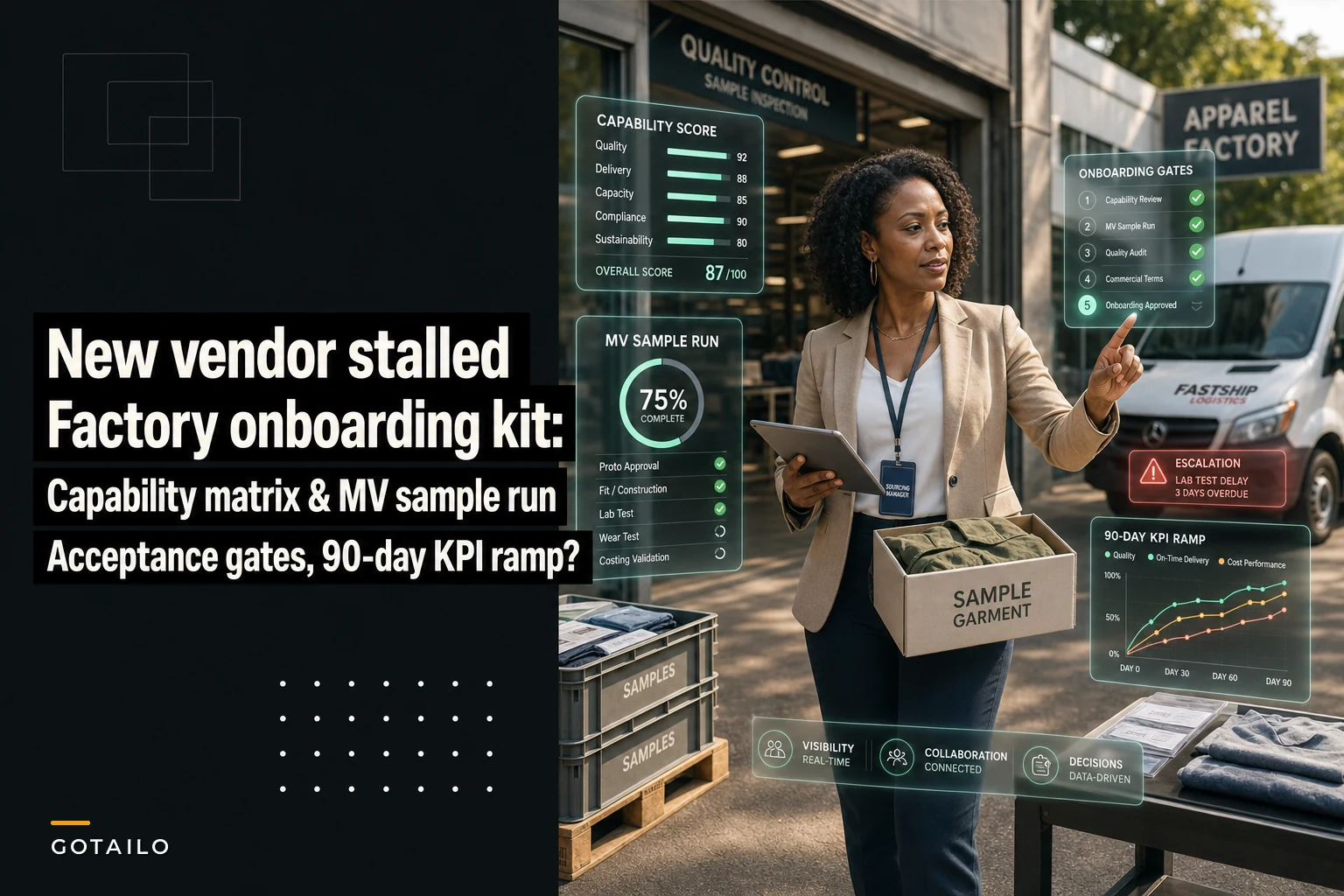

A new factory looks great on paper. The sample came back clean, pricing was competitive, the sales rep answered emails within the hour, and the sourcing trip went well. Then the first real PO drops and everything falls apart. Sizing drifts on the second cut. Stitch density doesn't match the approved sample. The shipment slips two weeks and nobody flagged it until the ex-factory date had already passed.
This isn't a supplier quality problem. It's an onboarding problem. Most apparel teams treat vendor onboarding as a contract-and-first-PO event instead of a structured 90-day ramp with real acceptance gates. The result is that a factory's actual capability — not the showroom version — reveals itself in the middle of a production order, which is the worst possible time to find out.
The rest of this is a working factory onboarding checklist apparel teams can actually run: a capability matrix to score what the factory can genuinely do, a minimum-viable sample run to test it cheaply, acceptance gates that decide go/no-go, 90-day ramp KPIs, escalation triggers, and the handover artifacts that keep it all from living in one person's inbox.
Start with a capability matrix, not a trust exercise
The most common early mistake is scoping a first order based on what the factory says it can do. A factory that quotes you knit tops will happily accept a woven blazer program because they don't want to lose the account. Nobody's lying exactly — they just genuinely believe they'll figure it out. And sometimes they do. But you don't want to find out on a 3,000-unit PO.
A capability matrix forces the conversation to be specific. Instead of "can you do outerwear?" you're scoring concrete dimensions against your actual assortment. Score each on a simple 1–3 scale (1 = not demonstrated, 2 = partial/needs support, 3 = proven with evidence) and require evidence, not claims.
| Capability dimension | What to actually verify | Evidence you should ask for |
|---|---|---|
| Product category fit | Have they run this construction, not a cousin of it? | Photos of prior bulk, similar tech packs, reference buyers |
| Fabric handling | Experience with your specific base cloth (stretch woven, French terry, etc.) | Shrinkage/twist data on comparable fabric |
| MOQ vs. your drop size | Real minimums per color/style, not headline MOQ | Recent PO sizes, fabric mill minimums |
| In-house vs. outsourced | Which operations get subcontracted (wash, print, embroidery) | List of subcontractors + who controls QC there |
| Lab/testing access | Can they run shrinkage, colorfastness, seam slippage in-house? | Test reports from last 90 days |
| Compliance & audit status | Current social/technical audit standing | Audit report date + open corrective actions |
| Peak-season capacity | Free machine hours in your production window | Line loading calendar for your months |
The insight most teams miss: the matrix isn't there to disqualify factories. It's there to tell you where the support has to go. A factory scoring a 2 on fabric handling isn't a reject — it means you build extra lab-dip and wash-test steps into their ramp, and you don't hand them your hardest fabric first.
Require dated evidence links for any claimed "3" so you can verify recent proven runs quickly.
Here's a quick visual of how a capability matrix workflow moves from scoring to support decisions.
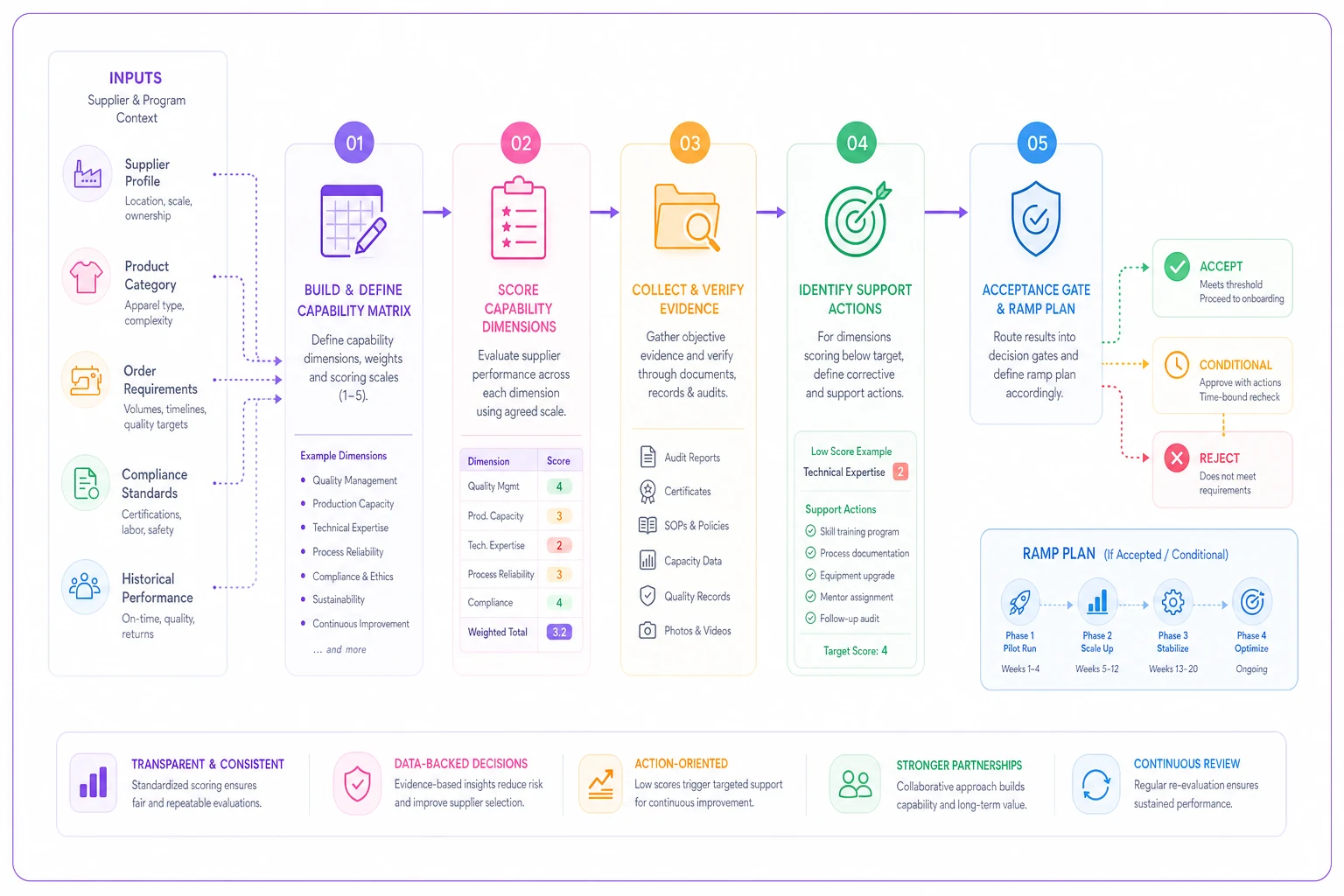
Use the scores to decide whether to scope down the first order, add specific ramp steps, or proceed as-is.
Minimum-viable sample run: test the seams, not the showroom
A single proto sample tells you almost nothing about production capability. It's usually sewn by the sample master — the best operator in the building — under no time pressure. Bulk is a different animal: different operators, line speed, real fabric lots, real subcontractors.
Eliminate delays in your fashion production cycle.
GoTailo helps you manage designs, orders, and inventory effortlessly, keeping production on schedule.
- Centralized order and inventory management
- Real-time supplier communication
- Integrated production scheduling
No credit card required
The fix is a minimum-viable sample run (MVSR): a small production-representative batch, sewn on the actual line, using actual bulk fabric, at something close to real cadence. Not a fashion show. A stress test.
A practical MVSR looks like this:
-
Pick a mid-difficulty style, not your easiest and not your hardest. You want signal, not a rigged result.
-
Order 30–50 units across the size range, including the extreme sizes where grading breaks down.
-
Require it off the main line, not the sample room — write this into the request explicitly.
-
Use bulk fabric from a real lot, so shrinkage and shading show up.
-
Time it. Note how long from fabric-in-house to units-ready. This is your first real cadence data point.
-
Inspect against a written AQL, the same standard you'll use in production — not a looser "it's just a sample" standard.
MVSR failures tend to cluster in the same three places across first orders: grading consistency at size extremes, seam performance on stretch fabrics, and anything touching a subcontractor — prints peeling, washes going uneven. If you only sample the easy middle sizes, you'll pass a factory that generates a wall of returns three months later.
Acceptance gates: the go/no-go decisions nobody wants to make
Onboarding fails quietly because there's no defined moment where someone has to say "this doesn't pass." Orders just keep flowing because stopping feels expensive. Acceptance gates make the stop explicit and unemotional.
Three gates carry most of the weight:
Gate 1 — Capability sign-off. The matrix has to clear a threshold before any PO. Set it plainly: no dimension below a 2, and category fit plus peak capacity must both be 3. Below that, either scope down the first order or don't proceed.
Gate 2 — MVSR acceptance. The sample run passes AQL, grading holds across sizes, and cadence lands within your tolerance. A common trap here is passing on quality while ignoring that the MVSR took twice as long as promised. Speed is a pass/fail criterion, not a footnote.
Gate 3 — First bulk PO acceptance. The first real order ships with an inline check at roughly 20% completion, not just a final inspection. Catching a systemic defect at 20% cut means you fix it; catching it at final means you're negotiating a discount on defective goods.
Gates work because they move the decision off the individual. When the merchandiser doesn't have to personally decide to reject a factory — the gate criteria did — the whole thing stops being political. For factories that clear the gates but still show recurring quality drift, a structured supplier scorecard and tiered remediation loop picks up where onboarding gates leave off.
90-day ramp KPIs: what to actually track
Once a factory is live, the ramp period is where you decide whether they become a core vendor or stay a one-season experiment. The mistake is measuring only the final delivery metric — on-time-in-full — and missing the early signals that predict it.
-
- First-pass yield (FPY) — units passing inspection without rework, per order. Trend matters more than any single number. Flat or falling FPY on orders two and three is a red flag even if order one was clean.
-
- Sample rounds to approval — how many rounds to hit approved standard. Should decline as they learn your tech packs.
-
- Cadence variance — promised vs. actual lead time, per milestone (fabric, cutting, sewing, finishing). Where it slips tells you which operation is weak.
-
- Response latency — average time to respond to a WIP query or a defect flag. Slow communication early predicts silent slippage later.
-
- Defect concentration — are defects random or clustered on one operation? Clustered means a fixable process gap; scattered means a deeper capability issue.
-
- Change absorption — how they handle a mid-order tech-pack correction. A factory that panics on a minor revision won't survive a real season.
A realistic ramp target: FPY climbing from around 88–90% on the first order toward the mid-90s by order three, sample rounds dropping from three to one, and cadence variance shrinking from a week or more down to a day or two. If those curves are flat after three orders, the factory has hit its ceiling.
Escalation triggers: the point where "monitor" becomes "act"
Ramp problems get tolerated far too long because there's no pre-agreed line. Someone keeps saying "let's give them one more order." Escalation triggers set that line in advance, so you're not renegotiating your own patience mid-crisis.
-
- FPY drops below 85% on any order after the first → mandatory root-cause call within 48 hours.
-
- Cadence variance exceeds 5 days on any single milestone → escalate to production manager, revise remaining timeline.
-
- Two consecutive orders miss the same acceptance criterion → freeze new POs pending a corrective action plan.
-
- Response latency exceeds 24 hours during an active production window → escalate account relationship.
-
- Any undisclosed subcontractor swap discovered → immediate stop-ship and re-inspection.
Writing these down matters because they trigger before a launch is at risk, not after. When a factory's ramp genuinely stalls and you need options fast, that's a different playbook — the kind covered in capacity-profiled design and tactical failover for apparel — but good triggers usually catch the problem while it's still fixable.
Handover artifacts: stop onboarding from living in one head
Here's the quiet failure mode that doesn't get talked about enough. The merchandiser who onboarded the factory knows all the workarounds — this factory needs extra time on washes, their grading runs a size small at 2XL, the QC contact is reliable but the sales rep isn't. Then that person changes roles and the institutional knowledge walks out the door. The next season's team relearns every lesson the hard way.
-
- Completed capability matrix with evidence links, dated.
-
- MVSR results file — inspection report, timing log, photos of failure points.
-
- Acceptance gate record — which gates passed, on what date, with what conditions.
-
- 90-day KPI dashboard — the trend curves, not just the latest numbers.
-
- Known-issues sheet — the workarounds, quirks, and "always double-check X" notes.
-
- Contact map — who actually gets things done vs. who's on the org chart.
Keeping these in one shared, versioned place instead of scattered across email threads and spreadsheets is where operational software earns its keep — not because it's clever, but because it means the next production manager inherits the real picture instead of a clean slate. When onboarding data, KPI trends, and known-issue notes live in one system, a stalling ramp shows up as a visible trend line instead of a surprise on the next PO.
When this full process makes sense — and when it's overkill
Running the full matrix-plus-MVSR-plus-gates sequence is worth it for factories you intend to make core: multi-season, meaningful volume, complex construction. The upfront cost — a few hundred dollars in sample units and a few weeks of ramp — is trivial against one blown seasonal launch.
When it's overkill: a one-off capsule with a factory you've already run bulk with, or a tiny test order where the MVSR is the whole order. Don't build a 90-day ramp around 200 units you'll never reorder.
Who should not skip it: anyone onboarding a factory in a new category, a new country, or with subcontracted operations you can't directly see. That's exactly where showroom capability and bulk capability diverge most.
A real scenario
A small contemporary womenswear brand — roughly 12 styles a season, mostly wovens — brought on a new factory to add a light knit program. The proto sample was excellent, so they placed a first PO of about 2,400 units across three styles without running any real sample batch.
The first bulk shipment came back with roughly 14% of units failing on neckline stretch and inconsistent hem finishing, concentrated almost entirely on the extended sizes. Rework and air-freighting replacements cost them somewhere in the low five figures, and one style missed its drop window entirely.
For the next factory, they ran the MVSR: 40 units, full size range, off the main line, inspected to production AQL. It surfaced the same neckline issue before any bulk order — caught in a $300 sample batch instead of a five-figure shipment. They added a specific wash-and-stretch test to that factory's ramp, and by the third order first-pass yield was sitting comfortably in the mid-90s. Same factory quality; completely different outcome, purely because the failure surfaced during onboarding instead of during production.
The takeaway
A new vendor failing to ramp is almost never a mystery. It's the predictable result of onboarding built on trust and a single proto sample, with no gates to stop a bad fit before it hits real production. A capability matrix scores what the factory can actually do, a minimum-viable sample run stress-tests it cheaply, acceptance gates make the go/no-go decisions unemotional, 90-day KPIs tell you if the ramp is real, and handover artifacts keep the lessons from evaporating when people change roles. Build the checklist once, run it every time, and the factories that were going to fail reveal themselves during a $300 sample batch — not in the middle of the order that was supposed to make your season.
Ready to tailor your apparel operations?
Join 500+ fashion brands using GoTailo to accelerate product launches, reduce waste, and improve supplier collaboration.