


Most apparel finance breaks in the same place: the gap between what production is doing and what accounting sees. Your production manager knows a PO went out to the mill three weeks ago. Your books show nothing until the invoice arrives, and your cash forecast shows nothing until the wire clears. By the time finance reacts, you've already committed to fabric you can't afford to sit on.
The core issue is timing. A purchase order is a real financial event — it commits cash, creates a future liability, and starts a chain that eventually lands in your P&L. But in most small apparel operations, the PO lives in a spreadsheet the production team owns, and finance only picks it up when money moves. That lag is where cash surprises come from.
This is a walkthrough of how to connect the whole chain — PO to cashflow to P&L — so that a production decision made today shows up in your forecast today, not six weeks later when the deposit invoice hits. We'll go through worked month-by-month cash examples, how to stage capex against production artifacts, sample journal entries, and the reconciliation cadence that keeps all three views honest.
Getting this right is what makes operational finance apparel production cashflow actually predictable instead of a monthly guessing game.
The three views of the same order (and why they disagree)
Every production order exists in three financial states at once, and each department tends to only see one of them:
-
Commitment — the moment you issue a PO, cash is spoken for even if nothing has left the account
-
Cash impact — when deposits, balances, freight, and duties actually move money
-
P&L recognition — when goods sell and cost flows against revenue
Production lives in the first view. Finance's cash forecast lives in the second. Your accountant and your investors live in the third. When these three don't reconcile against the same source, you get the classic apparel finance failure: profitable on paper, broke in the bank.
A typical example: you cut a Spring collection showing a healthy 58% gross margin. Great on paper. But between the fabric deposit in November and the first wholesale payment in April, you're carrying nearly the entire cost of the collection out of pocket for five months. The margin was never the problem. The sequencing of cash was.
The fix isn't more accounting. It's building one shared ledger of production events where a PO, a shipment, and an invoice all point back to the same order record. This connects directly to how you handle operational data governance for apparel teams — because a cash forecast is only as trustworthy as the underlying order data everyone's working from.
Mapping the PO to a cash timeline
Take a single production order and trace it all the way through. This is the muscle most teams never build — mapping each production artifact to the exact cash date it triggers.
Eliminate delays in your fashion production cycle.
GoTailo helps you manage designs, orders, and inventory effortlessly, keeping production on schedule.
- Centralized order and inventory management
- Real-time supplier communication
- Integrated production scheduling
No credit card required
Assume a mid-size drop: 2,000 units, landed cost around $18/unit, so roughly $36k in total production cost. Standard mill terms of 30% deposit, 70% on shipment. Sea freight and duties on top.
Here's the month-by-month cash view:
| Month | Production event (artifact) | Cash out | Cash in | Running cash position |
|---|---|---|---|---|
| Month 1 | PO issued, deposit invoice | –$10,800 | — | –$10,800 |
| Month 2 | Fabric sourced, sampling sign-off | –$1,200 (samples/lab) | — | –$12,000 |
| Month 3 | Bulk in production | — | — | –$12,000 |
| Month 4 | Shipment, balance invoice + freight | –$25,200 –$3,400 | — | –$40,600 |
| Month 5 | Goods land, duties, QC | –$2,100 (duty) | — | –$42,700 |
| Month 6 | Goods available, first wholesale ships | — | +$14,000 | –$28,700 |
| Month 7 | Net-60 wholesale receivables clear | — | +$34,000 | +$5,300 |
Two things jump out immediately. First, the deepest cash hole isn't at PO time — it's in Month 5, after the balance payment and duties, before any revenue. That's the number your credit line actually needs to cover, not the PO total. Second, you're cash-negative on this order for seven months even though it's profitable.
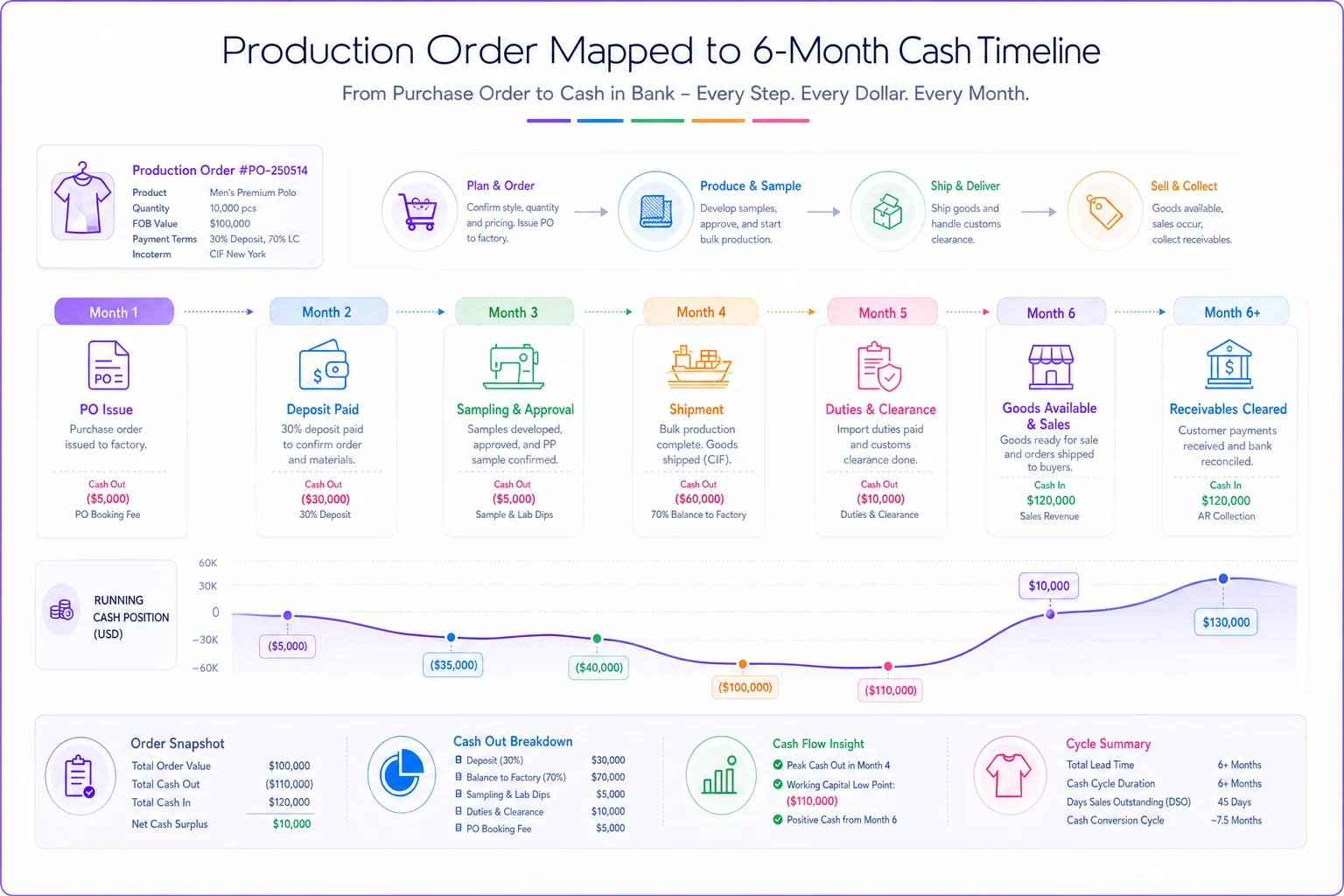
Small brands consistently plan around the PO amount ($36k) instead of the peak funding requirement ($42.7k) and the duration (seven months). The peak and the duration are what actually break you.
Sample journals: keeping commitments visible before cash moves
Standard bookkeeping only records transactions when money or invoices move, which is why finance can't see commitments early. You can fix this with a commitment ledger that sits alongside your accounting — even a simple one works.
PO #SS-114 issued — Mill A Committed purchases (memo) $36,000 Open PO liability (memo) $36,000
This never touches your real GL, but it means your cash forecast can pull open commitments. Then when the deposit invoice arrives:
Deposit — PO #SS-114 Inventory deposits / prepaid $10,800 Cash $10,800
At shipment, when the balance invoice and freight land and title transfers:
Goods received — PO #SS-114 Inventory (finished goods) $32,400 Freight-in $3,400 Inventory deposits $10,800 Accounts payable $25,000
And when goods sell:
COGS recognition — 400 units sold COGS $7,270 Inventory $7,270
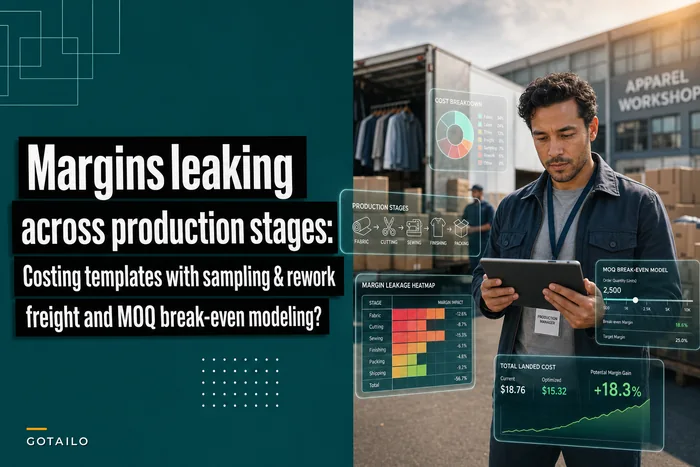
The key discipline is that inventory carries the full landed cost — fabric, freight, duty, and any rework. If you're expensing freight and duty separately as period costs, your gross margin is lying to you. That's the same leakage problem covered in detail in the production-stage costing templates — costs that never make it into unit economics.
Staging capex against production artifacts
Capex in apparel isn't just machines. It's tooling, pattern development, sampling infrastructure, and increasingly software and systems. The common mistake is treating a big capital outlay as a single event instead of staging it against production milestones.
Say you're bringing a new knitwear program in-house and need roughly $60k in equipment plus setup. Dropping that in one month wrecks your cash position right when you're also funding first production. Stage it against artifacts instead:
-
Deposit on equipment (30%, ~$18k) — released only after the pilot sample program proves the product sells
-
Installation and commissioning (40%, ~$24k) — tied to signed-off first-article inspection
-
Final payment + training (30%, ~$18k) — released after the line hits target output rate for two consecutive weeks
Each stage gate is a production artifact: a sample approval, a first-article report, a sustained output number. This does two things. It smooths the cash curve, and it stops you from paying for capacity you haven't validated. If the pilot flops at stage one, you've risked $18k, not $60k.
For the accounting, capitalize each stage as it completes rather than the whole thing upfront, and start depreciation only when the asset is actually in service — usually after that stage-three output validation. Depreciating idle equipment for three months quietly distorts unit costs during the exact period you're trying to prove the program works.
When this level of rigor makes sense — and when it doesn't
Not every brand needs a commitment ledger and staged capex gates. Over-engineering finance is its own kind of waste.
This makes sense when:
-
You're running multiple overlapping production cycles and can't tell which one is draining cash
-
Your peak funding requirement is approaching your credit line limit
-
You've been profitable on paper but had to delay a PO because of a cash crunch
-
You're carrying wholesale with net-30/60 terms, which stretches the cash gap dramatically
This is overkill when:
-
You're doing a handful of small POs a year and paying suppliers from clear cash
-
Your whole operation is made-to-order with customer deposits covering production
-
You're pre-revenue and still validating product — track cash simply and move fast
A solo designer doing two small drops annually on a pre-order model genuinely doesn't need this. The pre-orders fund production; the cash timeline is simple. Building a formal reconciliation cadence there is time better spent on product.
The signal you've outgrown the spreadsheet is when one person can no longer hold the full PO-to-cash picture in their head. That usually happens somewhere between three and six concurrent production orders.
The reconciliation cadence tied to production artifacts
The whole system falls apart without a rhythm. Reconciliation in apparel finance should hang off production events, not calendar dates alone. Here's the cadence that works:
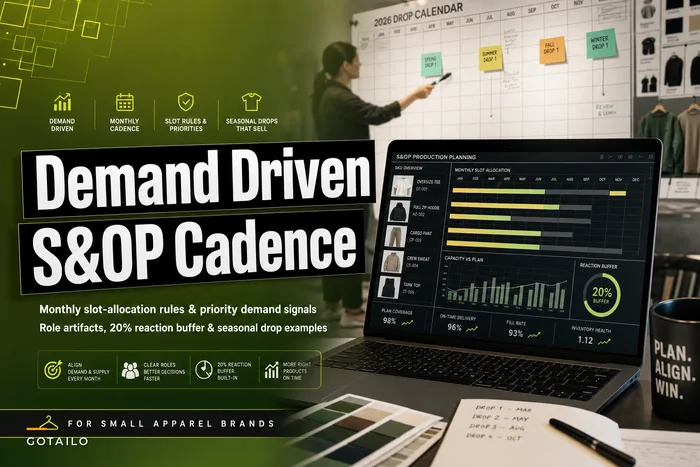
Schedule a single cross-functional S&OP meeting each month where production, finance, and sales lock in slipped dates and cash impacts together.
-
On every PO issue — log the commitment memo; update the rolling cash forecast with projected deposit, balance, freight, and duty dates
-
Weekly — reconcile open POs against production status; move any slipped milestones and reforecast the cash dates that shift with them
-
On every shipment — match the balance invoice and freight to the original PO; book goods into inventory at full landed cost; close the commitment memo
-
Monthly — reconcile the commitment ledger against the real GL, confirm inventory value matches physical WIP and finished goods, and true up COGS against actual sales
-
On duty/customs clearance — capture the actual duty paid versus estimate; adjust landed cost per unit if it moved materially
The most common reconciliation failure isn't math — it's a slipped production date that nobody pushed through to the cash forecast. A mill delay of three weeks moves your balance payment and your revenue, but if finance never hears about the slip, the forecast keeps showing cash arriving on the old schedule. That's how brands get blindsided by a shortfall production already knew about weeks earlier.
Tying this cadence to your monthly planning rhythm matters too. The cash forecast and the demand plan have to move together — a good S&OP cadence for small apparel brands is where slipped dates, reforecast demand, and reforecast cash should all reconcile in the same meeting instead of three separate ones.
A real scenario: the profitable brand that almost stalled
A contemporary womenswear brand doing roughly $1.1M–$1.3M a year in wholesale and DTC had a recurring pattern. Every fall they'd nearly run out of cash right before their strongest selling season — despite gross margins sitting comfortably in the mid-50s.
When they mapped their POs to a cash timeline, the problem became obvious. They ran three collections a year and the production cycles overlapped. The deposit for the next collection landed while they were still carrying the balance payment on the current one, and before wholesale receivables from the previous drop had cleared. Three separate cash holes stacking on top of each other. Their peak funding requirement across the overlap was close to $180k, but they'd sized their credit line at $120k based on a single collection's cost.
Nothing about the product or the margin was wrong. They restructured two things. First, they staggered collection deposits by about six weeks so the funding peaks didn't fully overlap — a scheduling change, not a financial one. Second, they negotiated the fall deposit down from 30% to 20% in exchange for slightly faster balance payment, which cut the deepest point of the hole by around $12k.
The result wasn't dramatic revenue growth. They just stopped white-knuckling October. Cash stayed positive through the overlap for the first time, and they could actually buy inventory for the season that mattered most instead of underbuying out of fear.
Building this so it survives growth
The spreadsheet version of all this works until it doesn't. What breaks first is usually the link between production status and the cash forecast — someone updates the production tracker but not the finance model, and the two drift until nobody trusts either.
The durable version is one system where the PO, its production milestones, shipments, invoices, and inventory all reference the same order record. When production marks a shipment, the balance payable and landed-cost inventory entry follow automatically. When a milestone slips, the projected cash dates move with it. That's where connected operational platforms earn their place — not by doing anything clever, but by making sure the commitment view, the cash view, and the P&L view can never quietly disagree, because they're all reading from one source.
The point of all this isn't precision for its own sake. In apparel, money leaves months before it comes back, and the timing of that gap — not your margin — is what determines whether a good season nearly kills you. Map the PO to the cash timeline, stage capital against real production proof, and reconcile against production events rather than calendar guesses. Do that consistently and the P&L stops being a surprise you read after the quarter closes, and starts being something you can actually see coming.
Ready to tailor your apparel operations?
Join 500+ fashion brands using GoTailo to accelerate product launches, reduce waste, and improve supplier collaboration.