

Most small apparel brands don't fail at planning because they lack a forecast. They fail because the forecast lives in one person's head, gets overwritten by whoever shouts loudest on the Monday call, and never gets translated into a hard production number until the factory asks "so how many are we cutting?" Two weeks before the cut date.
That gap — between demand signals and a committed production quantity — is where money leaks. You over-cut the cautious basics and under-cut the piece that sold out in three hours. You burn factory slots on SKUs that didn't need them and then scramble for capacity on the ones that did.
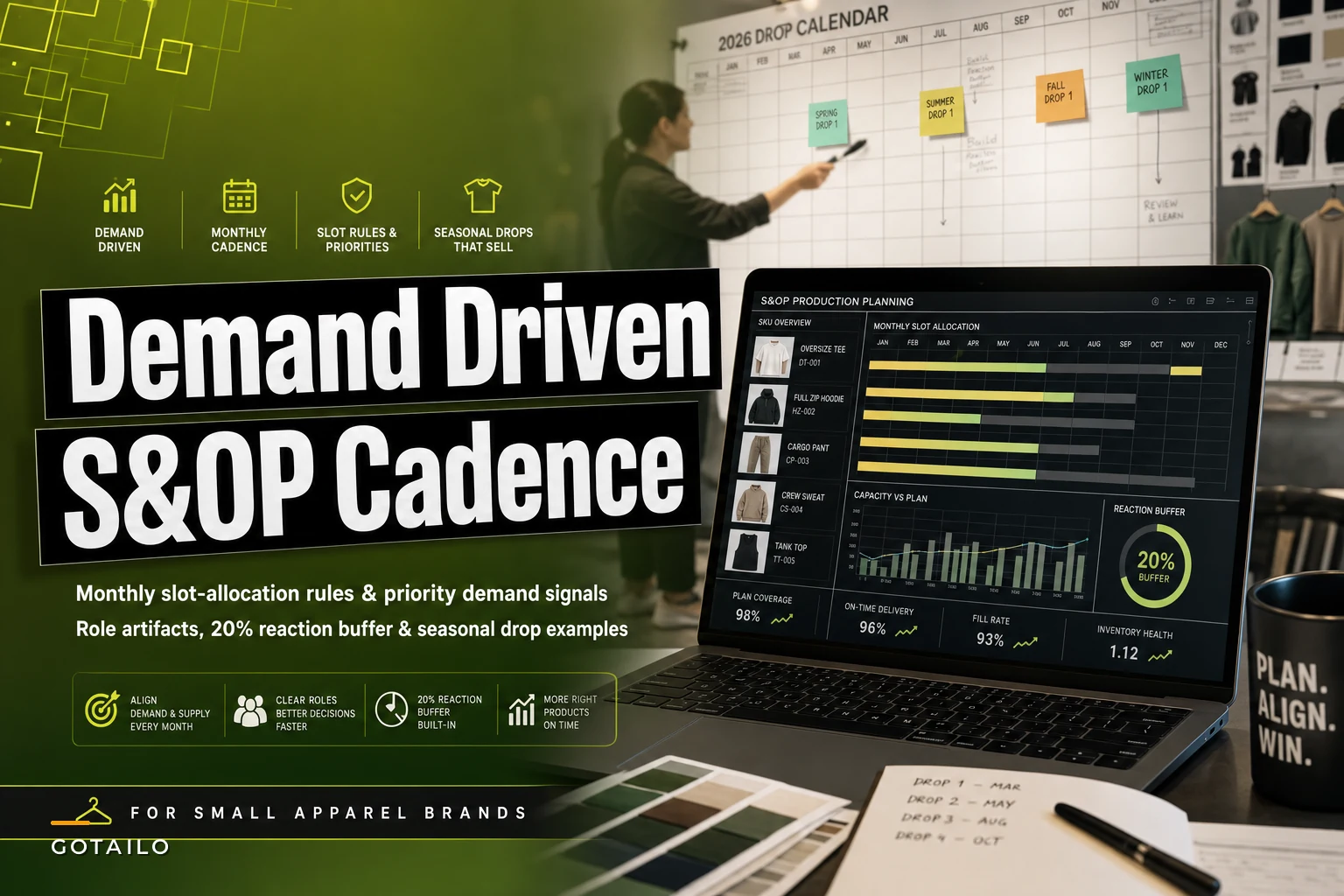
A proper S&OP process for small apparel brands doesn't need to be heavy. It needs to be a repeatable monthly rhythm where the right people bring the right inputs, demand signals get ranked consistently, and factory slots get allocated by rule instead of by argument. That's the whole game.
The core problem: signals arrive at different times and speak different languages
Nobody tells you this when you start doing seasonal drops. Your demand signals don't show up neatly at forecast time. They dribble in across months, and they don't agree with each other.
You've got pre-orders — real money, but small sample sizes and biased toward your most engaged customers. You've got last season's sell-through on comparable styles. You've got waitlist sign-ups, which feel like demand but convert unevenly. You've got the wholesale buyer who "definitely wants 200 units" but hasn't signed the PO. And you've got your designer's gut, which is sometimes the best signal in the room and sometimes the most expensive one.
The mistake is treating all of these as equal, or worse, letting the loudest signal of the week win. What happens on a lot of small teams is the same brand will trust pre-orders religiously for one drop and then completely ignore them the next drop because "last time pre-orders overpromised." No consistency, so no learning.
S&OP fixes this by forcing two disciplines: a fixed monthly cadence so signals are reviewed at the same moment, and a priority matrix so every signal gets weighted the same way every time.
Role-specific inputs: who brings what to the table
An S&OP meeting where everyone shows up and "discusses" is a waste of an hour. The value comes from everyone arriving with a specific, pre-formatted input. If you're a three-person brand, one person might wear three hats — but the inputs still need to exist separately, because they answer different questions.
Eliminate delays in your fashion production cycle.
GoTailo helps you manage designs, orders, and inventory effortlessly, keeping production on schedule.
- Centralized order and inventory management
- Real-time supplier communication
- Integrated production scheduling
No credit card required
| Role | Input they own | Format it should arrive in |
|---|---|---|
| Designer / Merchandiser | Drop lineup + intended assortment role (hero, support, basic) | SKU list tagged by role and target retail price |
| Sales / DTC lead | Pre-order counts, waitlist size, sell-through on comparable styles | Numbers per SKU, plus last-season comp reference |
| Wholesale lead | Confirmed POs vs. verbal interest, by account | Split into "signed" and "likely" columns |
| Production manager | Available factory slots, current WIP, vendor lead times | Slots per month + committed vs. open capacity |
| Finance / founder | Cash available for fabric buys, margin floor per SKU | Total buy budget + minimum acceptable margin |
The single most useful discipline here is the wholesale lead splitting signed from likely. Verbal interest that gets planned as if it were confirmed is probably the number one cause of overcut inventory in small wholesale-facing brands. A buyer saying "we love it" is worth maybe 30–40% of the stated quantity until the PO actually lands.
The production manager's input is the reality check that everything else bends around. If you only have four cut slots between now and the season, no amount of demand enthusiasm creates a fifth. This ties directly into aligning what you want to make with what the factory can actually deliver — if that link is weak, the whole cadence collapses. Our design-to-delivery production planning framework goes deeper on making that capacity picture concrete.
The demand-signal priority matrix: pre-order vs sell-through
When two signals disagree, which one wins? You need a rule that's decided before you're staring at the numbers, otherwise you'll rationalize whatever you already wanted to do.
Here's a weighting approach that works for most DTC-leaning small brands. Adjust the weights to your own history, but keep them fixed once set.
| Signal | Reliability | Weight | Notes |
|---|---|---|---|
| Confirmed pre-orders | High | 1.0x (count as real) | Actual money down |
| Signed wholesale POs | High | 1.0x | Contractually committed |
| Sell-through on close comparable | Medium-high | 0.7x of comp velocity | Best proxy for repeat styles |
| Waitlist / email sign-ups | Medium | 0.15–0.25x conversion | Convert historically, not optimistically |
| Verbal wholesale interest | Low-medium | 0.3–0.4x | Discount hard until PO |
| Designer conviction (no data) | Variable | Cap the downside | Fine for hero pieces, cap the cut |
The reason to separate pre-order and sell-through as distinct signal types matters more than people think. Pre-orders tell you about this specific product's pull, but from a biased sample — your earliest, most loyal buyers. Sell-through on a comparable style tells you about sustained demand across your full audience, but only if the comparison is honest.
The trap is a dishonest comp. A team will justify a big cut on a new midi dress by pointing to last summer's midi that "did great" — ignoring that last summer's was $88 and this one's landing at $145, or that it was a peak-season launch and this one's dropping in a slower month. A comp is only usable if the price band, the drop timing, and the assortment role all roughly match.
A practical rule: when pre-orders and comp sell-through disagree by more than roughly 40%, don't average them — investigate. One of them is telling you something. Usually pre-orders spiking above the comp means you priced the piece as a hero and your loyalists agree. Comp running above pre-orders often means the style is a slow-build that people buy after seeing it in the wild, not before.
Monthly slot-allocation rules
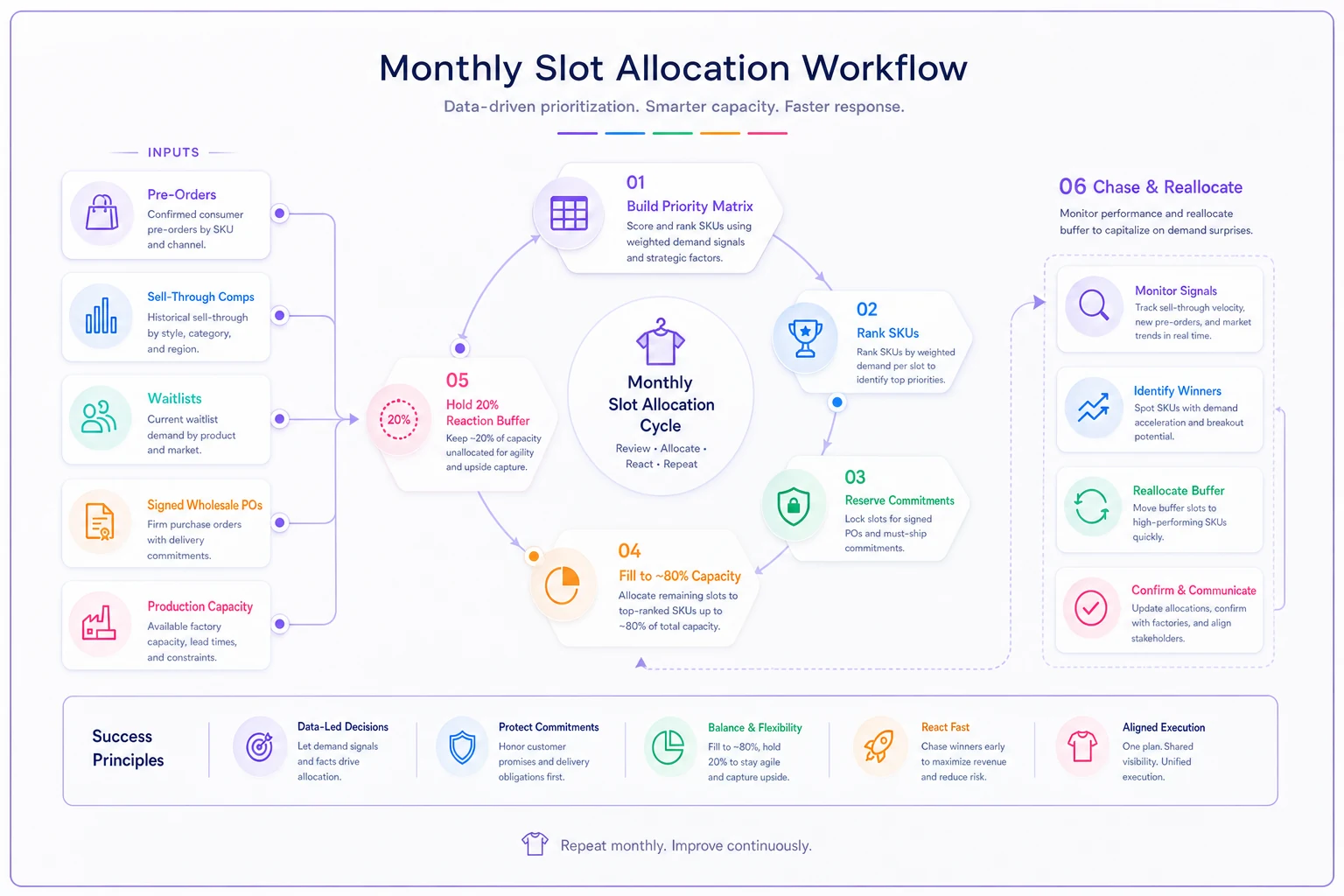
Once signals are weighted, you convert them into a demand number per SKU. Then you allocate that against real factory slots. This is where the discipline pays off, because capacity is finite and the temptation is to say yes to everything.
-
Rank every candidate SKU by weighted demand ÷ slot cost. A SKU that needs a full cut slot but only shows modest demand ranks below a SKU that shares a slot and shows strong pull.
-
Reserve slots for confirmed commitments first. Signed wholesale POs and strong pre-orders get slots before anything speculative. Non-negotiable.
-
Fill the middle tier by rank until roughly 80% of capacity is committed. Not 100%.
-
Hold around 20% of capacity as a reaction buffer. This is the rule small brands skip and regret. That buffer is what lets you chase the piece that unexpectedly sold out.
-
Assign leftover speculative SKUs to the buffer only if signals firm up by a defined cutoff date — usually a week or two before the slot has to be committed.
-
Anything that doesn't earn a slot gets deferred or killed, not quietly carried forward to clog next month's decision.
That reaction buffer is the difference between a brand that can reorder its surprise hit and one that watches it sell out and then does nothing because every slot was pre-spent. The lost margin on an un-chaseable sellout is often bigger than the carrying cost on a few over-cut basics — but it's invisible, so teams don't count it.
The other thing people ignore: kill decisions have to be explicit. A SKU that doesn't earn a slot this month should be marked deferred-with-a-date or dead. Otherwise it drifts into next month's meeting still wanting attention, and you accumulate a backlog of zombie styles that nobody has the authority to bury.
Treat the 20% buffer as a hard policy line in your slot spreadsheet, and don't let it be reallocated without a documented trade-off.
The reaction buffer is the difference between a brand that can reorder its surprise hit and one that watches it sell out and then does nothing because every slot was pre-spent. The lost margin on an un-chaseable sellout is often bigger than the carrying cost on a few over-cut basics — but it's invisible, so teams don't count it.
Worked example: a summer drop for a small DTC brand
Small women's brand, DTC-primary with some wholesale, doing a June drop. They have four cut slots available before the season, each slot handling roughly 600–900 units depending on complexity.
Candidate lineup:
-
Linen midi dress (hero) — pre-orders at 210 units, comp style last year sold around 640 over the season at a similar price. Weighted demand lands around 550–600.
-
Poplin shirt (support) — pre-orders 40, no clean comp. Waitlist of 380, apply roughly 0.2 conversion ≈ 75. Weighted demand ~120–140.
-
Wide-leg pant (support) — signed wholesale PO for 180 units, plus DTC pre-orders of 95. Weighted demand ~290.
-
Basic tank (repeat basic) — no pre-orders (it's a reorder), comp sell-through steady at around 500 per season. Weighted demand ~500.
-
Statement blazer (designer conviction) — no data, designer loves it, target price high. No demand signal.
Allocation walk-through:
The wide-leg pant has a signed wholesale PO, so it takes a slot first — that 180 is contractually real. The linen midi is the clear hero with both pre-orders and a strong honest comp; it takes a slot, cut around 550. The basic tank has steady comp history and low risk — it takes a slot at roughly 500.
Three slots committed. The fourth is the buffer. The poplin shirt's weighted demand of around 130 doesn't justify a full slot on its own, and the blazer has zero data. So the rule kicks in: neither gets a committed slot. The blazer gets a capped speculative cut — maybe 120 units, treated as a test, sharing capacity within an existing slot rather than burning its own. The poplin waits for the pre-order cutoff; if numbers firm up, it joins the buffer slot, otherwise it defers to the next drop.
Notice what the discipline prevented: nobody cut 400 blazers on conviction, and nobody gave away the buffer slot in the meeting. Two weeks later, when the linen midi pre-orders keep climbing past projection, that held slot becomes a chase-cut on the midi instead of a pile of blazers nobody ordered.
A short real scenario
A small menswear brand — around $1.5M revenue, mostly DTC with a growing wholesale side — kept running into the same wall each season. They'd cut to the designer's enthusiasm and the loudest verbal wholesale interest, then eat markdowns on roughly 20–25% of the range while stocking out on one or two pieces that would've reordered fine.
They didn't add software or headcount. They added the monthly cadence, the signed-vs-likely split on wholesale, and the 20% buffer rule. First season under the new rhythm, their end-of-season markdown load dropped into the low teens as a percentage, and they successfully chased a reorder on a surprise-hit overshirt they'd have missed entirely before. Nothing dramatic — just fewer expensive mistakes in both directions, which for a brand that size is the difference between a tight season and a painful one.
The founder's own comment was telling: the meetings got shorter, because arguments about "should we cut more of this" were now settled by the matrix instead of by whoever felt most strongly that day.
When this cadence makes sense — and when it doesn't
When it works well:
-
You run seasonal or monthly drops with distinct SKU lineups
-
You have more than one demand signal type (pre-orders and sell-through and wholesale)
-
Factory capacity is genuinely constrained, so slot allocation is a real decision
-
You've had at least a couple of seasons of history to build honest comps
When it's overkill:
-
You're pure made-to-order or pre-order-only — you don't allocate speculative slots, so most of this collapses to "make what's ordered"
-
You do one or two drops a year with a tiny SKU count you can hold in your head
-
You have effectively unlimited factory access and no capacity constraint (rare, but it happens with vertically integrated micro-brands)
Who should hold off: if your vendor lead times are so unpredictable that you can't trust a slot to exist when you commit to it, fix that first. Allocating slots against capacity that evaporates is planning on sand. Getting a handle on unreliable vendor lead times is the prerequisite, not a parallel project.
Keeping the cadence alive after month one
The hardest part isn't building this — it's not letting it decay. What kills S&OP in small brands isn't complexity, it's drift. Someone skips the meeting during a busy launch week, the signed-vs-likely split gets sloppy, the buffer slot gets "borrowed" for an emergency, and within three drops you're back to cutting on gut.
Two things keep it honest. First, the inputs have to live somewhere shared and current — not scattered across five spreadsheets that go stale between meetings. When pre-order counts, WIP, open slots, and last-season comps all sit in one place that updates as orders come in, the monthly meeting becomes a decision session instead of a data-gathering scramble. A workflow platform that centralizes production and demand data earns its keep here — not by making the decisions, but by making sure everyone walks in looking at the same numbers instead of arguing about whose spreadsheet is right.
Second, write down the actual commitment after every cycle — what you weighted, what you allocated, what you deferred — and check it against reality next season. A brand that reviews "we weighted waitlist at 0.2 and it actually converted at 0.31" adjusts and gets better. A brand that never looks back re-argues the same fights forever.
S&OP for a small apparel brand isn't a corporate planning ritual scaled down. It's a monthly forcing function that makes disagreeing signals sit at one table, get weighted the same way every time, and turn into a slot commitment somebody actually owns. Pre-orders and sell-through stop competing in your head and start competing on a matrix. Factory slots stop going to the loudest voice and start going to the strongest signal-per-slot. The 20% you hold back stops being an afterthought and becomes the thing that lets you chase the wins you'd otherwise watch sell out.
Start with the inputs. Get the roles bringing the right numbers in the right format, run the matrix once, and allocate against real slots. The first cycle will feel clunky. By the third, your meetings will be shorter and your cuts will be smarter — and that's the whole point.
Ready to tailor your apparel operations?
Join 500+ fashion brands using GoTailo to accelerate product launches, reduce waste, and improve supplier collaboration.