

Most apparel operations don't fail because someone is bad at their job. They fail at the seams — the handoffs between merchandising and planning, between planning and production, between the factory floor and whoever's writing POs. A buyer commits to a story in a line review, the planner builds a buy plan off numbers that shifted two weeks later, and the factory gets a tech pack referencing a fabric that's already been re-sourced. Everyone did their part. The system still produced a mess.
What's missing in almost every small-to-mid apparel brand isn't talent or effort. It's a shared, enforceable map of who owns what, what artifact has to exist before the next team can start, and what rule actually blocks the work from moving forward when something's incomplete. That's what demand to delivery orchestration apparel teams need — not another dashboard, but a gating structure that makes bad handoffs physically hard to pass along.
This article lays out that map: the artifacts required at each gate, who owns them, the rules that stop a gate from opening, and how to build this if you don't have a PLM and never will. You don't need enterprise software to run disciplined orchestration. You need agreement on what "done" means at each stage.
Why the handoffs break — and why it gets worse as you grow
At a small scale, orchestration happens in people's heads. The founder knows the margin target, the designer knows the fabric is confirmed, the one planner knows the factory can take the order. It works because the whole operation fits in a group chat.
Then you add a second factory, a third channel, a seasonal temp merchandiser, and suddenly the knowledge that used to live in three brains is scattered across email threads, a shared drive with four versions of the same tech pack, and a WhatsApp message someone forgot to screenshot. The work didn't get more complex. The coordination did.
The pattern worth naming: handoff failures scale faster than headcount. Every new person or node you add doesn't create one new connection — it creates a connection to everyone already in the chain. Three people have three relationships. Six people have fifteen. The informal coordination that worked at five people collapses somewhere around fifteen to twenty, usually right when the brand is growing fast enough that nobody has time to fix it.
The specific failure points tend to cluster in the same three places:
-
Merchandising → Planning demand assumptions get locked before costing and capacity are confirmed, so the buy plan is built on a story that can't actually be produced profitably.
-
Planning → Production POs issue against tech packs or BOMs that aren't version-locked, so the factory builds to a moving target.
-
Production → Delivery QC and inline status live on the factory's side, invisible to the planner until something's already late.
Each of these is a gate. And a gate without a rule is just a doorway everyone walks through regardless of whether the work behind it is finished.
The canonical gate structure
Think of the demand-to-delivery flow as a series of gates, each requiring specific artifacts to exist and be signed off before the next team can begin. The point isn't bureaucracy — it's that incomplete work stops at the gate, not three weeks downstream when it's expensive to fix.
Eliminate delays in your fashion production cycle.
GoTailo helps you manage designs, orders, and inventory effortlessly, keeping production on schedule.
- Centralized order and inventory management
- Real-time supplier communication
- Integrated production scheduling
No credit card required
Below is the core map. Five gates, the artifacts each one requires, the accountable owner, and the rule that keeps it closed until it's genuinely ready.
| Gate | Required Artifacts | Accountable Owner | Gating Rule (blocks progress until true) |
|---|---|---|---|
| G1 — Concept Lock | Line plan, target retail + target margin, initial assortment grid | Merchandising Lead | Every SKU has a target cost and target margin assigned. No "TBD" costs allowed. |
| G2 — Demand Commit | Buy plan by SKU/size curve, channel split, pre-season forecast | Planner | Forecast reconciled against capacity reality and cost-to-make within margin band. |
| G3 — Production Release | Version-locked tech pack, confirmed BOM, approved fit + lab dip, issued PO | Production Manager | Tech pack version frozen; all material approvals signed; factory capacity slot confirmed. |
| G4 — Inline Gate | Cut ticket, inline QC log, first-output approval | QC / Factory Liaison | First-output inspection passes defined AQL; no open critical defects. |
| G5 — Ship Release | Final inspection report, packing list, compliance/labeling pack | QC + Logistics | Final AQL passed; packaging and labeling verified against spec. |
Two things about this table matter more than the table itself.
First, the gating rule column is where orchestration actually lives. Plenty of teams have the artifacts — a tech pack exists, a buy plan exists. What they don't have is a rule that says you cannot issue the PO until the tech pack version is frozen. Artifacts without rules just document the chaos.
Second, notice how G2's rule reaches backward into cost and capacity. That's deliberate. The most common orchestration failure in apparel is committing demand before confirming you can make it profitably at the volume you're promising. We covered the capacity side of this in depth in aligning assortment to factory reality — the gate here is the enforcement point for that alignment.
A quick visual of the gates and their handoffs can help teams agree where the rules belong.
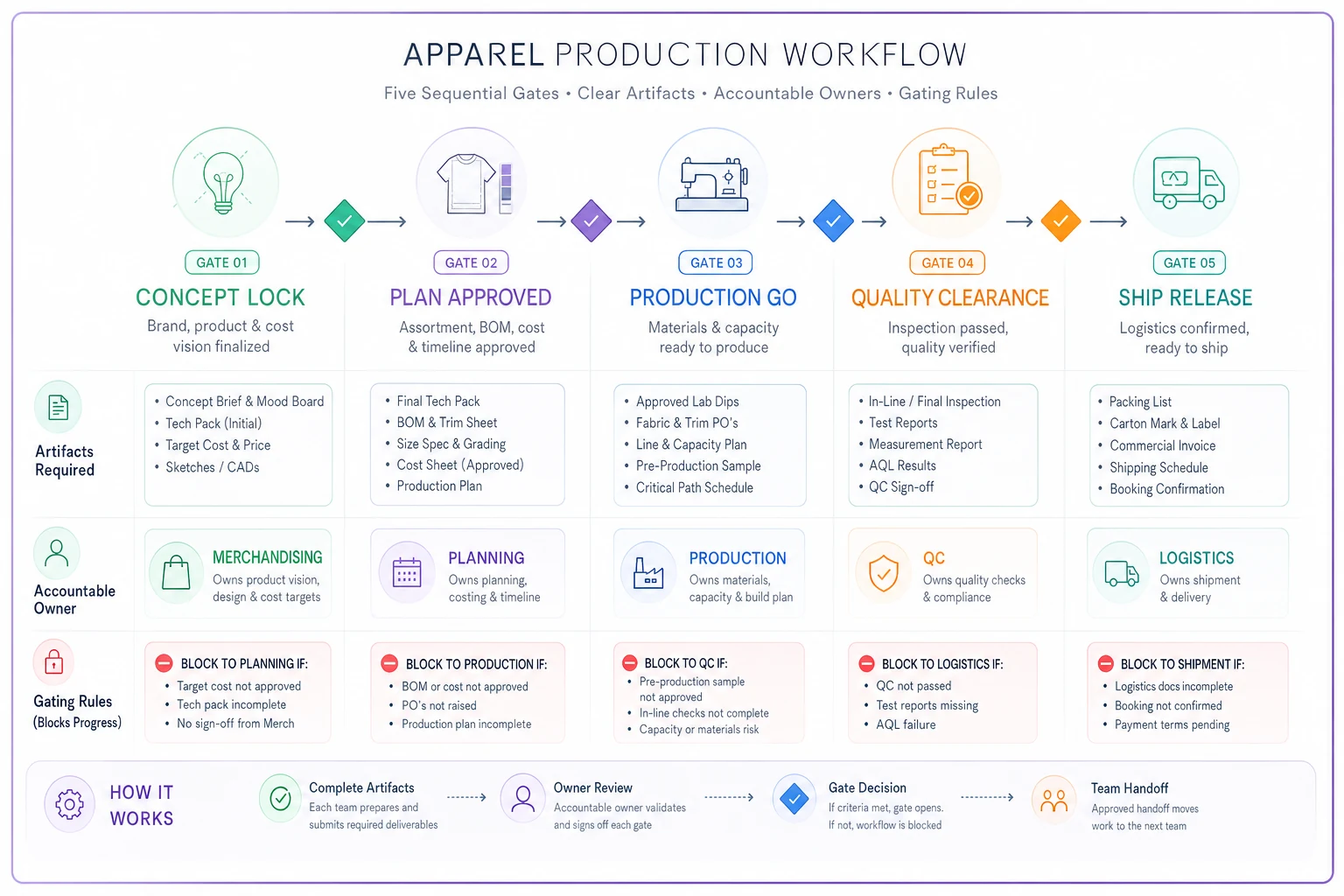
The visual ties the artifacts and the accountable name to the gate where a rule must be enforced, which is how teams stop incomplete work before it becomes expensive.
Artifacts, not opinions: what each gate actually needs
A gate is only as strong as the artifact that satisfies it. Vague artifacts — "the designer said the fit looks good" — fail silently. Here's what a usable artifact looks like at each stage.
G1 Concept Lock — the Assortment-with-Costs grid. Not just styles and colors. Every line item carries target cost, target retail, and the resulting margin. If a style can't hit margin at concept, you want to know now, not after sampling burns three weeks and a few hundred dollars per style in development.
G2 Demand Commit — the reconciled buy plan. The buy plan isn't just quantities. It's quantities checked against two constraints: can the factory produce this inside the window, and does the landed cost at this volume still hit the margin band from G1? A buy plan that ignores either is a wish list. The monthly cadence for keeping these reconciled is something we broke down in the S&OP cadence for small apparel brands — the gate is where that cadence produces a hard commitment.
G3 Production Release — the frozen tech pack and confirmed BOM. This is the single highest-leverage artifact in the whole chain. A production release built on an unlocked tech pack is the root cause of a huge share of rework, wrong-material cuts, and factory disputes. Version control here isn't optional. The SKU should be in a known, locked state before release — the kind of state-tracking discipline we laid out in the SKU lifecycle state machine.
G4 Inline Gate — first-output approval. The artifact is a signed first-output inspection against a defined AQL. The failure mode here is factories that run the full line before anyone checks the first pieces. First-output catches the systemic problem — wrong seam allowance, wrong thread, misread spec — before it's multiplied across the whole order.
G5 Ship Release — final inspection + compliance pack. This is where retailer chargebacks are born or avoided, depending on whether the compliance pack is complete.
RACI without the committee feeling
RACI gets a bad reputation because people turn it into a spreadsheet nobody reads. For orchestration, you only need to be strict about one letter: Accountable.
Every gate has exactly one accountable owner. Not a team. Not "merchandising and planning jointly." One name. That person signs the gate open, and that's who you go to when something slipped through. Everyone else can be responsible, consulted, or informed in whatever configuration fits your org — but accountability doesn't get shared, because shared accountability is how things fall between people.
A workable lightweight version:
-
G1 Merchandising Lead accountable. Planner and costing consulted. Design responsible for inputs.
-
G2 Planner accountable. Merchandising and Production consulted. Finance informed.
-
G3 Production Manager accountable. Design and QC consulted. Factory informed and responsible for slot confirmation.
-
G4 QC / Factory Liaison accountable. Production Manager informed.
-
G5 QC accountable for quality sign-off, Logistics accountable for shipment release. Both must sign.
One pattern worth flagging: when the same person is accountable for two adjacent gates, orchestration quietly breaks down, because there's no real handoff — just one person checking their own work. If your planner owns both G2 and G3, you've collapsed the one review point that catches demand-vs-production mismatches. Split them even if it's awkward.
A real scenario: the brand that gated its way out of chargebacks
A womenswear brand running around 40–50 SKUs per seasonal drop across two factories kept getting hit with the same problem: roughly one in five styles arrived at the warehouse with a labeling or packing discrepancy, triggering retailer chargebacks and warehouse rework. They assumed it was a factory quality issue.
It wasn't. When they mapped the flow, the real break was between G3 and G5. The labeling spec was being finalized after the PO issued — sometimes while goods were already in production. The factory built to the best information it had, which was stale. Nobody owned the gate that said "labeling spec locked before release."
They didn't buy new software. They added one rule: no PO issues at G3 unless the labeling and packing spec is attached and signed. The production manager simply couldn't release without it.
Over the next two drops, the discrepancy rate went from around 20% of styles down to low single digits. The chargeback exposure, which had been running in the low thousands per drop, mostly disappeared. The fix cost nothing except the discipline of holding a gate closed until an artifact existed.
That's the whole thesis in one story. The problem looked like quality. It was orchestration.
The staged adoption path for teams without a PLM
Most advice about demand-to-delivery orchestration assumes you have a PLM and an ERP talking to each other. Most small apparel brands have neither, and bolting on a PLM mid-season is a great way to blow up a drop. You can run real orchestration on spreadsheets and shared docs — as long as the gates and ownership are enforced. Here's the staged path.
-
Stage 0 — Name the gates and owners. Before any tooling, write down the five gates, the artifact each requires, and the single accountable owner. One page. If this causes an argument, good — that argument is the orchestration problem surfacing before it costs you a drop.
-
Stage 1 — Standardize the artifacts. Build one template per gate artifact: the assortment-with-costs grid, the reconciled buy plan, the tech pack cover sheet with a version field, the first-output checklist, the ship-release pack. Same format every time. The consistency is what makes the gate checkable.
-
Stage 2 — Enforce one gate manually. Pick your worst break point — usually G3. Enforce the rule for one full drop. No release without a frozen, signed artifact. Resist the urge to fix everything at once; proving one gate works builds the credibility to enforce the rest.
-
Stage 3 — Add gate checklists and a status log. Give each gate a short checklist, and track every SKU's current gate in one shared view. Even a single well-maintained sheet showing which styles are at which gate eliminates most of the status-chasing that eats planners' time.
-
Stage 4 — Centralize and reduce manual chasing. This is the point where a workflow platform earns its place — not to replace your judgment, but to hold the artifacts, enforce the gating rules automatically, and flag when a SKU is stuck. When the system won't let a PO issue against an unlocked tech pack, you've encoded orchestration into the tooling instead of relying on someone remembering. AI-assisted workflow checks quietly help here too — flagging a buy plan that exceeds confirmed capacity, or catching a tech pack version mismatch before release — so the gate catches the error even when a tired human wouldn't.
-
Stage 5 — Instrument and improve. Once gates are enforced, measure where SKUs stall. The gate that stalls most often is telling you where your process is actually weakest, which is almost never where people assumed.
Enforce one gate manually for a full drop to build credibility before expanding automation or adding more gates.
Don't skip stages to get to the software. A platform enforcing broken rules just enforces them faster.
Gate checklist you can use this week
A compact version of what each gate's checklist should verify before it opens:
-
G1 Every SKU has target cost, target retail, target margin. No blank cost fields. Assortment approved against the line plan.
-
G2 Buy plan quantities checked against factory capacity for the window. Landed cost at committed volume still inside margin band. Channel split assigned.
-
G3 Tech pack version frozen and dated. BOM confirmed against current sourcing. Fit and lab dip signed. Labeling/packing spec attached. Factory slot confirmed. PO references the locked version.
-
G4 First-output inspected against defined AQL. No open critical defects. Cut quantity reconciled to PO.
-
G5 Final inspection passed. Packing list matches PO. Labeling verified against spec. Compliance documents complete.
Print it. Tape it to the wall if you have to. The checklist exists to make "is this gate actually done?" a yes/no question instead of a judgment call made under deadline pressure.
Rollout checkpoints — how to know it's working
Rolling out gates without checkpoints creates a new form of chaos where people argue about whether a gate is "really" closed. Build in review points:
-
After one drop Did the enforced gate actually hold? Count how many times someone tried to bypass it and why. Those bypass attempts are your real failure modes.
-
After two to three drops Are artifacts consistent, or is everyone still improvising their own buy plan format? Inconsistent artifacts mean Stage 1 isn't done, no matter what the org chart says.
-
Quarterly Which gate stalls SKUs most? Reallocate attention there. A gate that never stalls anything might be too loose — or genuinely solid. Look at the downstream defect data to tell which.
Look at the downstream defect data to tell which.
When this makes sense — and when it doesn't
When gating is worth the overhead: You're running more than roughly 10–15 SKUs per drop, you've got more than one factory or channel, and you've felt the pain of a late discovery — a wrong material cut, a labeling chargeback, a buy plan that couldn't be produced on time. At that scale, informal coordination is already failing; you just haven't named it yet.
When it's overkill: You're a one-or-two-person operation doing a handful of styles with a single trusted factory. Formal gates will slow you down more than they protect you. Keep a light version — maybe just a frozen-tech-pack rule — and skip the rest until you grow into it.
Who should NOT roll this out all at once: Teams in the middle of a hot season. Don't install five new gates the week before a critical drop ships. Enforce one gate, prove it, and expand between seasons when you have room to absorb the friction.
Bringing it together
Demand-to-delivery orchestration isn't a tool you buy or a diagram you hang on the wall. It's the agreement — made concrete through artifacts, owners, and gating rules — that incomplete work stops where it's cheap to fix instead of flowing downstream to where it's expensive. The brands that run clean seasons aren't the ones with the most software. They're the ones where everyone knows exactly what has to exist before the next team starts, and nobody can open a gate on a wish.
Start with one page naming your gates. Enforce your worst gate for one drop. Build the artifacts to be checkable. The orchestration follows from there — and by the time you're ready for a platform to hold the rules for you, you'll know precisely which rules matter, because you'll have watched which gates kept saving you.
Ready to tailor your apparel operations?
Join 500+ fashion brands using GoTailo to accelerate product launches, reduce waste, and improve supplier collaboration.