

The gap between what merchandising commits to and what the factory can actually build shows up in the same place every season: the week the POs are supposed to drop, and half of them can't. The styles are approved, the fabrics are (mostly) booked, and then someone from production quietly points out that three of your hero SKUs all need the same specialized machine operators in the same two weeks, and there aren't enough of them.
That's not a scheduling problem. That's a planning philosophy problem. Merchandise-to-manufacturing planning in apparel breaks down because assortment decisions get made in a world of ideal demand curves, and manufacturing lives in a world of finite capacity, shared resources, and lead-time physics. When those two worlds only meet at the PO stage, you've already lost your best options.
This piece is about building the connective tissue between the two — the gating rules, allocation bands, priority buckets, and reallocation playbooks that let a merchandising line plan translate cleanly into a manufacturable cadence. Not perfectly. Nothing in apparel is perfect. But cleanly enough that you stop discovering conflicts three weeks too late to fix them.
Why assortment and capacity drift apart
Merchandising and production don't fight because people are difficult. They drift apart because they optimize against different constraints on different clocks.
Merchandising is optimizing for the assortment story — the right price points, the right color depth, the right newness ratio, the right margin blend. Their natural unit of thinking is the option: how many styles, how many colorways, how much depth. When they add a style, the mental cost is roughly "one more row in the line sheet."
Production is optimizing for flow — keeping lines balanced, minimizing changeovers, honoring lead times, and not blowing past a factory's realistic weekly output. Their unit of thinking is the build: cut orders, sew minutes, machine allocation, operator skill. When merchandising adds a style, the real cost to production might be a full changeover, a new trim qualification, or a fabric that only one mill can supply on a 90-day lead.
The pattern that keeps repeating: both teams agree on what to make long before anyone agrees on when it can physically be built. The line plan gets locked, buys get committed, and only then does the calendar get reverse-engineered against factory capacity. By that point the assortment isn't negotiable, so production absorbs the mismatch through overtime, air freight, or quietly late deliveries.
A typical example looks like this: a mid-sized contemporary brand runs four seasonal drops plus two capsule refreshes. Merchandising builds each drop to hit an option count target. Nobody's tracking that drops two and three both lean heavily on the same knit construction from the same vertical mill — until the mill comes back and says it can serve one at full depth or both at reduced depth. Now you're cutting units from a plan that was already sold internally to the sales team.
What actually breaks as you scale
At low volume, this all gets handled by heroics. One person holds the whole picture in their head, and when a conflict shows up they walk over to production, hash it out, and adjust. That works at roughly 60–120 SKUs a season. Past that, the failure modes get expensive.
Eliminate delays in your fashion production cycle.
GoTailo helps you manage designs, orders, and inventory effortlessly, keeping production on schedule.
- Centralized order and inventory management
- Real-time supplier communication
- Integrated production scheduling
No credit card required
The shared-resource collisions become invisible. With 400+ active SKUs across multiple drops, no single person can hold which styles compete for the same fabric, the same finishing process, or the same skilled sew line. Conflicts stop being "we talked it out" and become "we found out at the PO stage."
Priority becomes political instead of operational. When capacity is tight and everything is late, whoever argues hardest wins the line time — not whoever's SKU actually matters most to the season. Without an explicit priority framework, your best-margin, on-time-critical styles get bumped by a loud stakeholder's pet project.
Reallocation turns into a fire drill. A mill slips two weeks, and suddenly someone's rebuilding the entire production calendar in a spreadsheet at 11pm, guessing at knock-on effects. Every reallocation touches the design-to-delivery production planning chain, and without pre-built responses you're improvising under pressure — which is exactly when mistakes compound.
The line plan and the build plan disagree, and nobody notices until it's a margin problem. This is closely tied to how you manage your SKU lifecycle from tech-pack to obsolescence — if states aren't clean, styles that should be gated out of a season are still consuming capacity you needed elsewhere.
The core issue: informal coordination has a ceiling. Past a certain SKU count and a certain number of shared production resources, you need the coordination logic written down as rules the whole team runs against, not conversations you have when something breaks.
The four building blocks of a capacity-linked cadence
The fix isn't a single tool or a single meeting. It's four connected mechanisms that sit between the line plan and the production calendar. Each one handles a different failure point.
1. Assortment gating
Gating is the discipline of not letting a style advance to buy-and-build until it clears capacity reality. It's a checkpoint, not a rejection machine. The point is to catch conflicts while the assortment is still flexible.
-
Does the fabric/trim have a confirmed source that can hit the drop's lead time at this depth?
-
Does the construction fit an available sew line without displacing an already-committed higher-priority style?
-
Does adding this style push any shared resource — mill capacity, a finishing process, a specialty operation — past its realistic ceiling for the window?
If a style fails a gate, you don't kill it automatically. You flag it for a decision: reduce depth, shift to a later drop, swap to an alternate construction, or explicitly accept the risk. The value is that the decision happens now, with the whole assortment on the table, instead of at PO time when your only lever is overtime.
Gate hard where the capacity risk is real.
The mistake teams make here: gating everything with the same rigor. You don't need to gate a carryover basic the same way you gate a novelty fabric with a single-source mill. Gate hard where the capacity risk is real.
2. Pre-season allocation bands
Allocation bands set the range of production capacity each drop or category can claim before the season even starts — expressed as a band, not a fixed number, because you don't know exact depth yet.
Instead of "Drop 2 gets 40,000 units," you set "Drop 2 gets 34,000–46,000 units of sew capacity, with knit construction capped at 18,000." Bands do two things at once. They give merchandising room to build the assortment without micromanaging every unit, and they give production a ceiling that prevents any one drop from quietly cannibalizing capacity another drop is counting on.
Band width matters. Too tight and merchandising feels boxed in and ignores it. Too wide and it's not a constraint at all. A reasonable starting point is roughly ±15% around the target, tightened as the season firms up. When actual buys start pushing the top of a band, that's your early signal to have the reallocation conversation — before it becomes a crisis.
3. Priority SKU buckets
When capacity is short — and it always eventually is — you need to know what gets protected and what gets cut before the pressure hits. Priority buckets do that by sorting every SKU into tiers with pre-agreed rules.
A simple, durable structure:
| Bucket | What goes here | Capacity rule when tight |
|---|---|---|
| Tier 1 – Protected | Hero styles, franchise carryovers, styles with firm wholesale commitments | Never cut. Get first claim on line time. |
| Tier 2 – Flex depth | Strong performers with elastic demand | Depth can be trimmed 10–25% before touching Tier 1 |
| Tier 3 – Trade-off pool | Newness, tests, nice-to-haves | First to shift drops, reduce depth, or drop entirely |
| Tier 4 – Conditional | Styles that only exist if capacity is genuinely spare | Built only after Tiers 1–3 are secured |
The discipline is agreeing on these tiers with sales and merchandising in the room, before anything goes wrong. That way when a mill slips, you're executing a decision everyone already signed off on instead of relitigating priorities during a fire.
The common mistake: letting Tier 1 balloon. If half your assortment is "protected," you don't have priorities — you have a wish list. A healthy Tier 1 is usually a minority of the SKU count but a large share of projected volume and margin.
4. Scenario reallocation playbooks
Most disruptions in apparel aren't unique. Mills slip, fabric fails inspection, a sew line goes down, demand spikes on one SKU and craters on another. If you've been in this category for a few seasons, you can pre-write the response to the top handful of scenarios.
-
Mill slips 2+ weeks on a Tier 1 fabric → shift that style's build to the next window, pull a Tier 3 style forward to fill the freed line time, notify sales of the revised delivery. Decision owner: production planner. Escalate only if it moves a firm wholesale date.
-
Cut fabric fails inspection, short by ~8% → reduce depth on the lowest-priority colorway of that style first, hold Tier 1 colorways whole. Decision owner: merchandising + production jointly.
-
Demand signal spikes on one SKU mid-season → pull capacity from its Tier 3 neighbors in the same construction before committing new fabric buys.
The point isn't to predict everything. It's that when the predictable 80% happens, nobody's inventing a response from scratch, and the truly novel 20% gets your full attention because you're not drowning in routine chaos.
A quick visual of the cadence shows how gates, bands, buckets, and playbooks feed into the production calendar.
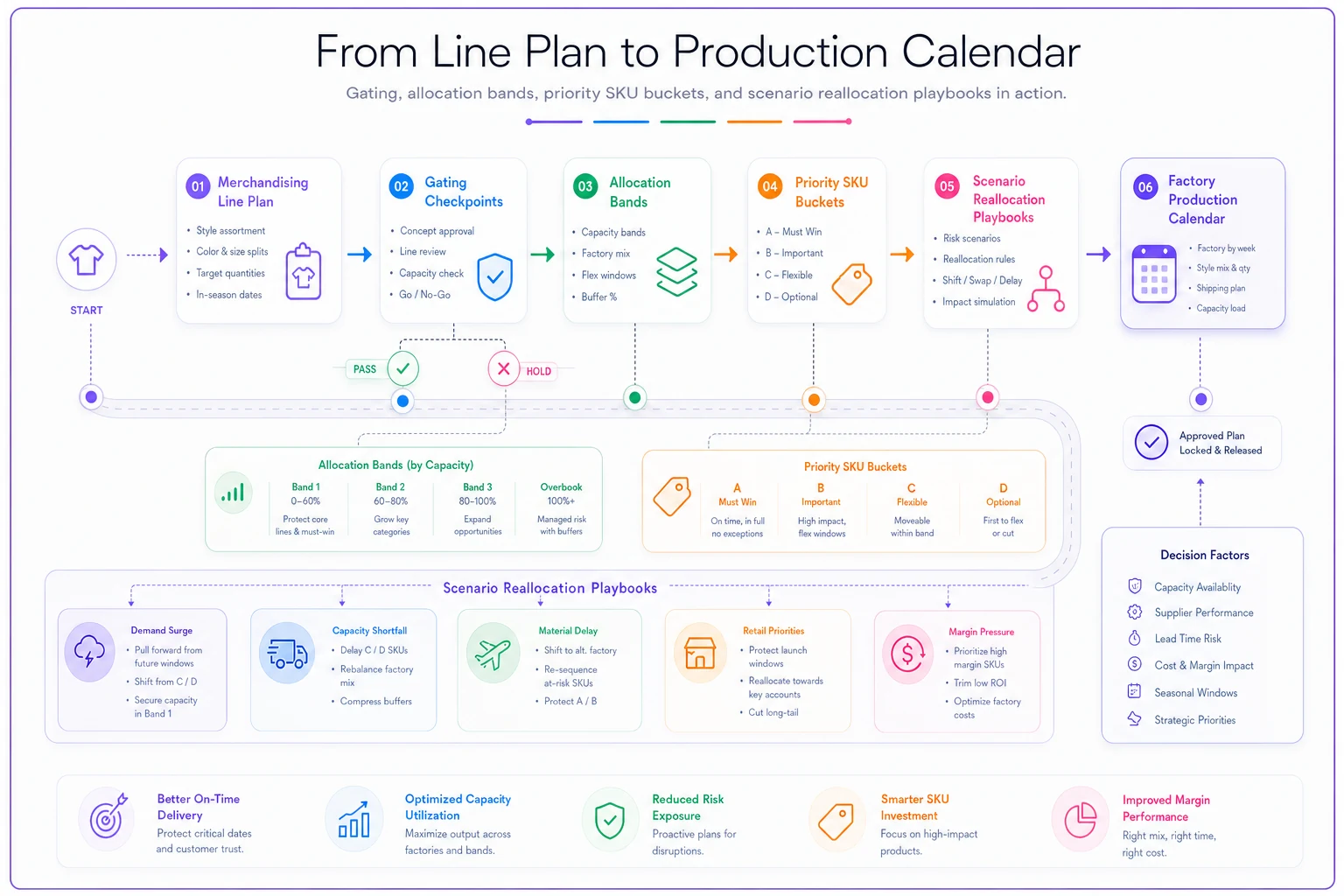
The fix isn't a single tool or a single meeting. It's four connected mechanisms that sit between the line plan and the production calendar. Each one handles a different failure point.
The allocation table with commitment tiers
The mechanism that ties all four together is a living allocation table — one shared view where every SKU carries its priority bucket, its allocation band, its gate status, and its commitment tier: how locked-in the build actually is.
Commitment tiers matter because "on the line plan" and "committed to build" are different things, and confusing them is where money leaks. A useful set of commitment tiers:
-
Exploratory – in the assortment, not gated, no capacity reserved
-
Reserved – passed the gate, capacity held within a band, buy not yet placed
-
Committed – fabric bought, line time booked, cancellation now costs real money
-
Locked – in production, changes only through formal reallocation
Reading down this table, anyone should be able to answer: what's actually at risk if this mill slips? What can still move for free? What's already sunk cost? That single view is what turns reallocation from a panicked spreadsheet rebuild into a decision you make in an afternoon.
A workable process for keeping it honest:
-
At line plan lock, every SKU gets a priority bucket and an initial commitment tier (mostly Exploratory/Reserved).
-
Run gates weekly during the buy window; move cleared styles to Reserved, flag failures for decision.
-
On each buy commitment, advance the SKU's tier and check it against its allocation band — if the band's top is breached, trigger a reallocation review.
-
When a disruption hits, pull the matching playbook, apply it against the commitment tiers (never break a Locked style for an Exploratory one), and update the table.
-
Post-season, review which gates caught real conflicts and which playbooks fired — tune the bands and tiers for next season.
Keeping a table like this current across merchandising, sourcing, and production is exactly the kind of coordination that spreadsheets handle badly at scale. Once you're past a few hundred SKUs and multiple drops, the manual version drifts out of date within days — and a stale allocation table is worse than none, because people trust it. A shared operational platform earns its keep here not by making decisions for you, but by keeping gate statuses, commitment tiers, and capacity bands synced across teams so everyone's arguing from the same numbers instead of three different spreadsheets. Automated flags like "this buy just breached Drop 2's knit band" or "this Tier 1 fabric slipped its confirmed date" turn the reallocation trigger into something that surfaces automatically instead of something a person has to catch.
When this system is worth building — and when it isn't
Build it when: you're running multiple drops per season, you're past roughly 200 active SKUs, and you have genuine shared-resource constraints — a limited number of skilled sew lines, vertical mills serving multiple styles, or finishing processes that bottleneck. If your capacity conflicts are real and recurring, the overhead pays for itself in one avoided fire drill.
Skip most of it when: you run a small, stable assortment with a factory that has ample slack and short lead times. If you never hit a capacity ceiling and conflicts are rare, formal gating and commitment tiers are process for process's sake. A lightweight priority list is plenty.
Who should be careful: brands scaling fast. The trap is waiting until the chaos is unbearable to build this, then trying to install four new mechanisms mid-crisis. Introduce them one at a time while things are still calm — start with priority buckets, since they're the cheapest to agree on and pay off immediately the first time capacity gets tight.
A real scenario
A women's contemporary brand, roughly $18–22M in revenue, ran three main drops and two capsules — around 350–400 SKUs a season. Their pattern: line plans locked on time, but about a quarter of POs slipped their planned drop date every season, and they were spending somewhere in the mid five figures annually on air freight to recover.
The root cause, once they mapped it, was almost boring. Two of their three drops leaned on the same French terry construction from one vertical knitter, and nobody had visibility into the combined load until buys were already placed. The knitter couldn't serve both at planned depth, so production quietly delayed the second drop every season and made up the schedule with airfreight.
They put in three of the four mechanisms — priority buckets, allocation bands per construction, and a shared allocation table with commitment tiers. Gating stayed informal the first season. The change wasn't dramatic-sounding: they capped that terry construction across drops at the knitter's realistic ceiling, forced the depth trade-off during the buy window instead of after, and pushed marginal colorways into Tier 3.
By the second season, on-time PO release went from roughly three-quarters to around 90%, and air freight dropped by more than half. Nothing exotic happened. They just made the capacity conflict visible while the assortment was still soft enough to change.
The shift that actually matters
The teams that get merchandise-to-manufacturing planning right aren't the ones with the best forecasting or the most capacity. They're the ones who moved the capacity conversation earlier — out of the PO stage and into the assortment stage, where you still have real options.
Every mechanism here is really about the same thing: converting decisions from reactive to pre-agreed. Gate before you buy. Set bands before you allocate depth. Rank priorities before capacity gets tight. Write the reallocation response before the disruption. None of it eliminates the physics of finite factory capacity — but it stops that physics from ambushing you three weeks too late to do anything but pay for the mistake.
Start with whichever mechanism maps to the conflict that hurt you most last season. If it was priorities getting bulldozed, build the buckets. If it was drops colliding on shared resources, build the bands and the table. You don't need all four at once. You need the assortment and the factory to stop meeting for the first time at the PO stage.
Ready to tailor your apparel operations?
Join 500+ fashion brands using GoTailo to accelerate product launches, reduce waste, and improve supplier collaboration.