

Most recall conversations in apparel start too late. Usually after a retailer sends the email nobody wants: "We're seeing skin irritation complaints on style 4471." At that point, the questions come fast. Which dye lot? Which cut tickets? How many units, and where are they right now — DCs, stores, in-transit, or already on customers?
The brands that handle this well aren't the ones with the biggest compliance departments. They're the ones who built their batch-tagging discipline before they ever needed it, so scoping a problem takes hours instead of days. The ones who struggle are usually sitting on a spreadsheet that tracks POs but can't connect a finished garment back to a specific fabric roll or sewing line.
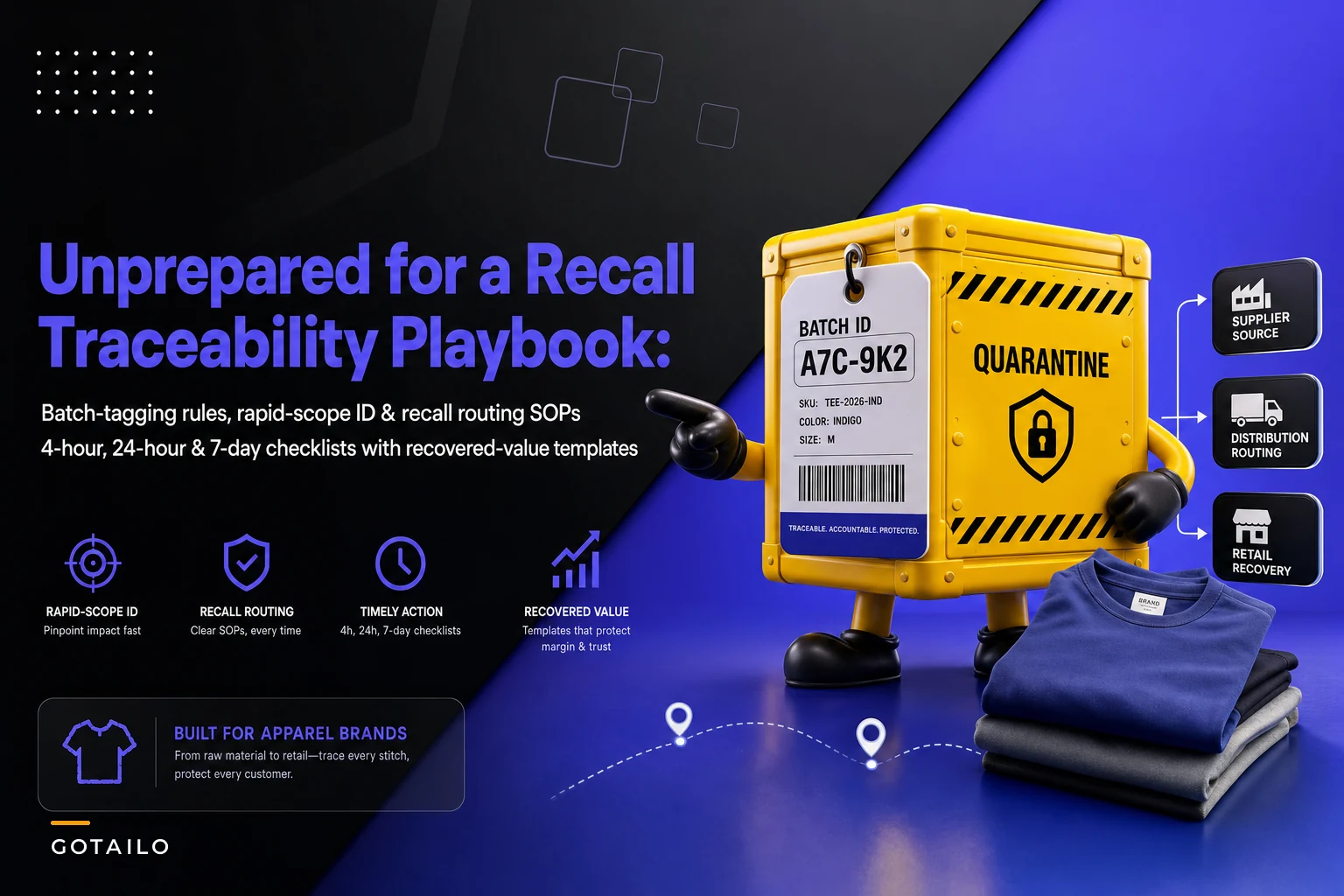
This is a working playbook for an apparel recall built on batch traceability — the tagging conventions that make scoping fast, the time-boxed checklists for the first 4 hours, 24 hours, and 7 days, the routing SOPs for pulling product back, and a simple recovered-value accounting template so you actually know what the event cost you.
The real reason recalls spiral: your batch ID stops halfway through production
Here's the pattern that keeps showing up. A brand can trace fabric receipt beautifully — roll number, mill lot, supplier cert. They can also trace shipments out — carton, ASN, retailer PO. What breaks is the middle. The garment gets cut, bundled, sewn, pressed, and packed, and somewhere in there the link between "this finished unit" and "that specific dye lot and cut ticket" quietly disappears.
So when a defect hits — a fusible that delaminates after three washes, a drawcord that fails a children's safety pull test, a print that bleeds — the brand can't isolate the affected units. They can only say "it's somewhere in this 8,000-unit production run." And because they can't prove which units are clean, they end up pulling all 8,000. That's the difference between a $12k contained recall and a $90k blanket one.
The root cause is almost never bad intent. It's that the batch identifier isn't carried forward at each handoff. A cut ticket has a number. A bundle has a ticket. A carton has a label. But nobody designed those to nest inside each other, so you can't walk backward from a returned garment to its origin.
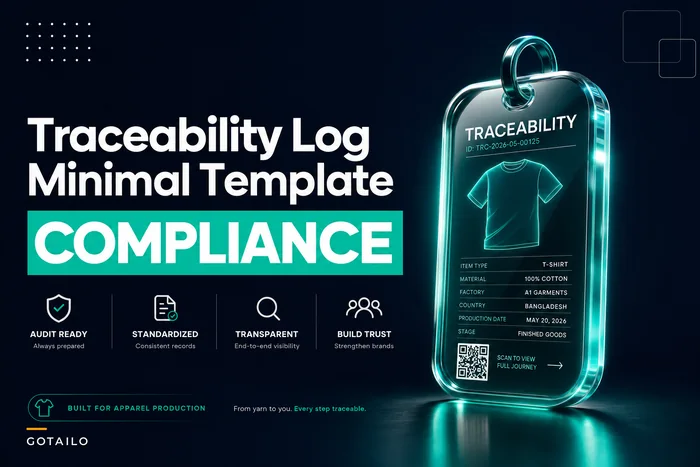
If your materials logging is still loose, fix that foundation first — this minimal materials traceability log and audit routine is a good starting point before you layer batch tagging on top.
Batch-tagging conventions that actually survive the factory floor
The goal is a single ID that lets you go both directions: from a finished unit back to its inputs, and from a suspect input forward to every unit and location it touched.
Eliminate delays in your fashion production cycle.
GoTailo helps you manage designs, orders, and inventory effortlessly, keeping production on schedule.
- Centralized order and inventory management
- Real-time supplier communication
- Integrated production scheduling
No credit card required
A batch tag that works looks something like:
STYLE-SEASON-CUTTKT-DYELOT-LINE-DATE
For example: 4471-FW25-CT18-DL7734-L2-0912
That string tells you the style, the season, the cut ticket, the dye lot, the sewing line, and the production date. Print it on the bundle ticket, carry it onto a small internal batch label sewn into the side seam or printed on the polybag, and reference it on the carton manifest. You don't need RFID for this. A well-designed code and disciplined handoffs get you most of the value.
-
One dye lot per cut ticket whenever possible. The moment you mix two dye lots into one cut ticket, your batch boundary blurs and a color- or chemistry-related recall doubles in scope.
-
Never reuse a cut ticket number across seasons. Reuse is how you end up recalling FW25 units because a defect actually belonged to SS24.
-
Tag the sewing line, not just the factory. Many defects — skipped bar tacks, tension problems, needle-related contamination — are line-specific. Line-level tagging can cut your recall scope dramatically versus recalling a whole factory's output.
-
Record the pack-out date, not the ship date. Pack-out is closer to the physical batch. Ship dates get consolidated and mislead your scoping.
Carry the batch tag onto the bundle ticket and an internal seam label so returns always surface the identifier.
Here's the comparison that tends to convince production managers to tighten this up:
| Tagging depth | Time to scope a defect | Typical recall size | Recovery accuracy |
|---|---|---|---|
| PO-level only | 2–4 days | Entire production run | Poor — you guess |
| Cut-ticket level | 8–12 hours | 1–3 cut tickets | Moderate |
| Cut-ticket + dye lot + line | 2–4 hours | The actual affected batch | High |
The third row is the whole point. When your tag carries dye lot and line, you can often prove that only 900 of 8,000 units are suspect — and defend that with records if a retailer pushes back.
Rapid-scope identification: the first hour is about boundaries, not answers
When a complaint lands, the instinct is to figure out why. Resist that. In the first hour, your only job is to draw the boundary — which batches are potentially affected, and where those units physically are. The "why" investigation runs in parallel but it doesn't gate the pull.
Scoping runs in a specific order:
-
Anchor on the reported unit. Get the batch tag off the actual defective garment if you can — a photo of the side-seam label or polybag code. If the complaint is from a customer, ask the retailer for the unit's carton or lot reference.
-
Expand to the batch. Pull every unit that shares that cut ticket + dye lot + line combination.
-
Test the blast radius. Ask two questions
does this dye lot appear in other cut tickets? Did this sewing line run other styles the same day with the same failure mode? This is how you catch a contaminated chemical bath or a broken machine that touched more than one batch.
-
Locate every unit. Split the affected quantity across DC on-hand, in-transit, at-retail, and sold-through. You'll act on these four buckets very differently.
-
Freeze the clean-adjacent stock. Put a hold on any batch you can't yet clear, even if it's not confirmed bad. Releasing it later is cheap; recalling it twice is not.
The mistake that wrecks this stage is scoping by style instead of by batch. Style-level scoping treats every unit of 4471 as suspect. Batch-level scoping isolates the 900 units that actually share the failure's fingerprint.
The time-boxed checklists
Three windows, each with a clear owner and a clear exit condition.
First 4 hours — contain and freeze
-
[ ] Log the complaint with source, date, and the reported batch tag (or best available reference)
-
[ ] Assign a single recall owner — one name, not a committee
-
[ ] Run rapid scoping steps 1–4 above; produce a preliminary affected-batch list
-
[ ] Place an inventory hold on all suspect and unclear batches at your DC and 3PL
-
[ ] Notify your factory to freeze any remaining WIP or unshipped stock from the same batch
-
[ ] Quarantine physical returns/samples of the defective unit — don't let them get restocked or tossed
-
[ ] Draft a one-line internal severity call
safety issue, compliance issue, or quality issue (this decides everything downstream)
First 24 hours — confirm scope and open communications
-
[ ] Confirm the final affected-batch list with records (cut tickets, dye lot certs, line logs)
-
[ ] Split affected units into the four location buckets with quantities
-
[ ] Notify affected retail/wholesale partners with batch IDs, affected quantities, and the ask (stop-sale, hold, or return)
-
[ ] If it's a safety issue, start your regulatory notification clock and document the timeline
-
[ ] Stand up the recovery routing plan (see routing SOP below)
-
[ ] Prepare customer-facing messaging if any units sold through
-
[ ] Begin the root-cause investigation in parallel — but don't let it delay the pull
First 7 days — recover, account, and close the loop
-
[ ] Track returned/recovered units against expected quantities by bucket
-
[ ] Reconcile recovered units to the recovered-value template (below)
-
[ ] Complete root-cause analysis and document corrective action (supplier, line, or process)
-
[ ] Clear and release any frozen batches you've now proven are clean
-
[ ] File the closing record
scope, cost, cause, corrective action, and what you'd tag differently next time
The exit condition for each window matters as much as the tasks. You don't leave the 4-hour window until stock is frozen. You don't leave the 24-hour window until partners are notified and scope is confirmed. Time-boxing prevents the slow bleed where a recall quietly runs for three weeks because nobody declared it "contained."
Communications timeline: who hears what, and when
The sequencing of who you tell is where brands either protect their relationships or torch them. A useful pattern:
-
Hour 0–4 internal only. Owner, ops, QA, and leadership. No external messaging until you have a defensible preliminary scope.
-
Hour 4–24 notify affected trade partners. Lead with the batch IDs and the specific ask. Retailers respond far better to "stop-sale on lot DL7734, 340 units at your DC" than to "we might have an issue with style 4471."
-
Hour 24–72 customer-facing, if units sold through. Keep it factual and specific to the affected batch.
-
Day 3–7 close-out communication to partners confirming recovery status and corrective action.
The thing most teams miss: specificity builds trust during a recall. Vague notifications make retailers assume the worst and pull your whole assortment defensively. A precise, batch-scoped notification signals you have control, and partners tend to cooperate rather than overreact.
Recall routing SOPs: get the units to one predictable place
The physical recovery is where recovered value leaks. Units get returned to random locations, mixed with good stock, or written off when they could've been reworked. Route everything through a single decision point.
The routing logic:
-
Every recovered unit goes to one quarantine location — not back to normal receiving. Mixing recovered units with sellable inventory is how a recalled batch ends up shipping again.
-
Sort into disposition buckets on arrival rework-eligible, downgrade/liquidate, or destroy. A failed drawcord might be reworkable; a chemistry problem usually isn't.
-
Record disposition against the batch tag so your recovered-value math is accurate.
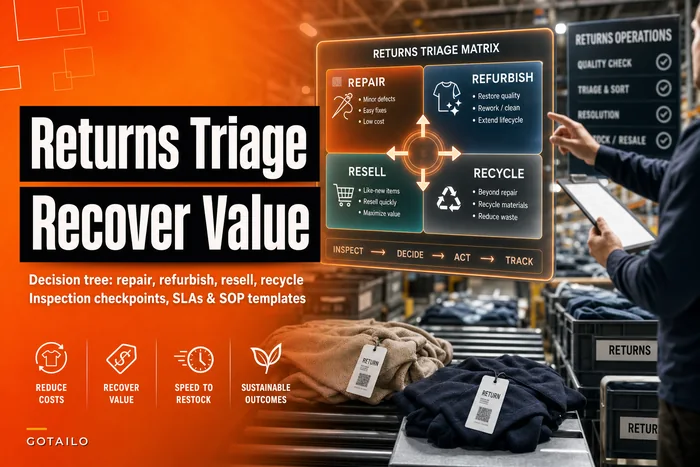
If recovered units are reworkable, your existing returns-handling discipline applies directly — the same triage thinking in this returns triage matrix for repair, refurbish or restock works for recall recovery, just with a tighter quarantine rule so nothing slips back into sellable stock by accident.
Visualize the routing flow below.
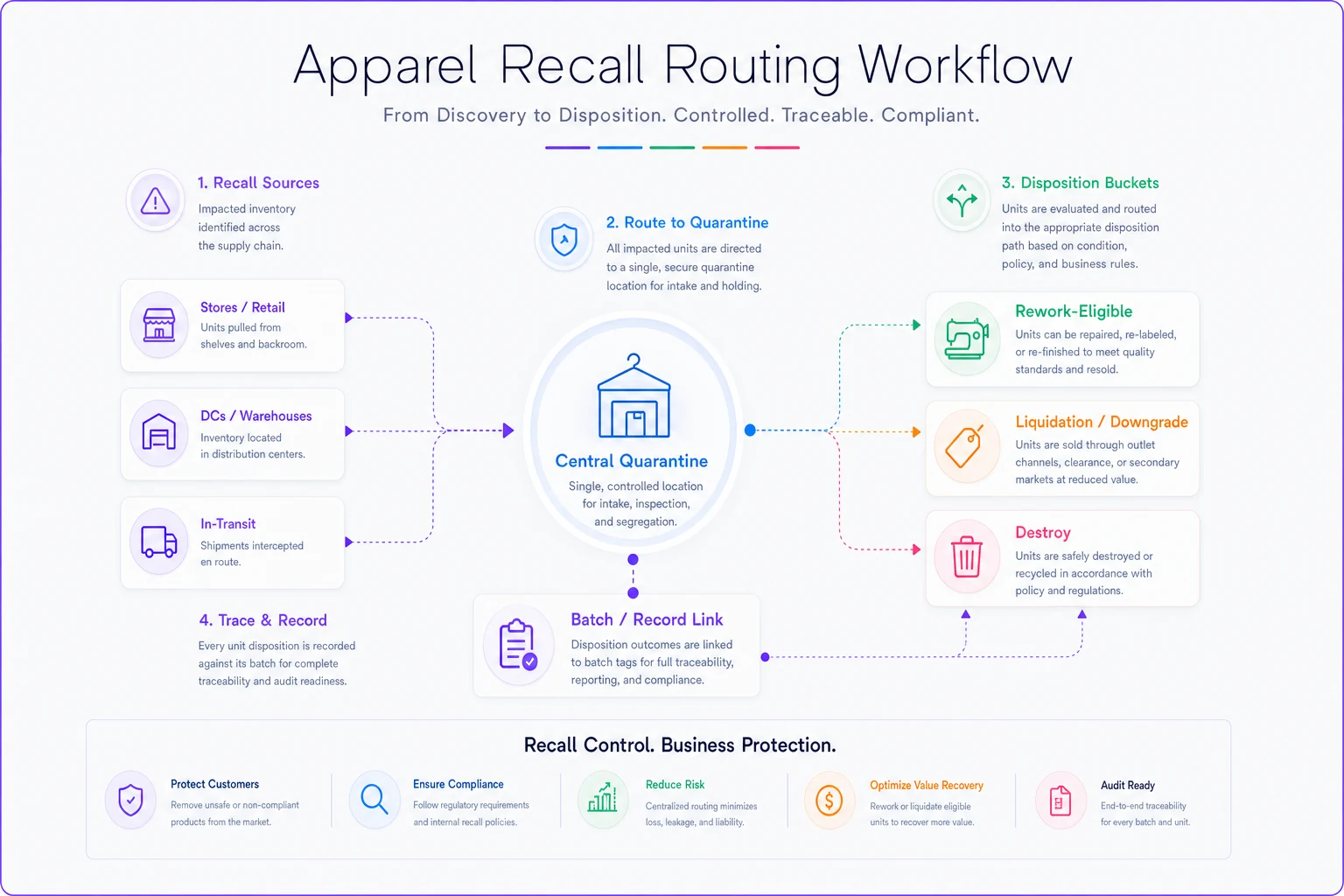
The routing logic keeps recovered units centralized, prevents mixing with sellable stock, and ensures disposition is tied to the originating batch.
Recovered-value accounting: know what the event actually cost
Most brands never total up a recall. They feel the pain, absorb it across a few line items, and move on. That's a mistake, because without a real number you can't justify the traceability investment that would shrink the next one.
A simple recovered-value template, per batch:
| Line item | Amount |
|---|---|
| Units recovered (rework path) × recovered value | + |
| Units recovered (liquidation) × liquidation value | + |
| Units destroyed × unit cost | − |
| Freight/reverse logistics on returns | − |
| Rework labor and materials | − |
| Retailer chargebacks / markdown allowances | − |
| Internal labor hours on the recall | − |
| Net recall cost / recovered value | = |
Two recalls of the same size can have wildly different costs depending on how well you scoped and routed. A tightly scoped, well-routed recall might net out at a fraction of a sloppy one — the difference comes down to how many clean units you avoided pulling and how many recovered units you salvaged instead of destroyed.
A real scenario
A mid-sized women's contemporary label ran an 8,000-unit blouse program across two dye lots and three sewing lines. Three months post-delivery, a retailer flagged puckering and seam failure on a handful of units after washing.
Their original tagging was PO-level only. Best case, they were looking at recalling the entire 8,000-unit run — roughly $90k in units at cost, plus reverse freight and chargebacks. Before pulling the trigger, they pulled the batch tags off two returned units and found both traced to the same dye lot and the same sewing line — line 2, dye lot 7734, one cut ticket of about 900 units.
Because they'd started tagging at cut-ticket + line level on this program (not perfectly, but enough), they could isolate roughly 900 suspect units instead of 8,000. Around 600 came back through DC and retail holds; close to 400 of those were reworkable at a modest labor cost, and the rest were liquidated. The final net cost landed somewhere in the $14k–$18k range instead of the $90k blanket scenario.
The corrective action was mundane — a tension issue on one machine on line 2 — but the point is they only had to touch the batch that machine produced. Without line-level tagging, they'd have written a check five or six times larger.
When this level of rigor makes sense — and when it's overkill
Full batch tagging down to dye lot and line pays off when you're producing safety-sensitive categories (childrenswear, sleepwear, anything with regulatory exposure), running large repeat programs, or selling through wholesale partners who will chargeback aggressively.
It's overkill for tiny one-off drops of 50–100 units where you could physically inventory the entire run in an afternoon. In that case, cut-ticket-level tagging is plenty. The cost of the tagging discipline should never exceed the recall scope it protects against.
Who should not skip this: anyone doing children's products, anyone selling to major retailers, and anyone whose products involve dyes, chemical finishes, or safety-critical components like drawcords and small parts. For those categories, the batch tag isn't paperwork — it's the difference between a contained event and a business-threatening one.
Closing thought
A recall is a stress test of decisions you made months earlier, at the cutting table and the sewing line, when you either carried the batch ID forward or let it drop. Tight tagging conventions, fast batch-level scoping, time-boxed checklists, single-point routing, and honest recovered-value accounting don't prevent defects — nothing does. What they do is shrink the blast radius from "the whole run" to "the batch that actually failed," and that gap is usually measured in tens of thousands of dollars and a handful of retailer relationships you'd rather keep.
Build the tagging before you need it. The 4-hour clock is a terrible time to discover your batch trail ends at the cutting room door.
Ready to tailor your apparel operations?
Join 500+ fashion brands using GoTailo to accelerate product launches, reduce waste, and improve supplier collaboration.