


Last month, a small streetwear brand got hit with a recall notice. Not because their hoodies contained harmful chemicals — they didn't. The problem? They couldn't prove it. Their fabric supplier swore the batch was clean, but without documentation linking specific fabric rolls to specific production runs, the brand had to pull 800 units from stores.
The kicker? They actually had most of the information. It was just scattered across purchase orders, shipping documents, cutting tickets, and email threads. No way to connect fabric roll #A2847 to the 200 hoodies sitting in Nordstrom.
This keeps happening. Brands know they need materials traceability — especially with new regulations coming down the pipeline — but they're stuck between two bad options: expensive PLM systems that take months to implement, or continuing to wing it with spreadsheets and hope nothing goes wrong.
Most small apparel brands don't need to track 47 data points across 15 checkpoints. They need to answer three basic questions when something goes sideways: Which materials went into this product? Where did those materials come from? Can we prove it?
That's it. Everything else is nice-to-have.
Teams struggling most with traceability aren't disorganized. They're drowning in complexity. Their factories send different formats. Their suppliers use different numbering systems. Their own teams can't agree on what to track. So they track everything, badly, instead of tracking the essentials well.
Building a materials traceability log apparel teams can actually maintain
The pattern becomes obvious after watching dozens of brands scramble during audits and recalls: the simpler the system, the more likely it survives contact with reality.
Start with five core fields. Not fifty. Five: Material ID — Your internal reference (like FAB-2024-047) Supplier Batch — Whatever number your supplier uses PO Number — Links to your purchase documentation Production Run — Which styles/orders used this material Location — Where it physically sits right now
That's your foundation. Every material that enters your pipeline gets these five data points logged. No exceptions, no "we'll update it later."
The handoff map that actually works
Receiving → QC
-
Warehouse logs arrival with supplier batch number
-
QC adds test results (pass/fail is enough)
-
Both sign off electronically or on paper
QC → Production Planning
-
Planning assigns material to specific production runs
-
Updates projected usage quantities
-
Notes any special handling requirements
Production Planning → Cutting Room
-
Cutting room confirms physical receipt
-
Logs actual quantities pulled
-
Records any remnants returned
Cutting → Sewing
-
Bundle tickets reference material batch
-
Line supervisors verify material matches paperwork
-
Any substitutions get flagged immediately
Each handoff takes about 90 seconds to document. Those 90 seconds create an unbroken chain from supplier to finished product.
The audit scenario nobody prepares for
Picture this: It's Thursday afternoon. An email lands from your biggest wholesale account. "We need documentation showing the organic cotton certification for order #7829 within 48 hours."
Eliminate delays in your fashion production cycle.
GoTailo helps you manage designs, orders, and inventory effortlessly, keeping production on schedule.
- Centralized order and inventory management
- Real-time supplier communication
- Integrated production scheduling
No credit card required
Without a materials traceability log apparel brands typically spend the next two days in chaos mode. Calling suppliers at midnight their time. Searching through thousands of emails for certificates. Trying to match invoice numbers to shipment numbers to production dates.
With even a basic log? You pull up order #7829, see it used material batch FAB-2024-031, trace that to supplier batch #QD-8847, and forward the organic certificate that was uploaded when the fabric arrived. Fifteen minutes, done.
During audits they don't just ask for one order. They pick three random SKUs and want full traceability. They ask about a return from six months ago. They want to know about that one colorway you discontinued.
Building your emergency audit kit
Tier 1 — Always needed:
-
Master materials log for the current year
-
Supplier certificates (grouped by supplier, not date)
-
Lab test results for your top 10 materials
-
Standard operating procedure for traceability (even if it's one page)
Tier 2 — Often requested:
-
Photos of material labels and packaging
-
Signed receiving documents
-
Production batch records linking materials to outputs
-
Disposal or destruction records for rejected materials
Tier 3 — Sometimes required:
-
Supplier audit reports
-
Transportation documents showing chain of custody
-
Warehouse temperature/humidity logs (for sensitive materials)
-
Training records showing staff know the procedures
The brands that sail through audits aren't necessarily more organized — they just know what auditors actually look for. It's not about perfection. It's about showing a consistent system that someone could follow.
When recalls hit: the 4-hour scramble
A recall notice is different from an audit. With an audit, you have time to gather documents. With a recall, every hour costs money and reputation.
Real example: A kids' clothing brand discovered their supplier had shipped fabric with excessive formaldehyde levels. Not dangerous, but above regulatory limits. They had four hours to identify every single garment made with that fabric batch before stores opened the next morning.
Without traceability? They would've recalled everything from that season — roughly 12,000 units across 15 SKUs. With their basic materials log? They isolated it to 1,900 units across 3 SKUs. The difference: about $78,000 in unnecessary recalls plus whatever brand damage comes from pulling products that were actually fine.
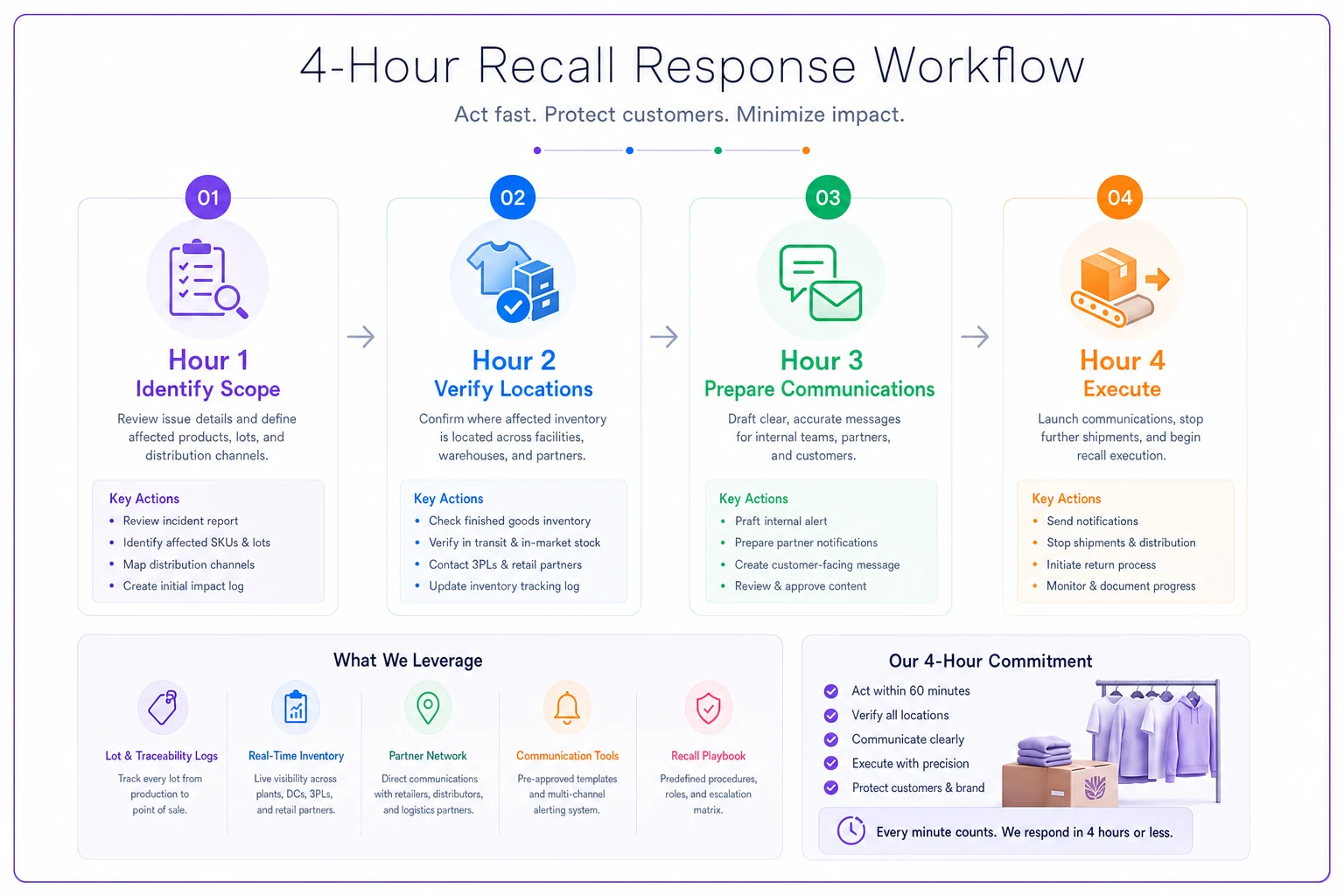
The recall response workflow
-
Hour 1
Identify scope
— Pull the material batch number from your log, list every production run that used that batch, calculate maximum possible affected units -
Hour 2
Verify locations
— Check current inventory by SKU, identify shipments in transit, list retailers holding affected stock -
Hour 3
Prepare communications
— Draft recall notice with specific SKUs and date ranges, prepare FAQ for customer service, create return/refund procedures -
Hour 4
Execute
— Send notices to all retailers, update website with recall information, begin pulling inventory from warehouse
Here's a quick visual guide to the 4-hour recall steps.
Without a materials traceability log apparel teams guess. They recall too much or too little. They can't answer customer questions. They lose credibility with retailers who then require more documentation for future orders.
The compliance requirements actually headed your way
Everyone talks about upcoming regulations but nobody explains what you'll actually need to prove. Based on what's already rolling out in Europe and California, here's what small brands should prepare for: Chemical compliance — Not just testing, but proving which materials went into which products. A certificate for "our cotton" isn't enough. You need to link specific tested batches to specific production runs. Supply chain transparency — Customers and regulators want to know where materials come from. Not the full journey from cotton seed to store shelf, but at least your direct supplier and their location. Environmental claims — Say your hangtags mention "recycled polyester"? Better be able to prove which products actually contain it and in what percentage. Random testing is increasing. Labor compliance — This extends beyond your own facilities. You'll need to document which suppliers provided which materials, so when labor issues surface, you can assess your exposure.
The brands getting caught aren't necessarily doing anything wrong — they just can't prove they're doing things right.
The minimal template that actually gets used
Forget complex databases. Here's a Google Sheets template that real teams can maintain:
| Date Received | Material ID | Description | Supplier Batch | PO Number | Quantity | Unit | Test Status | Cert Links | Production Runs | Current Location | Notes |
|---|---|---|---|---|---|---|---|---|---|---|---|
| 2024-01-15 | FAB-2024-001 | Cotton Jersey 180gsm Navy | QD-8847 | PO-2419 | 500 | yards | Passed | [Link] | RUN-301, RUN-302 | Warehouse A-3 | Organic cert exp. 2025 |
| 2024-01-18 | TRM-2024-002 | YKK Zipper #5 Black | YK-10298 | PO-2420 | 2000 | units | Passed | [Link] | RUN-301 | Production floor | Metal-free verified |
That's it. Twelve columns that answer 90% of traceability questions.
Consistency beats completeness. Better to track five fields religiously than fifteen fields sporadically. Every material, every time, no exceptions.
Making it stick: the weekly audit routine
Monday morning (15 minutes):
-
Review materials received last week
-
Verify all fields completed
-
Chase any missing supplier batch numbers
Wednesday check-in (10 minutes):
-
Update production runs for materials in use
-
Confirm quantities remaining
-
Flag any discrepancies
Friday wrap-up (20 minutes):
-
Upload any new certificates received
-
Update locations for materials moved
-
Archive completed production runs
Assign one person to own the weekly audit — consistency comes from individual ownership, not committees.
Assign one person to own this. Not a committee, not "whoever has time" — one person who takes pride in keeping it clean.
The automation opportunity most brands miss
The data you need for traceability already flows through your business. Purchase orders have supplier info. Receiving documents have quantities. Production schedules show what materials go where.
Nobody connects these systems. Your purchasing team uses one spreadsheet, warehouse uses another, production uses paper tickets. A materials traceability log apparel companies can trust needs to pull from all these sources automatically.
Modern operational platforms can capture this data at natural touchpoints — when materials arrive, when production starts, when quality checks complete. No extra data entry, just connecting what you already track. The same barcode scan that confirms receipt can update your traceability log, trigger quality testing reminders, and link certificates.
This isn't about complex AI predicting supply chain disruptions. It's about basic operational software that treats traceability as part of normal workflow, not an extra burden. When materials data flows automatically from receiving through production to shipping, compliance becomes a byproduct of operations, not a scramble during audits.
Who should actually implement this (and who should wait)
Ready now:
-
Brands with 3+ SKUs in production
-
Anyone selling to major retailers
-
Companies making health or sustainability claims
-
Teams who've been asked for traceability data before
Not ready yet:
-
Single-product brands still validating market fit
-
Pure design houses that don't touch production
-
Brands where suppliers ship directly to customers
If you're in the "ready now" category, start this week. Not next quarter when you have more time — this week. Pick your five core fields, set up the basic template, and start logging materials currently in your pipeline.
From chaos to confidence
A materials traceability log isn't about perfection — it's about progress. The small streetwear brand from the beginning? They implemented a basic system like this after their recall scare. Six months later, when Macy's requested full documentation for their holiday collection, they provided it in two hours instead of two weeks.
The difference wasn't sophisticated software or expensive consultants. It was a simple system, consistently applied, with clear ownership and regular audits. They went from dreading compliance requests to handling them before lunch.
Start simple. Five fields. Three handoff points. One owner. Build the habit before you build the system. Because when that recall notice or audit request lands in your inbox, you won't have time to build anything — you'll only have what you've already been tracking.
The brands winning at compliance aren't the ones with perfect systems. They're the ones with good-enough systems that actually get used.
The brands winning at compliance aren't the ones with perfect systems. They're the ones with good-enough systems that actually get used.
Ready to tailor your apparel operations?
Join 500+ fashion brands using GoTailo to accelerate product launches, reduce waste, and improve supplier collaboration.