

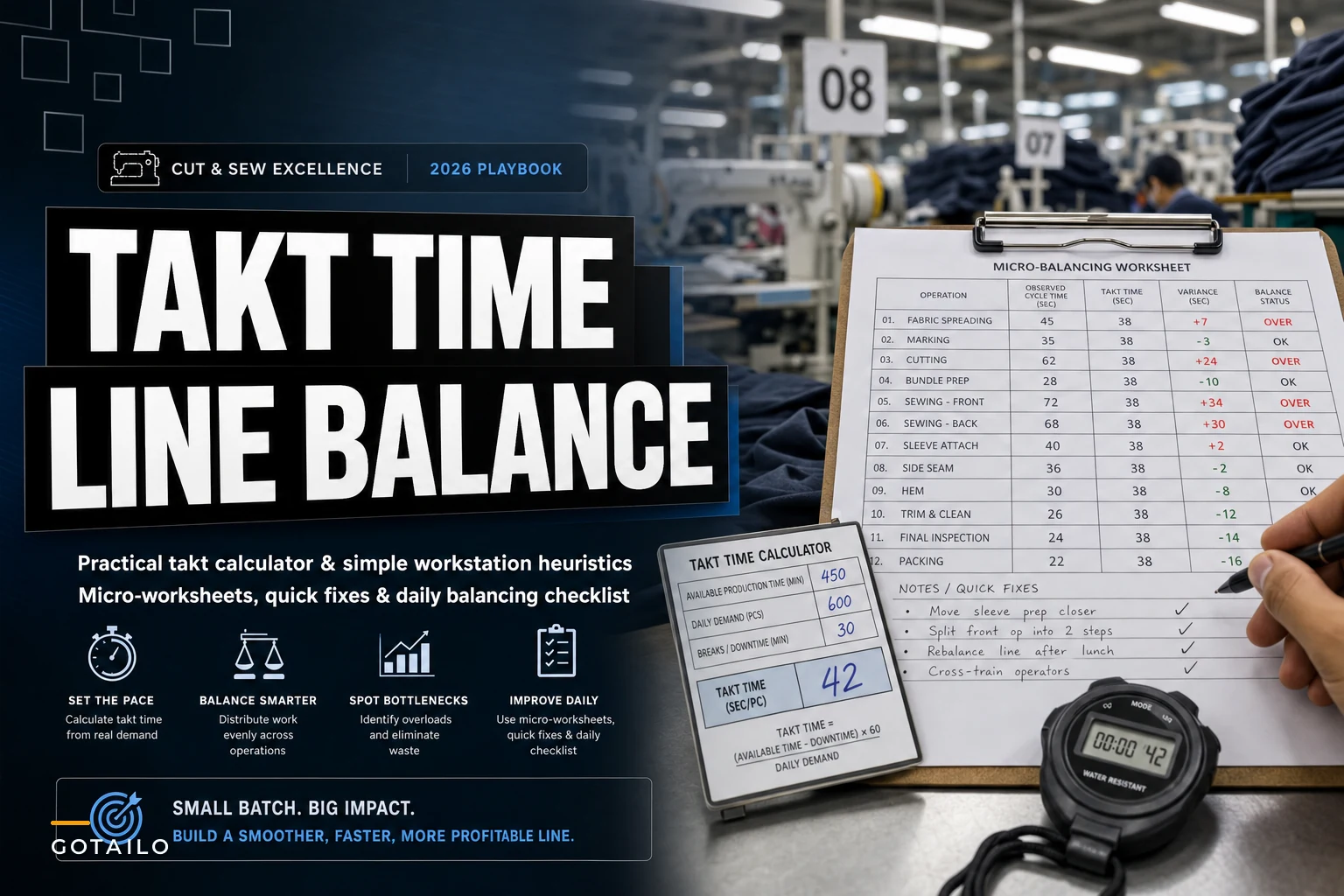

Most small cut-and-sew lines aren't balanced. They're stacked. Bundles pile up behind the two slowest operators, the line supervisor shuffles people around by feel, and by the end of the day WIP is sitting unevenly across ten workstations with no real explanation for why. The output number looks fine on paper — 480 units — but nobody can tell you how it got there, or whether tomorrow will repeat.
That gap between "we hit the number" and "we understand the number" is where line balancing lives. For small factories running 8 to 25 machines, the standard industrial-engineering approach is overkill. You don't need a time-study department. You need a takt figure you trust, a few balancing heuristics that work with real people, and a daily worksheet that catches WIP drift before it snowballs. This is that system.
Start with takt, but define your window honestly
Takt time is simple math: available production time divided by required units. The mistake small factories make isn't the formula — it's lying to themselves about the inputs.
-
Line startup and machine warm-up (usually 10–15 min)
-
Bundle changeovers between styles
-
Scheduled breaks and any unpaid clean-down at day end
-
A realistic allowance for machine stoppages (thread breaks, bobbin changes, minor jams)
Simple takt-time calculator (do this by hand once, then reuse):
| Input | Example value |
|---|---|
| Shift length | 540 min |
| Breaks (2 × 15 min) | −30 min |
| Startup / warm-up | −12 min |
| Changeover allowance | −20 min |
| Machine-stop allowance (~8%) | −38 min |
| Effective available time | 440 min |
| Target output (units) | 400 |
| Takt time | 440 ÷ 400 = 1.10 min/unit |
So your line needs to complete one finished garment every 66 seconds to hit 400 units. That's your beat. Every workstation gets measured against it.
The bigger insight here: most small factories quote a takt that assumes 90%+ uptime they've never actually measured. When you back out a realistic stop allowance, the takt loosens — and suddenly the line isn't "behind," it was just planned against a number that was never real.
Why the line is unbalanced (it's rarely the operators)
Before touching worksheets, it helps to name where imbalance actually comes from, because the fix depends on the cause.
Eliminate delays in your fashion production cycle.
GoTailo helps you manage designs, orders, and inventory effortlessly, keeping production on schedule.
- Centralized order and inventory management
- Real-time supplier communication
- Integrated production scheduling
No credit card required
Operation content mismatch. Some operations simply take longer than takt. A collar attach might genuinely need 95 seconds against a 66-second takt. No amount of encouragement fixes that — the work content exceeds the beat, and that station will always be a bottleneck until you split it.
Skill spread on the same operation. Two operators doing the same seam, one at 55 seconds and one at 80. Same machine, same bundle. That's a training and placement problem, not a method problem.
Layout-driven waiting. Bundles travel across the floor, and the physical distance between two connected operations creates transport time nobody counts. Work-in-progress pools at the handoff.
Style-mix whiplash. The line was balanced for a basic tee, then a lined jacket got dropped into the same seats without rebalancing. Operation times changed completely but the seating didn't.
A common pattern: a 12-machine line running a knit polo hits 60% of target output. Everyone blames slow sewers. The actual data shows two operations — placket set and collar close — running 40% over takt while four other stations sit idle a third of the day. The people were fine. The distribution of work was broken.
Micro-balancing heuristics that work on small lines
Formal line-balancing algorithms assume you can freely reassign fractional work elements. On a real cut-and-sew floor you can't — you're constrained by machine types, operator skills, and the physical sequence of the garment. So you balance with heuristics, not optimization software.
-
List every operation with its observed cycle time. Not the standard from the tech pack — the actual average of 8–10 timed cycles per operator, mid-morning, not right after startup.
-
Flag every operation above takt. These are your bottlenecks. Everything else is secondary.
-
Attack the worst bottleneck first, alone. Don't rebalance the whole line. Fix the single station holding back output.
-
For an over-takt operation, choose one of three moves split the operation across two stations, offload a sub-element to an idle neighbor, or add a parallel station (two operators doing the same slow operation feeding one downstream).
-
Rebalance idle stations toward the new bottleneck. After fixing the worst, the second-worst becomes your ceiling. Repeat.
-
Stop when your slowest station is within ~10% of takt. Chasing perfect balance on a 12-person line wastes more time than it saves.
Quick fixes by symptom
-
One station always has a bundle mountain behind it → split that operation or add a parallel seat.
-
Station goes idle for stretches → pull a sub-element from the upstream bottleneck onto it.
-
WIP creeps up steadily all day → your line is running slightly over takt on average; recheck your machine-stop allowance, it's probably too low.
-
WIP swings wildly (empty then flooded) → batch/bundle sizes are too large; cut bundle size in half to smooth flow.
-
A fast operator finishes and waits → don't slow them down; give them the pace-setting downstream operation so their speed pulls the line.
The pattern most supervisors miss: you rebalance one bottleneck at a time, then re-measure. Trying to redesign all twelve stations at once produces a plan that collapses the moment one operator is absent. Incremental beats perfect.
The micro-balancing worksheet
This is the sheet a line supervisor fills out before a style runs. Deliberately small — one page, fillable in about 15 minutes.
| Op # | Operation | Machine | Observed cycle (sec) | Takt (sec) | Over/Under | Action |
|---|---|---|---|---|---|---|
| 1 | Shoulder join | Overlock | 48 | 66 | −18 | absorb sub-element |
| 2 | Collar close | Flatlock | 95 | 66 | +29 | SPLIT |
| 3 | Placket set | SNLS | 88 | 66 | +22 | PARALLEL |
| 4 | Sleeve attach | Overlock | 62 | 66 | −4 | ok |
| 5 | Side seam | Overlock | 51 | 66 | −15 | absorb from #2 |
| 6 | Hem | Coverstitch | 58 | 66 | −8 | ok |
The "Action" column is the whole point. Any station in the red gets a specific move, not a vague note to "speed up." When collar close is split into prep and close across two seats, each half lands near 47 seconds — comfortably under takt — and station 5's idle time absorbs the prep work.
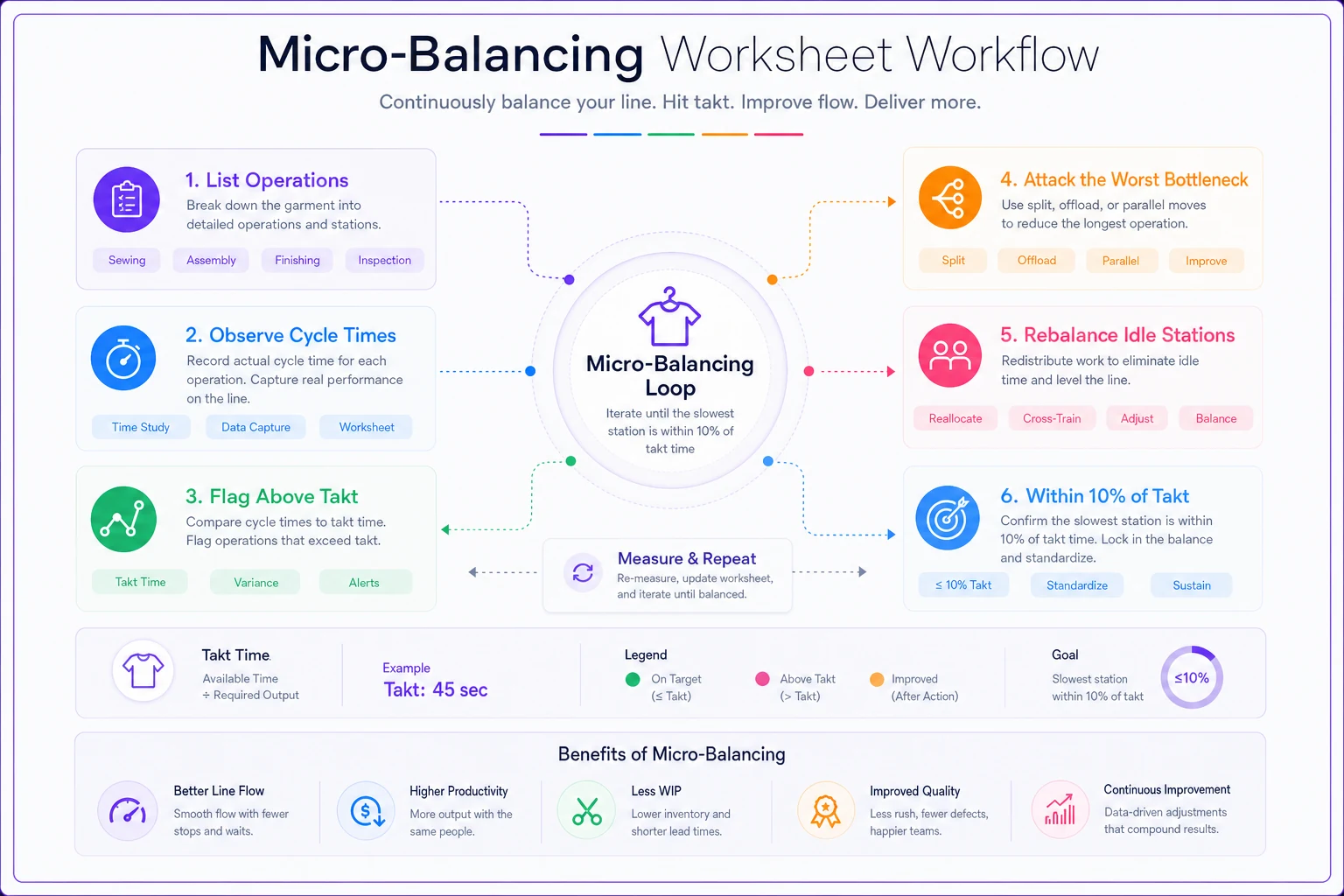
This diagram shows the step-by-step micro-balancing workflow in practice.
Keep the filled worksheets. Over a few weeks you'll build a library of balanced layouts by garment type, and re-running a repeat style becomes a lookup instead of a fresh guessing session.
The daily balancing checklist — where WIP variance actually gets controlled
Balancing a line once is the easy part. Keeping it balanced across a day with absences, machine issues, and style changes is the real work. The lever for that is a short daily routine that catches drift early.
WIP variance — the difference between how much work-in-progress sits at each station — is your best early-warning signal. When one station's WIP is climbing while another's is emptying, the line is quietly unbalancing and output will drop in an hour or two even though it looks fine right now.
-
[ ] Confirm today's target and recalculate takt if the run length changed
-
[ ] Walk the line at startup — note any absent operators and reassign against the worksheet, not by memory
-
[ ] Count WIP at each station once mid-morning (bundles waiting, not in-hand)
-
[ ] Flag any station with WIP more than ~2× the line average
-
[ ] Apply the matching quick fix (split, parallel, or offload)
-
[ ] Re-count WIP after lunch — is the flagged station recovering?
-
[ ] Log end-of-day output vs takt-implied target and note the reason for any gap
That mid-morning WIP count is the single highest-value habit on this list. Two counts a day — one before lunch, one after — will tell you more about line health than the output number ever will, because output is a lagging indicator and WIP is a leading one.
This connects directly to how you reconcile inventory on the floor. If your WIP numbers on the balancing sheet never match what physical counts show, you've got a reconciliation gap worth closing — the WIP reconciliation routine and sample forms covers the counting discipline that makes balancing data trustworthy in the first place.
A real scenario: the polo line that was "slow"
Business: a 14-machine contract factory in a small industrial unit, running mostly knit tops for two regional brands.
Problem: a piqué polo program was landing at roughly 300–320 units/day against a target of 480. The owner assumed he needed to hire faster operators or run overtime.
Timing the line properly showed the real issue: effective available time was only around 425 minutes once realistic changeover and stoppage allowances were subtracted, putting takt near 53 seconds. Two operations — placket set and collar close — were running 85 to 95 seconds, roughly 30 seconds over takt each. Meanwhile three overlock stations sat idle nearly a third of the shift.
The fix took two days. Collar close was split into prep and close across two seats. Placket set was run as a parallel operation with two operators feeding one downstream station. Sub-elements from the split operations were pushed onto the idle overlock seats. Bundle size dropped from 30 to 15 to smooth flow.
Result: output settled around 430–450 units/day within a week — not the theoretical 480, but close enough that overtime stopped and the program became profitable. Just as important, daily WIP counts flattened out. The line stopped producing a bundle mountain behind the collar station every afternoon. Nobody was hired. Nobody worked faster. The work was just distributed against a takt figure that was finally honest.
When this makes sense — and when it doesn't
This makes sense when you run repeatable styles in bundles across a fixed line of 8+ machines, and output varies day to day without a clear cause. Takt and micro-balancing give you a language for the floor and a fast way to diagnose drops.
This is a bad idea when you're a sample room or a make-through operation where one operator builds an entire garment. There's no line to balance — takt doesn't apply, and forcing it just adds paperwork.
Skip the daily WIP counting if you're running one style for weeks with a stable, well-trained crew and flat output. The routine earns its keep when your style mix changes often or your crew composition shifts day to day. For a factory that changes styles every few days, it's essential. For a stable long-run line, monthly re-balancing is enough.
One more caution: don't over-engineer the timing. Eight to ten observed cycles per operation is plenty for a small line. Chasing statistical precision on cycle times is a research project, not a production tool — and the operators will notice the stopwatch and slow down, which corrupts your data anyway. Time quietly, average, move on.
Where balancing and quality intersect
A rebalanced line can quietly raise your defect rate if you're not watching. When you split an operation or hand a sub-element to an operator who doesn't usually do it, quality dips for a day or two while the new distribution settles. Parallel stations are especially prone to inconsistency — two operators doing the same seam won't produce identical results without a shared standard.
Fold your balancing changes into your inline checks so a distribution change doesn't turn into a rework wave. If you don't yet have lightweight checks at the handoffs, the compact cut/sew inspection lists and defect taxonomy pair naturally with a balancing routine — catch the drift in quality at the same station where you're managing the drift in WIP.
Bringing it together
Line balancing on a small cut-and-sew floor isn't about optimization algorithms or expensive time studies. It's three habits done consistently: calculate a takt you actually believe by backing out real losses, fix bottlenecks one station at a time using splits and parallels, and count WIP twice a day so imbalance shows up before it costs you output.
The factories that run smoothly aren't the ones with the fastest operators. They're the ones where the work is spread evenly against an honest beat, and where a supervisor can look at a WIP count mid-morning and know exactly which station to touch. Everything in this playbook — the takt calculator, the micro-balancing worksheet, the daily checklist — exists to make that decision fast and repeatable, so a good day on the line stops being an accident nobody can explain and starts being something you can produce on purpose.
Ready to tailor your apparel operations?
Join 500+ fashion brands using GoTailo to accelerate product launches, reduce waste, and improve supplier collaboration.