

Three weeks ago, a sportswear manufacturer in North Carolina discovered 1,400 units with misaligned side seams during final packing. The entire batch needed rework. The kicker? Every single piece had passed through their production floor without anyone catching the issue that started at the cutting table.
Your production line is bleeding quality, but you don't know where the cuts are happening
This wasn't about lazy workers or broken equipment. Their quality control process had a fundamental gap — no structured inline inspection checkpoints between cutting and final QC. Just workers doing their jobs, passing pieces forward, assuming someone else would catch problems.
Defects compound in modern cut-and-sew operations. A cutting error becomes a sewing nightmare. A minor tension issue turns into puckered seams across hundreds of pieces. Without inline checkpoints, you're running blind until final inspection, when fixing problems costs 5-10x more than catching them early.
Why production teams skip inline inspections (and pay for it later)
Most small to mid-size apparel manufacturers operate on tight margins and tighter deadlines. Setting up comprehensive inline inspection feels like adding friction to an already stressed system. Teams convince themselves that experienced operators will naturally catch issues, or that final QC is sufficient.
Eliminate delays in your fashion production cycle.
GoTailo helps you manage designs, orders, and inventory effortlessly, keeping production on schedule.
- Centralized order and inventory management
- Real-time supplier communication
- Integrated production scheduling
No credit card required
Operators focus on their specific tasks — cutting, sewing, pressing. They're measured on output, not defect detection. A cutter hitting their hourly targets won't slow down to inspect edge alignment on every piece. A sewing operator maintaining their efficiency rate won't stop to check if the previous station's work meets spec.
When everyone owns quality, nobody owns quality. Without designated checkpoint moments and clear inspection criteria, defects flow downstream like water finding the path of least resistance.
Documentation creates another problem. Even when operators spot issues, there's rarely a system to capture what they found, where it originated, or how often it's happening. A verbal "heads up" to the next station doesn't create data you can analyze. Problems repeat because there's no feedback loop connecting defect patterns to their sources.
The compound cost of late-stage defect discovery
A basic t-shirt that costs $3.50 to cut and sew has different rework costs depending on when you catch the problem:
-
Caught at cutting table
$0.25 to recut
-
Caught after initial sewing
$1.20 to unpick and resew
-
Caught at finishing
$2.80 for full rework
-
Caught by customer
$12+ including shipping, returns, reputation damage
Multiply that across a 2,000-unit order. A cutting alignment issue that would cost $500 to fix immediately becomes a $5,600 problem if it reaches finishing. That's before considering the schedule impact of pulling workers off current production to fix yesterday's mistakes.
The hidden costs hurt more. When rework piles up, your best operators get pulled into fixing problems instead of producing new units. Lead times stretch. Customers lose confidence. Your next price negotiation gets harder because buyers know your quality is inconsistent.
Building garment-specific inspection checkpoints that actually work
The solution isn't adding inspection at every single step — that would grind production to a halt. You need strategic checkpoints at natural handoff points where defects are most likely to emerge or compound.
Post-cutting checkpoint
-
Check 1 in every 10 pieces for
-
- Pattern piece completeness
-
- Edge quality and alignment
-
- Notch placement accuracy
-
- Grain line consistency
Pre-assembly checkpoint
-
Inspect first 3 pieces of each bundle for
-
- Component matching (collar to body, sleeves to armholes)
-
- Interface application
-
- Marking transfer accuracy
Mid-assembly checkpoint
-
Review every 20th piece for
-
- Seam alignment and width consistency
-
- Stitch tension and density
-
- Pocket/detail placement
Pre-finishing checkpoint
-
Sample 10% for
-
- Overall construction quality
-
- Pressing marks or shine
-
- Thread trimming completeness
-
- Label placement
Make these checks fast and binary. Each checkpoint should take under 30 seconds per piece with clear pass/fail criteria. No subjective quality judgments, just specific measurements and visual checks that anyone can perform consistently.
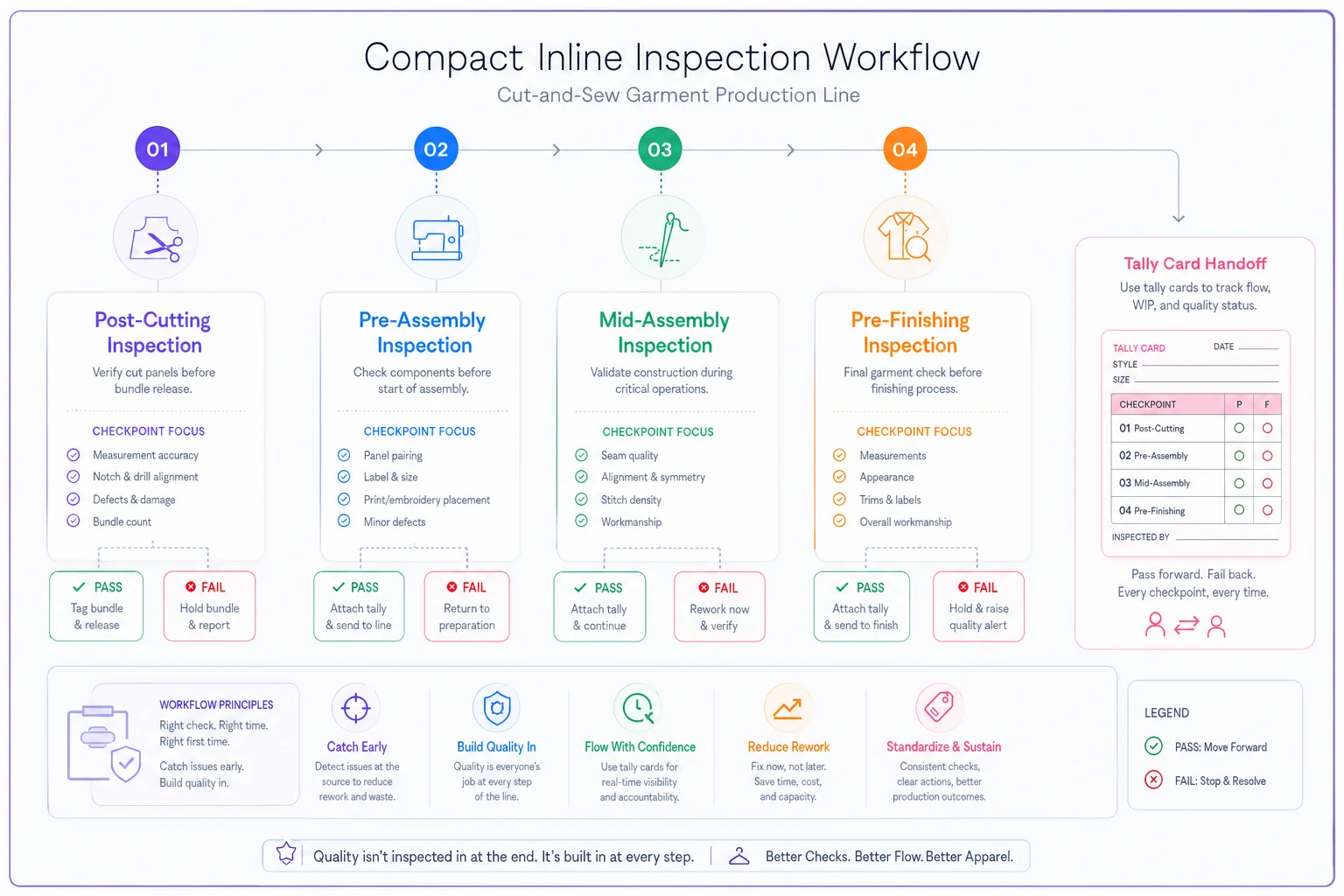
A simple visual of the checkpoint flow helps teams understand where to stop and what to record.
The timing matters too. Don't inspect when operators are rushing to meet end-of-shift quotas. Build checkpoints into natural workflow breaks — when bundles transfer between stations or when machines are being threaded for new colors.
A compact defect taxonomy that operators will actually use
Traditional quality manuals list hundreds of potential defects. Nobody memorizes that. Your floor needs a simplified taxonomy that covers 90% of what they'll encounter, organized by where defects originate rather than where they're discovered.
| Category | Code | Defect Type |
|---|---|---|
| Cutting-origin defects | C1 | Misaligned pieces (pattern not followed) |
| C2 | Rough/frayed edges | |
| C3 | Missing notches or marks | |
| C4 | Wrong grain direction | |
| C5 | Piece size variance beyond tolerance | |
| Sewing-origin defects | S1 | Skip stitches or thread breaks |
| S2 | Uneven seam allowance | |
| S3 | Puckering or gathering | |
| S4 | Misaligned seams or components | |
| S5 | Wrong stitch type or density | |
| S6 | Raw edges showing | |
| Finishing-origin defects | F1 | Pressing marks or shine |
| F2 | Incomplete thread trimming | |
| F3 | Label/trim attachment issues | |
| F4 | Measurement out of spec | |
| F5 | Overall appearance issues | |
| Material defects | M1 | Fabric flaws (holes, pulls, stains) |
| M2 | Shade variation | |
| M3 | Print/pattern misalignment |
This 18-point system covers virtually everything your team will encounter. More importantly, the coding immediately tells you where to investigate. A spike in S3 defects means checking sewing machine tension. Multiple C1s indicate cutting table setup problems.
Print these codes on laminated cards for each checkpoint. Operators learn them within days because they see the same 8-10 defects repeatedly. The rest become familiar through use, not memorization drills.
Lightweight logging that creates actionable data
Paper inspection sheets end up in boxes nobody opens. Excel spreadsheets get abandoned after two weeks. Your logging system needs to be simple enough that operators actually use it while providing data you can analyze.
-
Date and shift recording
-
Checkpoint location identification
-
Style/SKU being produced
-
Total pieces inspected count
-
Defect codes found (using taxonomy)
-
Operator who performed inspection
That's it. No lengthy descriptions, no photos required, no complex forms. Just enough data to spot patterns and trace problems to their source.
The magic happens when you aggregate this data weekly. Suddenly you can see that C1 defects spike on Monday mornings (cutting table calibration drift over weekends). S3 puckering increases with certain fabric types. F2 thread trimming issues concentrate on one specific production line.
Don't get fancy with the data collection initially. A basic notebook works better than a digital system operators won't use. You can always upgrade later once the habit sticks.
KPIs that predict problems before they explode
Most apparel manufacturers track defect rates at final inspection — essentially measuring failure after it's too late to prevent it. Inline checkpoint data lets you track leading indicators that predict quality issues before they cascade.
First-pass yield by checkpoint What percentage of pieces pass through each checkpoint without defects? A sudden drop at any checkpoint signals immediate investigation needed. Track this daily and you'll spot problems while they're still small.
Defect origin distribution Where are defects originating as a percentage of total found? If 60% trace back to cutting but cutting only represents 15% of your labor cost, you know exactly where to focus improvement efforts.
Defect discovery lag How many stations does a defect travel through before discovery? If S2 (uneven seams) regularly makes it through 3-4 stations before detection, your mid-assembly checkpoint needs adjustment.
-
First-pass yield below 85% at any checkpoint = immediate review
-
Any origin category exceeding 40% of defects = process audit required
-
Average discovery lag over 2 stations = checkpoint criteria need tightening
These numbers aren't arbitrary. They're based on what actually works in real production environments.
Weekly tracking works better than daily for most small manufacturers. Daily numbers jump around too much to see meaningful patterns. Monthly summaries miss problems that could be fixed quickly. Weekly hits the sweet spot.
Real-world implementation without disrupting production
Rolling out inline checkpoints into an active production environment requires careful staging. You can't just announce new inspection requirements and expect smooth adoption.
Start with one product line, ideally your highest volume SKU where quality issues hurt most. Implement just the post-cutting checkpoint first. Run it for a week, gather data, show the team what you're catching. Build confidence that this isn't about finding fault but preventing rework.
Week two, add the pre-assembly checkpoint. Week three, mid-assembly. By week four, you've got the full system running on one product line with operators who understand the value because they've seen defects caught early.
Training takes maybe 15 minutes. Show checkpoint operators the defect codes. Give them physical samples of common issues. Do three practice runs together. That's enough to get started — refinement happens through daily use, not lengthy training sessions.
Resistance typically comes from two places. Operators worry inspection slows them down (it doesn't if done right). Supervisors fear defect data makes them look bad (reframe it as preventing customer complaints, not assigning blame).
The first week feels clunky. Operators forget to check pieces or mark cards. Don't worry about perfect compliance initially. Focus on building the habit. By week three, it becomes automatic.
Case study: A production floor that caught problems before they multiplied
A children's wear manufacturer in Los Angeles implemented this exact system six months ago. They produce around 8,000 units monthly across 15 SKUs, primarily basic cotton separates for major retailers.
Before inline checkpoints:
-
8-12% defect rate at final inspection
-
300-400 pieces requiring daily rework
-
Consistent delays on shipments due to quality issues
After implementation:
-
2-3% defect rate at final (mostly minor issues)
-
Under 50 pieces in daily rework
-
On-time shipment rate improved from 78% to 94%
The real win wasn't just fewer defects. Their data showed 70% of problems originated at cutting, specifically with their manual cutting process for curved pieces. They invested $15,000 in better cutting tools and templates — paid for itself in reduced rework costs within two months.
Now their buyers trust their quality consistency. Price negotiations focus on value, not risk mitigation. That reputation shift was worth more than the direct cost savings.
When inspection checkpoints become operational intelligence
The immediate benefit of inline checkpoints is catching defects early. But the long-term value lies in the operational intelligence you build. Three months of checkpoint data tells you more about your actual production capabilities than years of final inspection reports.
Patterns humans miss become visible. Maybe defects spike every time you run navy fabric (dye affecting cutting accuracy). Perhaps Thursday afternoon shifts consistently show higher error rates (fatigue patterns). Certain operator combinations might produce notably fewer defects when paired.
This intelligence drives targeted improvements instead of broad "quality initiatives" that rarely stick. When data shows 40% of sewing defects happen on side seams, you don't need company-wide sewing training — you need 30 minutes focused on side seam technique.
The checkpoint data also becomes powerful for customer conversations. When buyers push for lower prices, you can show exactly what quality level you're delivering and what it costs to maintain. When they complain about a defect, you can trace it back through checkpoints to show it's an anomaly, not a pattern.
Smart manufacturers use this data for capacity planning too. If certain styles consistently show higher defect rates at specific checkpoints, they build extra time into production schedules. No more surprise delays when quality issues surface.
Software coordination for checkpoint management
As production scales, managing checkpoint data in spreadsheets becomes unwieldy. Multiple checkpoints, various SKUs, different shifts — all generating data that needs aggregation and analysis.
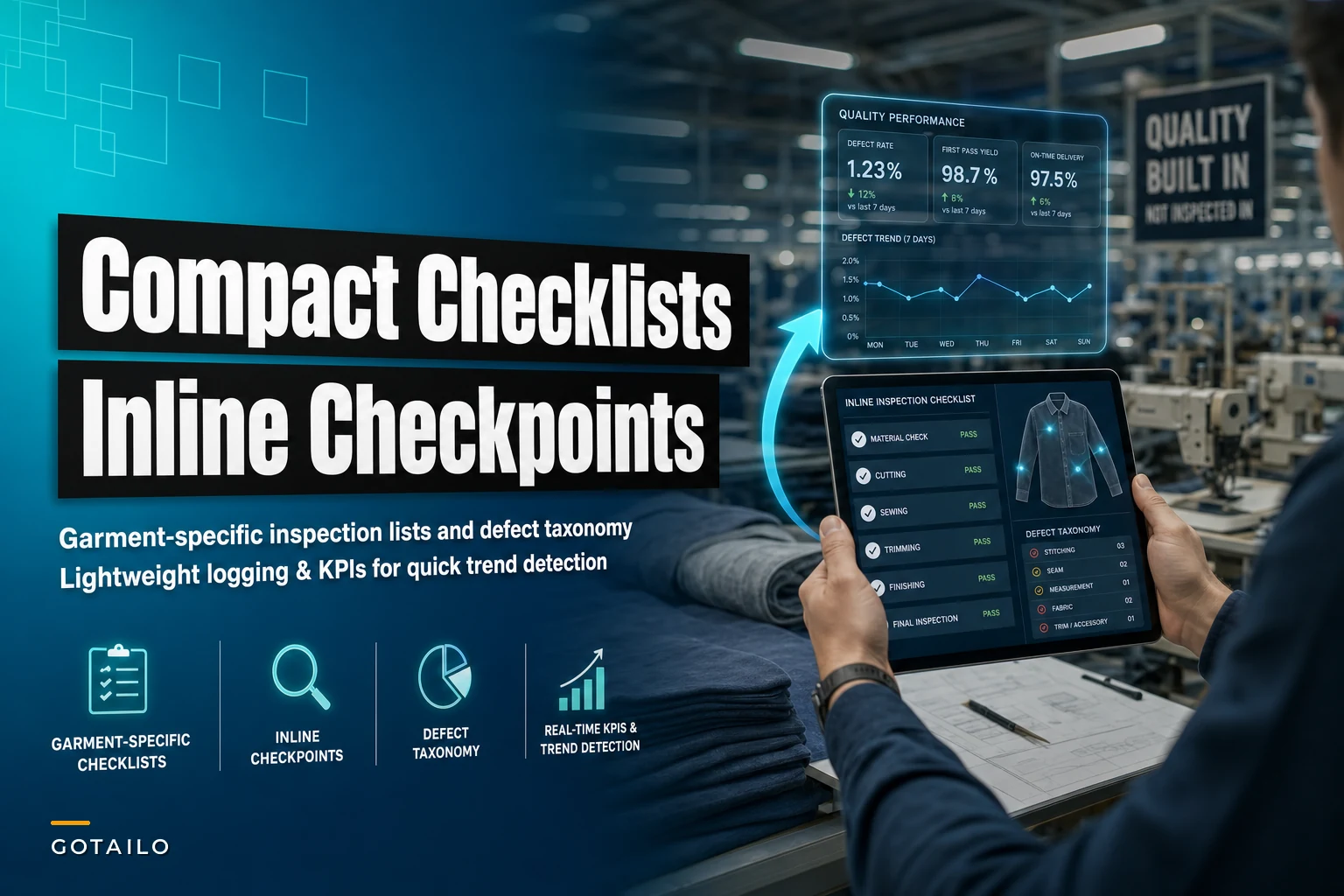
This is where AI-powered operational software helps teams maintain inspection discipline without drowning in administration. Modern platforms can digitize your tally cards, automatically calculate KPIs, and flag when thresholds are exceeded. Operators input defect codes on tablets at each checkpoint, supervisors see real-time quality trends, and management gets weekly pattern analysis.
The most valuable feature is automated alerting. When first-pass yield drops below threshold, the system notifies the floor supervisor immediately. When a specific defect code spikes, quality managers get prompted to investigate. This moves you from reactive discovery to proactive prevention.
Pilot tablet entry at supervisors' stations first so operators keep using simple tally cards while you digitize oversight.
Some manufacturers integrate checkpoint data with production planning. If Tuesday's cutting checkpoint shows high defect rates, Wednesday's sewing schedule automatically adjusts to account for rework time. This kind of coordination prevents the cascade effect where quality issues create scheduling chaos.
AI automation helps with pattern recognition too. Software can identify correlations humans miss — like fabric lot numbers that consistently produce higher defect rates, or specific machine-operator combinations that perform better. These insights become actionable intelligence for continuous improvement.
The difference between good intentions and good systems
Every apparel manufacturer wants to produce quality products. The difference between those who succeed and those who struggle isn't effort or intention — it's systematic defect prevention versus hoping problems don't happen.
Inline inspection checkpoints aren't about adding bureaucracy or slowing production. They're about creating moments of verification that prevent small issues from becoming big problems. The fifteen seconds it takes to check seam alignment saves the fifteen minutes it takes to rework a garment.
The system described here — strategic checkpoints, compact defect taxonomy, simple logging, three essential KPIs — can be implemented within a month for under $1,000 in direct costs. Most manufacturers waste more than that weekly on preventable rework.
Start with one checkpoint next Monday. Use the defect codes. Track what you find. Within two weeks, you'll wonder how you ever operated without this visibility. Within two months, your rework pile will shrink noticeably. Within six months, your entire quality conversation changes from "what went wrong" to "what patterns are we seeing."
That shift separates manufacturers who constantly fight fires from those who prevent them from starting.
Start with one checkpoint next Monday. Use the defect codes. Track what you find. Within two weeks, you'll wonder how you ever operated without this visibility. Within two months, your rework pile will shrink noticeably. Within six months, your entire quality conversation changes from "what went wrong" to "what patterns are we seeing."
That shift separates manufacturers who constantly fight fires from those who prevent them from starting.
Ready to tailor your apparel operations?
Join 500+ fashion brands using GoTailo to accelerate product launches, reduce waste, and improve supplier collaboration.