
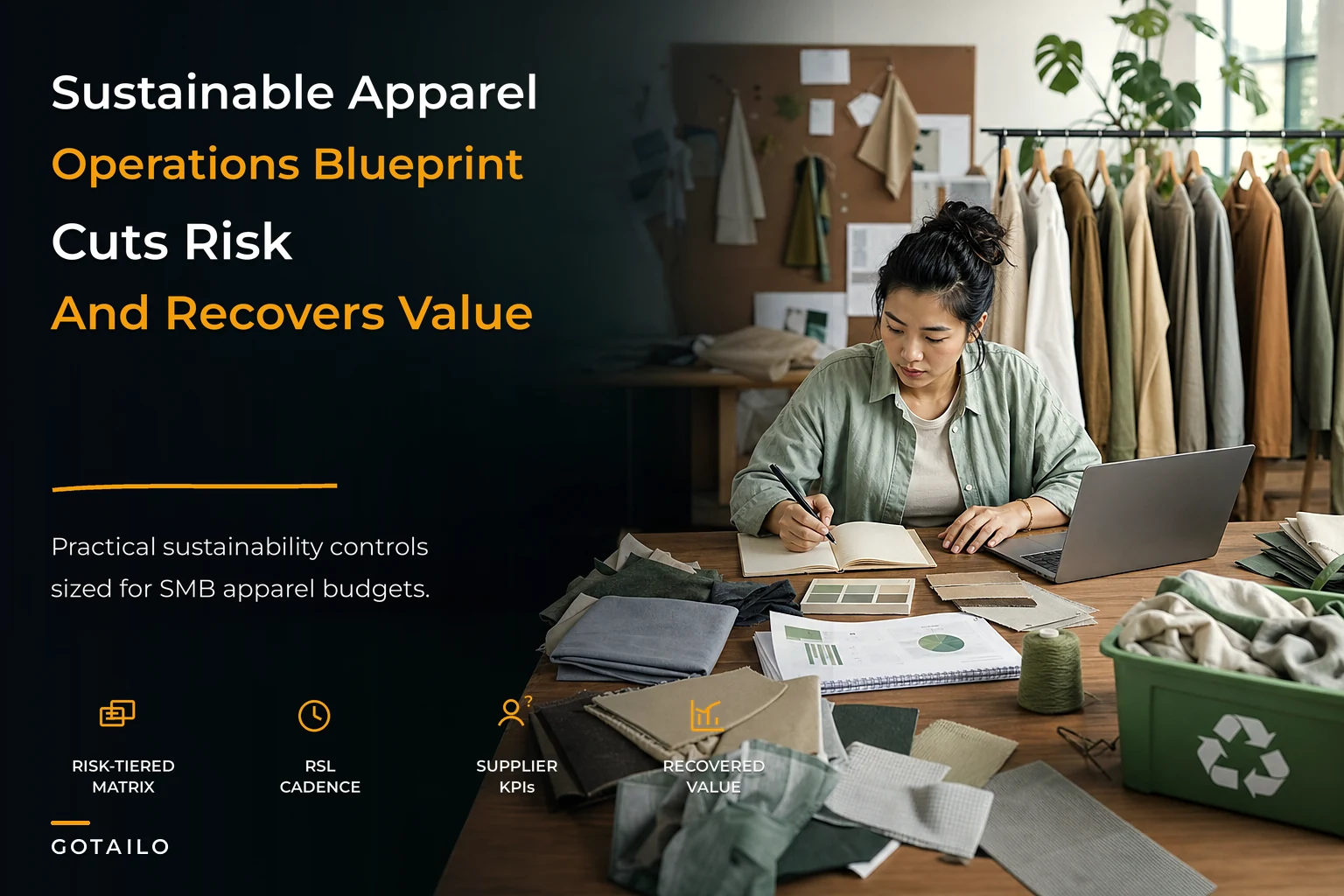

Most sustainability conversations in apparel fall apart the moment you look at the budget. The frameworks are built for brands with compliance departments, third-party auditors on retainer, and the cash to run material innovation labs. For a brand doing a few hundred thousand units a year — or a cut-and-sew supplier running three lines — those frameworks are noise. You don't need a 60-page ESG report. You need to know which of your materials and suppliers are actually going to burn you, and where a small amount of effort buys the most protection.
That's the whole game for sustainable operations in apparel SMB: proportional effort. Spend where the risk is, document only what you'd need to defend, and stop pretending you can audit everything at once. This post lays out a risk-tiered matrix, a realistic RSL testing cadence, the supplier KPIs that actually matter, and how to run circularity pilots small enough that your finance person doesn't panic — then book the results as recovered value instead of hand-waving them as "impact."
Why sustainability programs collapse at SMB scale
The failure pattern is almost always the same. A retailer or wholesale buyer sends over a compliance questionnaire. Someone on the team — usually whoever has the least on their plate that week — tries to answer all of it. They chase every supplier for test reports, most of which don't exist or are three years expired. The effort stalls somewhere around material #40, the spreadsheet rots, and the next season kicks off before anything got finished.
What's broken here isn't commitment. It's that the work was never tiered. Treating a cotton tee lining the same as a kids' sleepwear flame-retardant claim means you spread thin effort across everything and real coverage across nothing. A program that tries to be comprehensive on a small budget ends up being comprehensive about nothing.
The brands that get this right do the opposite. They decide early that roughly 70% of their SKUs get a light touch, around 20% get moderate attention, and maybe 10% get the full treatment — and that 10% is chosen by actual risk, not by what's easiest to test.
The risk-tiered sustainability matrix
The matrix is the backbone. Every material, product, and supplier gets scored across a few dimensions, and that score decides how much evidence you collect and how often. The point is to make the triage automatic so nobody has to re-argue it every season.
Eliminate delays in your fashion production cycle.
GoTailo helps you manage designs, orders, and inventory effortlessly, keeping production on schedule.
- Centralized order and inventory management
- Real-time supplier communication
- Integrated production scheduling
No credit card required
Here's a working version you can adapt:
| Risk tier | What lands here | Evidence minimum | RSL cadence | Supplier scrutiny |
|---|---|---|---|---|
| Tier 1 (High) | Kids/infant wear, direct-skin synthetics, anything with chemical claims, treated/finished fabrics, PU/PVC coatings | Current RSL test report (≤12 mo), supplier declaration, chemical disclosure | Every production run or every 6 months, whichever is sooner | Full onboarding + annual review |
| Tier 2 (Medium) | Dyed woven/knit outerwear, blended fabrics, prints, hardware/trims with coatings | Valid test report (≤24 mo) OR mill certification, signed declaration | Annual, plus on material change | Scorecard review 2x/year |
| Tier 3 (Low) | Undyed/natural fibers, simple cotton basics, low-contact accessories | Supplier self-declaration + mill traceability record | On change only, spot-check 1 in 10 | Scorecard review annually |
The dimensions that push something up a tier:
-
Skin contact and wear duration — a lining worn eight hours beats a tote bag.
-
Chemical processing depth — every finish, dye, and coating adds exposure risk.
-
Claim exposure — if marketing says "non-toxic" or "organic," that SKU is Tier 1 by definition, because the claim creates liability.
-
Supplier opacity — a mill you can't trace or that resists testing requests is riskier regardless of the fiber.
The thing most teams miss: a claim is a risk multiplier. The fabric might be totally benign, but the moment someone writes "chemical-free" on a hangtag, you've created an evidence obligation that didn't exist before. A surprising number of SMB sustainability fires start in the marketing deck, not the mill.
Evidence-minimum tactics: stop over-collecting
"Evidence minimum" means the least documentation you'd need to defend the tier if a buyer, regulator, or customer challenged it — and nothing more. Over-collection is its own failure mode. Teams that demand full test panels on every Tier 3 cotton basic burn their supplier goodwill and their own hours, then have nothing left when a Tier 1 issue actually surfaces.
A few rules that keep this sane:
-
Accept existing valid reports. If a mill already tested to a recognized RSL standard within your cadence window, take it. Re-testing identical material is wasted money.
-
Declarations are fine for low tiers. A signed supplier declaration carries real weight for Tier 3. You're not running a lab; you're building a defensible paper trail.
-
Date everything and set expiry. An undated test report is worthless. Every piece of evidence needs a "valid until" so your cadence enforces itself.
-
Store by material, not by product. One tested fabric might appear in a dozen SKUs. Linking evidence to the material means you test once and inherit it everywhere. This is the same principle behind keeping a minimal materials traceability log — the log and the evidence file should point at each other.
Date everything and set expiry.
Worth internalizing: evidence is a liability you're managing, not a trophy you're collecting. Every document you hold has an expiry and a maintenance cost. Hold only what defends a tier.
RSL cadence — the part everyone gets wrong
The cadence just means two things running at different rhythms: your Restricted Substances List (what's banned in the finished product) and your Manufacturing RSL (what's controlled in the process, often called MRSL). SMBs tend to conflate them or ignore the second entirely. The finished-product RSL protects your customer. The manufacturing RSL protects your supplier's workers and your downstream traceability — and it's the one buyers are increasingly asking about.
A workable rhythm:
-
At onboarding — collect baseline RSL evidence for every Tier 1 and Tier 2 material. This is non-negotiable and happens before the first PO.
-
On material change — any dye lot change, finish change, or mill switch resets the clock. This is the most-missed trigger. A supplier quietly changes a dyestuff to cut cost, and your last valid report no longer describes what you're actually shipping.
-
On cadence expiry — Tier 1 every six months or per run, Tier 2 annually, Tier 3 on change only.
-
On claim creation — the moment a new sustainability claim gets drafted, the relevant SKU jumps cadence until evidence backs it.
The mistake that costs real money: treating RSL compliance as a one-time onboarding checkbox. Materials drift. A supplier passing on day one can be out of spec by the third production run because an input substituted somewhere upstream. Without a change-triggered re-test, you don't find out until a buyer's own lab does — and by then it's a chargeback and a reputation problem, not a quiet re-test.
Supplier KPIs that actually move sustainability
Supplier scorecards tend to over-index on price and lead time. For sustainability, you want a small set of KPIs that are observable and that you can act on. Four that earn their place:
-
Evidence currency rate — percentage of a supplier's active materials with valid, in-cadence RSL evidence. A supplier sitting at 60% is a slow-motion problem.
-
Change-notification compliance — do they tell you when they switch dyes, finishes, or sub-suppliers? This is the single best predictor of whether your test reports mean anything.
-
Test pass rate on first submission — how often their declared materials pass without a re-test. Low pass rates signal either sloppy inputs or wishful declarations.
-
Circularity participation — willingness to take back cuttings, accept recycled-content inputs, or support a reclaim pilot. Soft at first, but it separates partners from vendors.
These sit naturally alongside the quality and delivery metrics you're probably already tracking. They also pair well with the social-compliance side of supplier review — the same visits where you'd run a factory social-audit checklist are the right moment to verify chemical handling and evidence practices in person. Don't make two separate trips for things one visit can cover.
Change-notification compliance is the KPI that predicts all the others. A supplier who proactively flags a dye change is a supplier whose reports you can trust. One who stays silent is one whose green checkmarks are decoration.
Low-cost circularity pilots tied to recovered-value accounting
This is where sustainability stops being a cost center and starts paying for itself — if you account for it honestly. The problem with most circularity talk is that the "value" is vague. Recovered-value accounting fixes that by forcing every pilot to produce a real P&L line: what did we recover, at what cost, and what's the net?
Three pilots that fit an SMB budget:
-
1. Cutting-waste reclaim. Collect fabric scraps from the cutting floor, sort by fiber, and either sell to a recycler or route to a small accessories line (scrunchies, pouches, patch pockets). Low setup, immediate measurability.
-
2. Deadstock liquidation with traceability. Instead of landfilling overruns, batch and sell them through a recommerce or B-stock channel. The key is keeping batch-level records so you can prove provenance — the same batch discipline you'd want for a recall traceability playbook makes deadstock saleable rather than suspect.
-
3. Take-back and refurbish. Offer customers a small credit to return worn garments, then repair and resell or harvest components. Start with one SKU family, not your whole catalog.
Sample recovered-value P&L, sized to an SMB
| Line item | Amount (quarter) |
|---|---|
| Scrap collected & sorted (labor) | –$1,400 |
| Bins, bags, storage | –$350 |
| Recycler pickup / freight | –$600 |
| Recovered revenue — recycler sale | +$1,900 |
| Recovered revenue — accessories line | +$2,600 |
| Avoided disposal/landfill fees | +$450 |
| Net recovered value | ≈ +$2,600 |
Nobody's retiring on $2,600 a quarter. But the point isn't the headline number — it's that the pilot pays for itself, generates a defensible sustainability story, and gives you a template you can scale. Run three of these and you're at a five-figure annual recovered-value line that sits in actual accounting, not a slide deck. The brands that keep circularity alive are the ones that booked it as recovered value from day one, so finance saw a return instead of a charity project.
A simple pilot template you can reuse
Every pilot should answer the same questions before it starts, so you're not improvising:
-
Scope — which SKU family or waste stream, and the volume you expect to handle.
-
Baseline — current disposal cost and current waste volume, measured, not guessed.
-
Recovery path — recycler, resale, repair, or component harvest.
-
Cost inputs — labor, storage, freight, any tooling.
-
Recovery outputs — revenue, avoided fees, recovered material value.
-
Measurement window — one quarter minimum, so seasonality doesn't distort it.
-
Go/no-go rule — the net threshold that decides whether you scale or kill it.
Write this on one page. If a pilot can't fit on one page, it's too big for a first attempt.
When this makes sense — and when it doesn't
When it makes sense: You have buyers asking compliance questions, you carry Tier 1 materials (anything kids', skin-contact synthetic, or claim-bearing), or you're generating enough cutting waste and overruns that disposal is a visible cost. If you're making marketing claims about sustainability, the matrix isn't optional — it's the thing standing between you and an indefensible claim.
When it's a bad idea: If you're pre-product-market-fit and still reworking your whole line every season, building a formal matrix is premature. Get your SKUs stable first. And if you have zero Tier 1 exposure — undyed natural-fiber basics, no claims, transparent mills — a lightweight declaration-based approach is genuinely enough. Don't manufacture compliance work you don't need.
Who should not do this: A brand with a single supplier and ten SKUs doesn't need a tiered matrix; they need a good conversation and two test reports. The system earns its complexity once you're juggling enough materials and suppliers that triage beats memory.
A real scenario
A womenswear brand running roughly 18,000 units a year across casual knits and a small outerwear line kept failing retailer compliance intake. Their problem wasn't non-compliance — it was that they couldn't find evidence fast enough. Test reports lived in three email inboxes, half were expired, and nobody knew which SKU used which dye lot.
They spent a season doing exactly what's described above: tiered every material, flagged the twelve Tier 1 SKUs (mostly outerwear coatings and a kids' capsule), collected current RSL evidence only for those, and accepted declarations for the cotton basics. They added two supplier KPIs — evidence currency and change notification — to their existing scorecards. Then they ran a single cutting-waste pilot.
Six months later, the retailer intake that used to take weeks of scrambling cleared in a few days, because evidence was tied to materials with expiry dates instead of buried in email. The waste pilot booked a modest net recovery — somewhere around $2k–$3k a quarter — and gave them a credible, specific story instead of vague "we care about the planet" language. Nothing dramatic. Just a program that stopped leaking time and started defending itself.
Where the systems connect
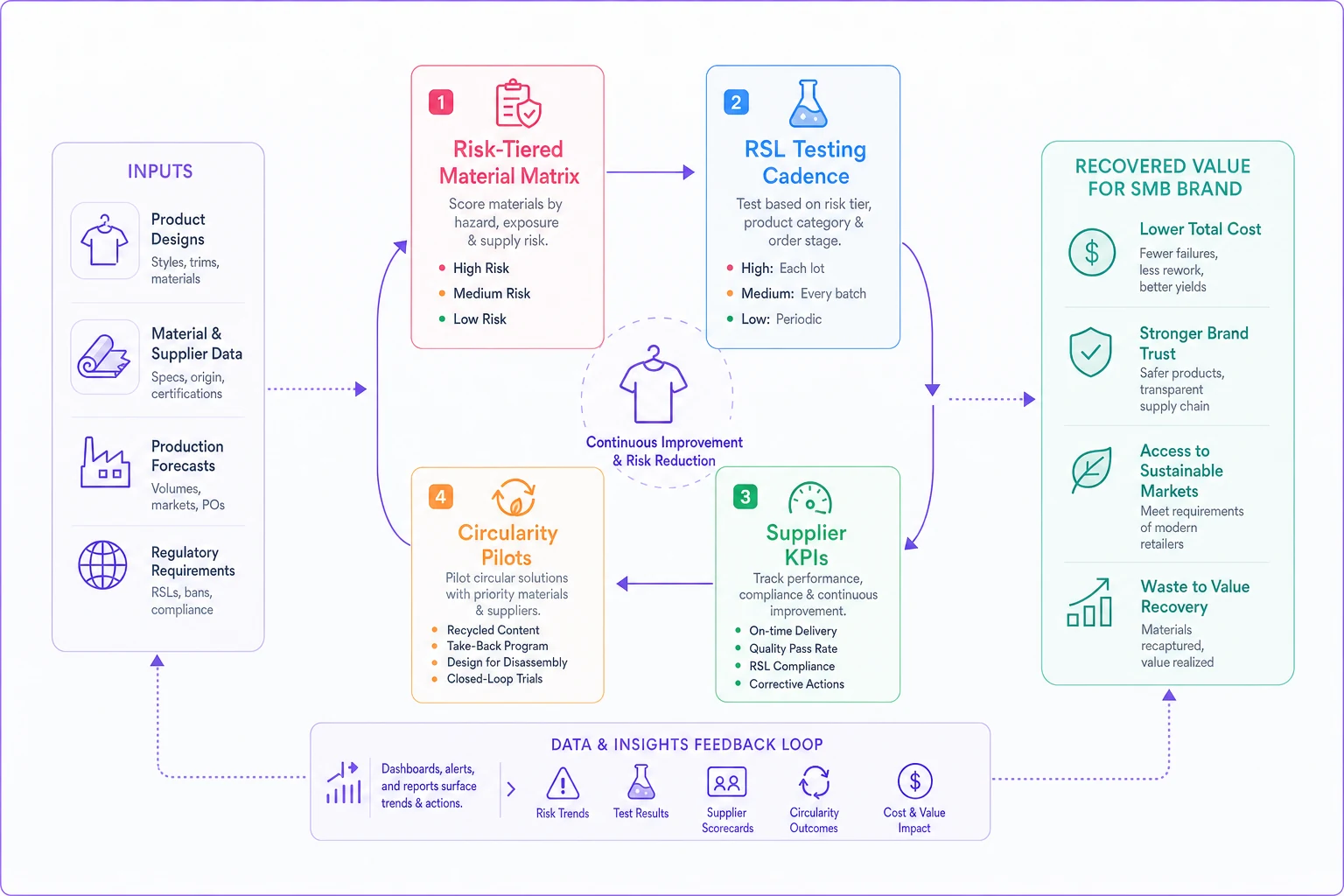
None of these pieces work in isolation, and that's really the point. The risk matrix decides your RSL cadence. The RSL cadence feeds your supplier KPIs. The KPIs tell you which suppliers can support circularity pilots. The pilots produce recovered value that funds the testing. Material-level evidence storage ties the whole thing together, because it's the connective tissue between traceability, compliance, and recovery.
The brands that struggle treat each of these as a separate project with a separate owner and a separate spreadsheet. The ones that make sustainable operations stick at SMB scale treat it as one system with shared records — one place where a material's tier, its evidence, its expiry, its supplier, and its recovery path all live together. That's the difference between a program that survives a staffing change and one that dies the moment the person who built it gets busy.
Start with the twelve SKUs that scare you most, document only what you'd defend, and let the recovered value pay for the rest.
Start with the twelve SKUs that scare you most, document only what you'd defend, and let the recovered value pay for the rest.
Ready to tailor your apparel operations?
Join 500+ fashion brands using GoTailo to accelerate product launches, reduce waste, and improve supplier collaboration.