


Most apparel procurement teams don't actually manage sourcing. They manage emergencies. A fabric price jumps, so someone scrambles. A factory misses a window, so someone re-sources. A buyer finds a cheaper trim, they switch — and three seasons later nobody remembers why the zipper spec changed or why that supplier is suddenly 40% of your knit volume.
That's not category management. That's reactive buying dressed up with a spreadsheet.
The difference between the two shows up most clearly at scale. A small brand running 60–80 SKUs can get away with gut-feel sourcing because one person holds the whole picture in their head. Push that same operation to 400 SKUs across four product families and six countries, and the gut-feel approach quietly starts leaking margin everywhere — duplicate suppliers, inconsistent payment terms, no leverage on commodity fabrics, and premium categories treated like transactional ones.
This article is about the system underneath good sourcing: how you split your spend into categories, how you decide what gets a deep strategic relationship versus a quick transactional buy, how you govern total cost of ownership instead of just unit price, and what rhythm keeps the whole thing from drifting back into chaos.
Why apparel sourcing fragments as you grow
The fragmentation almost always follows the same path.
Early on, sourcing is personal. You know your fabric mill owner. You text your sewing factory directly. Pricing lives in your head or an email thread. This works fine because volume is small and the relationships are few.
Then growth hits unevenly. Woven volume triples before knits do. Someone launches an outerwear capsule that needs an entirely new supplier base. A retailer program forces tighter margins, so procurement starts chasing cheaper trims across a dozen vendors. Each decision is rational on its own. Added together, they produce a sourcing map nobody actually designed.
The real cost of this fragmentation isn't always the obvious stuff. It's the invisible stuff:
-
You're buying the same interlining from three suppliers at three different prices because three buyers sourced it independently.
-
Your highest-margin program depends on a factory you treat like a commodity vendor, giving you zero relationship cushion when capacity tightens.
-
A low-value, high-frequency trim category eats more team hours than your strategic fabric partnerships do.
The core problem is that not all spend should be managed the same way. Treating every supplier relationship identically is the root cause of both over-investment (burning negotiation energy on things that don't matter) and under-investment (leaving critical relationships exposed).
The three category playbooks
Category management starts by sorting your spend into three buckets, each with its own playbook. The sorting logic is simple on paper but gets ignored constantly: how much does this spend matter to the business, and how hard is it to switch?
Eliminate delays in your fashion production cycle.
GoTailo helps you manage designs, orders, and inventory effortlessly, keeping production on schedule.
- Centralized order and inventory management
- Real-time supplier communication
- Integrated production scheduling
No credit card required
| Category type | Characteristics | Example in apparel | How you manage it |
|---|---|---|---|
| Strategic | High spend, high risk/complexity, hard to switch | Signature performance fabric, key cut-and-sew factory for your margin program | Deep partnership, joint planning, multi-year view, shared forecasts |
| Preferred | Meaningful spend, moderate switching cost, some differentiation | Standard knit bodies, core denim, repeat trims across collections | Shortlist of 2–3 qualified vendors, annual pricing, performance scorecards |
| Transactional | Low spend or low complexity, easy to switch, commodity | Generic thread, poly bags, basic care labels, standard hangtags | Minimal relationship, competitive quotes, automate reordering |
The mistake teams make is assuming dollar amount decides the bucket. It doesn't. A low-dollar component can be strategic if it's a single-source specialty — a proprietary coating, a specific hardware finish. A high-dollar commodity fabric can be transactional if ten mills can make it to spec tomorrow.
Switching difficulty is the dimension people consistently underweight. When your margin depends on a factory that's the only one holding your proven patterns, sampling history, and fit corrections — that's strategic regardless of what the PO total says.
Strategic playbook
Strategic categories get the opposite of a competitive bidding war. You're trying to deepen, not shop around. That means shared production calendars, early visibility into fabric commitments, capacity reservations before the season locks, and a genuine two-way relationship where you flag problems early and they do the same.
The investment here is time, not just money. Quarterly business reviews, co-development, treating their constraints as your constraints. If your strategic fabric partner has a six-week dye-lot minimum, that goes into your assortment planning — you don't fight it every season.
Preferred playbook
Preferred categories live in the middle, and this is where most teams get the best ROI on structure. Keep a qualified shortlist — usually two or three vendors — so you have leverage and a backup, but you're not re-sourcing from scratch every season. Annual pricing agreements, consistent scorecards, and a clear primary vs. secondary split by volume keep these efficient.
This is also the tier where supplier scorecards and a tiered remediation loop do the most work. Preferred vendors are good enough to keep but not so irreplaceable that you tolerate slipping performance. A scorecard gives you the structured basis to shift volume between primary and secondary when quality or delivery starts drifting.
Transactional playbook
Transactional categories should barely touch a human. The goal is spending as little attention as possible. Standardize the spec, pre-qualify a couple of sources, set reorder triggers, and let it run. The failure mode here is overthinking — teams negotiate poly bag pricing to the third decimal while a strategic fabric contract sits unreviewed for two years.
Deciding which bucket a category belongs in
A simple decision tree saves a lot of arguing. Run each category through these questions in order:
-
If this supplier disappeared tomorrow, could we replace them within one season without hurting our product or margin? - No → lean strategic. - Yes → keep going.
-
Is this spend large enough that a 5–10% price change moves our product margin meaningfully? - Yes → at least preferred, possibly strategic if also hard to switch. - No → keep going.
-
Does this component carry quality, compliance, or brand risk if it fails? - Yes → preferred at minimum (a failed care label or non-compliant trim can trigger returns and chargebacks). - No → transactional.
-
Is the item standardized across the industry, with multiple qualified sources? - Yes → transactional, automate it. - No → preferred, keep a managed shortlist.
The output is a clean category map: every meaningful line of spend assigned to a playbook, with a named owner. The named owner part matters more than it sounds. Unowned categories are the ones that drift into fragmentation, because when nobody's accountable, everybody sources independently.
When this framework is overkill
If you're running a single product line with under 100 SKUs and fewer than ten suppliers, formal category segmentation is probably more structure than you need. You'll spend more time maintaining the framework than it saves. The honest threshold is usually around the point where no single person can hold the full supplier map in their head — multiple product families, or spend spread across enough vendors that duplication starts creeping in.
TCO governance: what unit price hides
The second half of real category management is governing total cost of ownership, not unit price. This is where apparel teams bleed margin without seeing it, because the cheapest quote almost never has the cheapest true cost.
Total cost of ownership for a sourced component or factory relationship includes things that never show up on the quote:
-
Quality cost — defect rates, rework, rejected lots, inline failures that eat your window.
-
Logistics cost — freight mode forced by a late supplier, duties, consolidation inefficiency.
-
Working capital cost — payment terms, minimum order quantities that force you to carry inventory, dye-lot minimums.
-
Switching and ramp cost — sampling cycles, fit corrections, the weeks it takes a new factory to hit stable yield.
-
Risk cost — single-source exposure, lead-time volatility, compliance gaps.
A typical example looks like this: a buyer switches a knit body to a supplier that's about $0.60 cheaper per unit on a 20,000-unit program. That's roughly $12k of apparent savings. But the new supplier runs a 3% higher defect rate, needs air freight once to recover a slipped date, and demands payment terms 30 days tighter. Add up the rework, the air freight premium, and the working capital hit — the "savings" turns into a net loss north of $8k on a decision that looked like a win in the quoting spreadsheet.
TCO governance means every strategic and preferred sourcing decision gets evaluated on landed, lifetime cost — not the number on the quote. For transactional categories, unit price is fine; the TCO differences are small enough to ignore. Reserve the deeper analysis for where it actually moves the needle.
A simple TCO scoring approach
You don't need a complex model. For strategic and preferred decisions, score each option across four weighted factors:
-
Unit price (landed, including freight and duty)
-
Quality track record (defect rate, historical rework)
-
Reliability (on-time delivery, lead-time variance)
-
Terms (payment days, MOQ flexibility)
Weight them to match the category. For a margin-critical program, quality and reliability might carry more weight than price. For a preferred commodity, price weighs heavier. The point isn't precision — it's forcing the conversation past unit price before a decision gets made.
The quarterly rhythm that keeps it from drifting
A category framework built once and never revisited is worthless within two seasons. Suppliers change, spend shifts, the map goes stale. The thing that keeps category management alive is a governance cadence — a predictable rhythm of reviews that forces the team to look up from firefighting.
A workable cadence for a growing apparel team:
Monthly
-
Review transactional reorder triggers and flag any price creep.
-
Check open scorecard flags on preferred suppliers.
Quarterly
-
Strategic supplier business reviews — capacity outlook, shared forecasts, joint problem-solving.
-
Re-score preferred vendors and rebalance primary/secondary volume splits if performance has shifted.
-
Review any category that's changed buckets (a growing capsule that's now big enough to move from transactional to preferred).
Annually
-
Full category map refresh — re-run every line through the decision tree.
-
Re-negotiate preferred pricing agreements.
-
Assess single-source exposure across strategic categories and decide where to build a backup.
The quarterly rhythm is the heartbeat. Strategic business reviews in particular are where most teams find their biggest wins — not in negotiation, but in early visibility. When your strategic fabric partner tells you in Q2 that a raw material is tightening, you can adjust your Q4 assortment before it becomes a crisis.
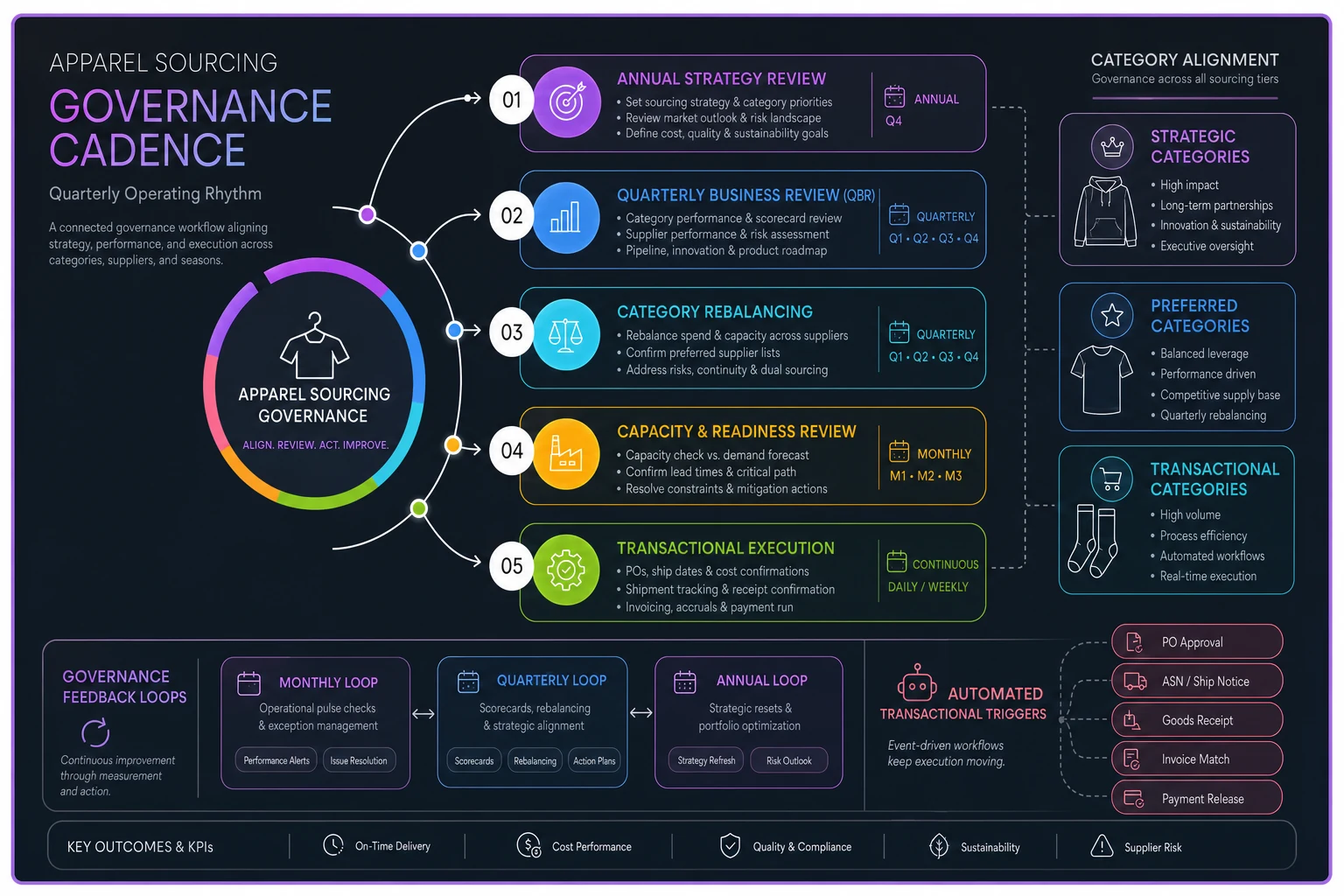
A simple visual of the cadence helps the team remember who owns each review and what output is expected.
Where this connects to the rest of your operation
Category management doesn't live in a vacuum. It feeds your capacity planning, your risk posture, and your financial predictability.
The clearest connection is resilience. A well-segmented supplier base is the foundation for handling disruption — when you already know which relationships are strategic and which are swappable, your capacity-profiled design and tactical failover playbooks have something solid to stand on. You can't build sensible failover plans if you don't know which suppliers are actually hard to replace.
It also connects to capacity planning. Your strategic factory relationships should be feeding capacity reservations into your production calendar. If merchandising keeps planning drops your strategic partners can't absorb, the segmentation exposes that mismatch early instead of at the PO stage.
And it feeds finance directly. TCO governance is really margin governance — knowing your true landed cost per program is what makes your P&L predictable instead of a quarterly surprise.
A real scenario
A mid-sized womenswear brand — roughly 350 active SKUs, around $9M in annual sourced spend across five countries — had grown entirely through relationship-based buying. No category map. Three buyers sourcing independently.
When they finally mapped their spend, a few things jumped out immediately. They were buying essentially the same interlining from four suppliers at prices ranging about 18% apart. Their highest-margin dress program — nearly a quarter of total contribution margin — ran through a factory they'd never done a formal business review with and had no backup for. And their buyers were collectively spending a significant chunk of their week re-sourcing commodity trims that could have been on autopilot.
They didn't overhaul everything at once. They started by segmenting, assigning owners, and setting a quarterly review. Within two seasons the duplicate interlining buys consolidated into a single preferred source, saving a mid-five-figure amount annually. The at-risk dress factory got a formal strategic review and a qualified secondary source stood up as insurance. Commodity trim buying got standardized and templated, freeing up roughly a day a week of buyer time.
Nothing dramatic happened in any single week. But the sourcing stopped being a series of surprises.
Keeping the system running without drowning in spreadsheets
The honest challenge with category management is maintenance. The framework is simple; keeping it current across hundreds of SKUs and dozens of suppliers is where it quietly dies. Scorecards go unupdated, the map drifts, and six months later you're back to reactive buying.
This is where centralizing the operational data behind sourcing actually earns its keep. When supplier performance, landed cost, lead-time variance, and category assignments live in one connected system rather than scattered across personal spreadsheets, the quarterly re-scoring takes an afternoon instead of a week — and scorecard flags surface on their own instead of waiting for someone to notice.
Keep scorecards focused on a few leading indicators so updates are quick and actionable.
The point isn't fancy technology; it's that the governance cadence only survives if the data feeding it isn't a manual chore every quarter. A workflow platform that keeps category maps, TCO inputs, and supplier scorecards in one place is what turns category management from a one-time project into a standing operating habit.
The takeaway
Sourcing category management isn't about sophistication — it's about matching your effort to what each category actually deserves. Strategic relationships get depth. Preferred categories get structure and competition. Transactional categories get automated out of your attention. Layer TCO governance on top so you're deciding on real landed cost, and hold it together with a quarterly rhythm that forces you to look up before problems become emergencies.
The brands that do this well aren't the ones with the cheapest quotes. They're the ones who always seem to have capacity when it tightens, who rarely get surprised by a supplier failure, and whose margins don't mysteriously erode season over season. That calm isn't luck. It's the system underneath doing its job.
Ready to tailor your apparel operations?
Join 500+ fashion brands using GoTailo to accelerate product launches, reduce waste, and improve supplier collaboration.