


You know that stomach-drop feeling when your fabric supplier casually mentions they're "running a bit behind" three weeks before your spring collection launches? Or when your button vendor goes radio silent after confirming a 14-day lead time that's now stretched to 35 days?
This isn't about occasional delays. This is about the chronic vendor lead time variability apparel brands face when suppliers treat deadlines as suggestions rather than commitments. The kind of variability that turns a profitable season into a markdown disaster.
Most apparel businesses handle vendor delays reactively — scrambling for alternatives, eating rush charges, or worse, missing launch windows entirely. But there's a different approach that changes the entire dynamic: measuring lead time distribution patterns at the supplier level and building operational playbooks around what the data actually tells you.
The hidden mathematics of vendor reliability
Average lead times tell you almost nothing useful about vendor performance.
A zipper supplier with an "average" 21-day lead time might deliver 80% of orders between days 18-23. That's manageable. Another supplier with the same 21-day average might deliver anywhere from 12 to 45 days. That second supplier will destroy your production schedule, even though both look identical on paper.
The real metric that matters is lead time distribution — specifically the tail risk hiding in that distribution. One supplier delivering 5% of orders more than 10 days late creates more operational chaos than another supplier who's consistently 3 days behind schedule.
I worked with a streetwear brand that kept missing drops despite "conservative" planning. They padded all vendor lead times by 25%. Still missed launches. The problem? Their main fabric supplier had a tail risk problem — about 8% of orders came in 30+ days late, completely outside their planning window.
Once they started tracking distribution patterns, everything became clear. Their trim suppliers were rock-solid (95% within 3 days of promise date) while their primary fabric vendor was essentially random after day 20. This data completely changed how they structured production.
Building your vendor measurement framework
Stop tracking vendors in spreadsheets with color-coded cells. You need actual distribution data to make this work.
Eliminate delays in your fashion production cycle.
GoTailo helps you manage designs, orders, and inventory effortlessly, keeping production on schedule.
- Centralized order and inventory management
- Real-time supplier communication
- Integrated production scheduling
No credit card required
-
Promise date vs actual delivery for every order
-
Distribution percentiles (50th, 75th, 90th, 95th)
-
Tail risk percentage (orders beyond 95th percentile)
-
Seasonal variation patterns
-
Order size impact on timing
Basic tracking setup looks like this:
| Supplier | Orders Tracked | P50 (days) | P75 (days) | P90 (days) | P95 (days) | Tail Risk % |
|---|---|---|---|---|---|---|
| FabricCo A | 47 | 18 | 22 | 28 | 35 | 8.5% |
| TrimMax B | 62 | 14 | 15 | 17 | 19 | 3.2% |
| ButtonPro C | 38 | 21 | 24 | 31 | 42 | 10.5% |
ButtonPro C is your biggest risk, despite having a similar median lead time to FabricCo A. That 10.5% tail risk means one in ten orders will blow up your timeline.
Track this for 6-8 months minimum. Less data gives you false confidence. Seasonal suppliers need full-year tracking to catch variation patterns.
Prioritize full-year tracking for seasonal suppliers to surface true variation patterns.
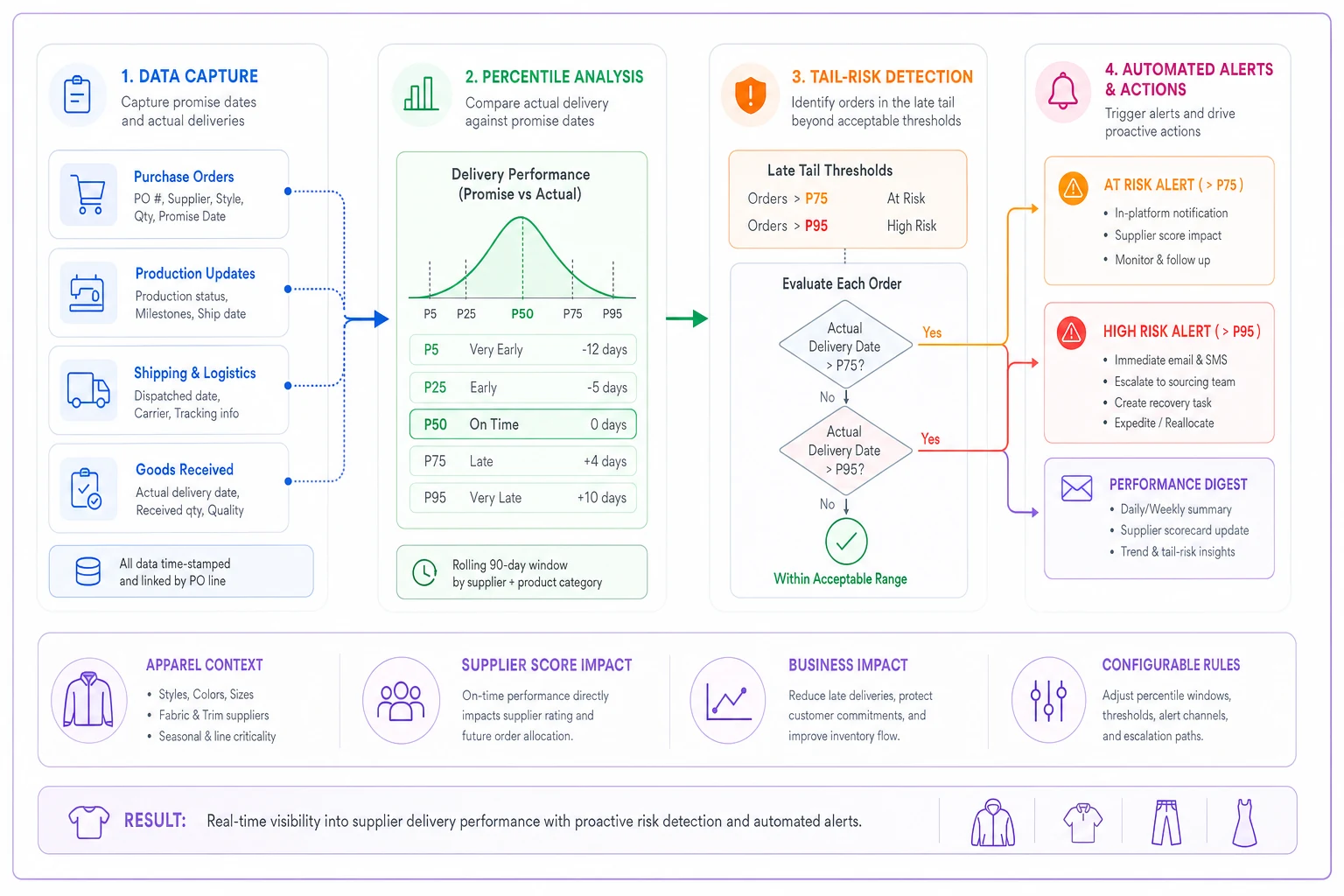
This simple workflow keeps measurement actionable: capture promise vs actual, compute percentiles, flag tail-risk suppliers, and trigger operational playbooks.
Supplier-specific operational playbooks
Generic supplier management doesn't work when each vendor has different reliability patterns. You need specific playbooks based on measured behavior.
For high-variability suppliers (tail risk >8%):
Never use these suppliers for critical-path items. If you must use them, implement parallel sourcing — place the same order with a backup supplier when tail risk probability exceeds your tolerance threshold.
One denim brand automated this: any fabric order from suppliers with >10% tail risk automatically triggered a 30% backup order from their secondary supplier. Yes, they occasionally had excess inventory. But they never missed a launch window again.
-
Graduated late penalties starting at P75 delivery time
-
Automatic order cancellation rights at P90
-
Pre-negotiated rush production rates for recovery scenarios
For moderate-variability suppliers (tail risk 4-8%):
These suppliers need active management but don't require extreme measures. Build checkpoint systems around their P75 timing.
-
50% of P50 time (early warning)
-
75% of P50 time (escalation trigger)
-
P75 time (backup activation)
A sustainable fashion brand implemented this with their midrange suppliers. They built a simple tracking system that automatically requested status updates at these checkpoints. Suppliers who missed checkpoint responses triggered immediate phone calls. This early warning system caught 70% of delays before they became critical.
For low-variability suppliers (tail risk <4%):
These are your operational anchors. Structure production around their reliability.
-
Priority production slots
-
Locked pricing periods
-
Dedicated account management
-
First access to capacity during peak seasons
Don't waste time micromanaging these relationships. One athletic apparel startup spent hours weekly checking on their most reliable supplier while ignoring early warning signs from problematic vendors. Classic attention misallocation.
Contract mechanics that actually protect you
Standard vendor contracts are written for perfect-world scenarios. You need contracts that reflect measured reality.
The sliding-scale delivery clause:
Instead of a single delivery date with a flat penalty, structure penalties around your measured percentiles:
-
On-time to P50
Full payment
-
P50 to P75
2% discount
-
P75 to P90
5% discount
-
P90 to P95
10% discount
-
Beyond P95
15% discount + cancellation option
This isn't about punishment — it's about aligning vendor incentives with your operational reality. Suppliers learn quickly that consistency pays better than occasional fast delivery with frequent delays.
The capacity reservation swap:
For high-tail-risk suppliers you can't avoid, negotiate capacity reservation swaps. You reserve production capacity with payment, but can swap specific products/materials up to 14 days before production start.
A boutique label used this with their unreliable-but-unique textile supplier. They'd reserve three production slots per quarter, then decide which products to run based on what materials actually arrived on time. This turned vendor variability from a crisis into a manageable constraint.
The graduated commitment structure:
Start new suppliers with short-term, small-batch contracts. Increase commitment levels based on measured performance:
-
First 6 months
Order-by-order, no commitment
-
Months 7-12
Monthly commitment if tail risk <8%
-
Year 2+
Quarterly commitment if tail risk <5%
This protects you from getting locked into relationships with vendors whose reliability looks good initially but degrades over time.
Buffer strategies that match your risk profile
The classic "add 20% to all timelines" approach wastes time and capital. Smart buffering means different strategies for different risk profiles.
Time buffers vs inventory buffers:
High-variability suppliers need time buffers — start production earlier for these components. Low-variability suppliers can use inventory buffers — keep safety stock of standardized items.
-
Custom hardware (high variability)
45-day time buffer
-
Standard zippers (low variability)
15% inventory buffer
-
Signature fabric (moderate variability)
30-day time buffer + backup supplier option
This targeted approach freed up $180k in working capital compared to their previous "buffer everything equally" strategy.
The cascade buffer system:
Structure production so delays cascade into less critical areas. Place high-variability components early in production when you have maximum flexibility.
-
Highest tail-risk items (custom materials, specialty components)
-
Moderate-risk items (standard materials with customization)
-
Low-risk items (commodity components)
This gives you maximum reaction time for problematic suppliers while avoiding unnecessary inventory on reliable items.
Real-world implementation story
A children's clothing brand with about $3M annual revenue completely restructured their vendor management after tracking lead time distributions for eight months.
Their biggest supplier (40% of materials spend) showed brutal tail risk — 12% of orders arrived more than 30 days late. Their initial instinct was to find a new supplier. But the data showed something interesting: orders placed during their supplier's off-peak season had only 3% tail risk.
Instead of switching suppliers, they restructured their entire production calendar. They moved 70% of orders to off-peak periods, accepting slightly higher unit costs for dramatically better reliability. For peak-season needs, they dual-sourced with a more expensive but reliable backup.
-
On-time launch rate increased from 65% to 91%
-
Rush shipping costs dropped by approximately $67k
-
Markdown rates on late deliveries decreased from 18% to 7%
-
Overall margin improvement of roughly 3.5 points
They weren't finding perfect suppliers — they measured what they actually had and built operations around reality instead of promises.
The technology layer that makes this scalable
Manual tracking breaks down around 10-15 active suppliers. Beyond that, you need systematic measurement and alerting.
The core system needs just three components:
-
Delivery performance tracking (promise vs actual)
-
Automated percentile calculation
-
Alert generation for checkpoint misses
AI-powered operational software makes a massive difference here. Instead of manually updating spreadsheets and calculating distributions, modern platforms automatically track deliveries, calculate real-time percentiles, and flag suppliers trending toward their tail risk zones.
The automation handles the mundane tracking while you focus on relationship management and strategic sourcing decisions. One platform implementation typically replaces 15-20 hours per week of manual vendor performance tracking with automated reporting and smart alerts when suppliers deviate from their historical patterns.
Common implementation mistakes
Mistake 1: Starting with too many metrics
Pick three core metrics initially. Add complexity only after the basics are working. A startup tried tracking 27 different vendor metrics from day one. They ended up with beautiful dashboards and zero actionable insights.
Mistake 2: Ignoring seasonal patterns
Many suppliers have predictable seasonal variation. A swimwear brand nearly ditched their best supplier because they measured performance during Chinese New Year. Always track full-cycle data before making structural changes.
Mistake 3: Over-optimizing reliable suppliers
Don't waste energy squeezing an extra day from suppliers with 3% tail risk. Focus optimization efforts where the variance actually hurts you.
Mistake 4: Sharing data incorrectly
Never share comparative supplier performance directly. Share individual performance against their own historical baseline. This encourages improvement without creating adversarial dynamics.
Moving forward with measured confidence
Vendor lead time variability in apparel isn't going away. Global supply chains, seasonal demand, and capacity constraints guarantee that promises and reality will continue to diverge.
But you don't need perfect suppliers to run reliable operations. You need to know exactly how imperfect each supplier is, then build systems that account for that specific imperfection.
Start simple: Pick your five most critical suppliers. Track their actual delivery performance for the next quarter. Calculate basic percentiles. Build one operational adjustment around what you learn.
That single adjustment — based on measured reality rather than hopeful assumptions — will likely save more launches than any amount of supplier negotiation or relationship management.
Because in the end, vendor reliability isn't about getting suppliers to change. It's about building operations that thrive despite their variability. And that starts with measuring what you're actually dealing with, not what you wish you had.
Because in the end, vendor reliability isn't about getting suppliers to change. It's about building operations that thrive despite their variability. And that starts with measuring what you're actually dealing with, not what you wish you had.
Ready to tailor your apparel operations?
Join 500+ fashion brands using GoTailo to accelerate product launches, reduce waste, and improve supplier collaboration.