


Running a 120-SKU apparel line where design finishes in March but production samples don't start until May because someone forgot to check fabric minimums against actual order quantities. Multiply that across six seasonal collections and three contract manufacturers who each interpret "ready for production" differently.
This disconnect between creative calendars and production reality destroys more small apparel brands than cash flow problems or marketing failures. It's the inability to connect what designers draw in February to what ships in September.
Most brands don't realize they're operating with broken handoffs until they're explaining to Nordstrom why their fall collection will arrive three weeks into October.
Why design and production speak different languages (and always will)
Design teams work backwards from market dates. They think "buyers need to see this in March showrooms" so they plan creative development for December through February. Makes complete sense from their perspective.
Production teams work forward from material availability. They think "if fabric arrives week 12, cutting starts week 14, sewing completes week 18." Equally logical.
Between these two timelines sits a void where nobody owns the translation. Design assumes production will figure it out. Production assumes design already checked feasibility. Both assume someone else is managing the dependencies.
Your design team finalizes a collection with specialty zippers that have 16-week lead times. They picked them in week 8, assuming standard 4-week sourcing. Nobody catches this until week 11 when production goes to order materials. Now your entire delivery window shifts by three months, or you scramble to redesign around available trims.
A typical 8-style collection has around 47 decision points between initial sketch and bulk production. Most brands formally track maybe 12 of them. The other 35 happen in email threads, WhatsApp messages, and "quick calls" that nobody documents.
The four gates that actually matter (ignore the rest)
Complicated stage-gate systems kill more collections than they save. You need exactly four hard stops where nothing moves forward until specific criteria are met.
Eliminate delays in your fashion production cycle.
GoTailo helps you manage designs, orders, and inventory effortlessly, keeping production on schedule.
- Centralized order and inventory management
- Real-time supplier communication
- Integrated production scheduling
No credit card required
Gate 1: Design Release This isn't when designers feel done. It's when you have:
-
Final technical drawings with all measurements
-
Complete bill of materials with supplier codes
-
Fabric swatches physically approved (not just digital)
-
Trim cards with actual samples attached
-
Grading rules specified for all sizes
Without these five elements, you don't have a design. You have an idea that production will spend the next three months trying to reverse-engineer.
Gate 2: Sourcing Confirmation Before any sampling begins, confirm:
-
All materials available in required quantities
-
Lead times locked with deposit dates
-
Minimums checked against actual order projections
-
Backup options identified for critical materials
-
Price confirmations in writing from all suppliers
Miss any of these and you'll discover in week 14 that your signature fabric requires 3,000-yard minimums when you only need 800.
Gate 3: Pre-Production Sample Approval Not the pretty sample for sales. The actual production sample that shows:
-
Construction methods your factory will actually use
-
Finishing quality at production speeds
-
Fit on your actual size curve, not just the fit model
-
Trim placement when sewn at normal operator pace
-
Wash/care testing results if applicable
Most brands skip straight from sales samples to bulk production, then wonder why quality varies by 30% between shipments.
Gate 4: Production Release Only after you have:
-
Final approved sample in each colorway
-
All materials physically at factory
-
Capacity slot confirmed with specific dates
-
Quality standards documented with photos
-
Packing and shipping specifications detailed
Without confirmed factory capacity, your materials sit in a warehouse while three other brands jump ahead in the production queue.
Each gate builds on the previous one. Skip one checkpoint and problems cascade through your entire timeline.
Building your RACI map (without the corporate nonsense)
RACI matrices usually become wall decorations that nobody references. What actually works: map just the handoff points between gates, not every minor task.
For each gate, you need exactly three roles:
The Decider - Single person who says yes/no to proceed. No committees. No group consensus. One name.
The Checker - Person who validates all requirements are met. Usually someone operational who understands both creative and production constraints.
The Informed List - Everyone who needs to know but can't override. Keep this under five people or communication breaks down.
For a typical 40-person apparel brand:
| Gate | Decider | Checker | Informed |
|---|---|---|---|
| Design Release | Creative Director | Production Manager | Sales, Sourcing, Planning |
| Sourcing Confirmation | COO or Owner | Sourcing Lead | Design, Finance, Production |
| Pre-Production Sample | Production Manager | Quality Lead | Design, Sales, Warehouse |
| Production Release | COO or Owner | Production Manager | Everyone customer-facing |
Notice what's missing? No "consulted" category. No "supports" designation. No "contributes" role. These fuzzy categories create delays while everyone waits to see who actually makes decisions.
The power comes from the Checker role. This person becomes your early warning system. They're not making strategic decisions, just validating that tactical requirements are complete. When the Checker says something's missing, it doesn't move forward. Period.
Clear ownership prevents the delays that kill timelines. Instead of three people assuming someone else will handle a decision, one person owns it completely. Instead of endless email chains about approval status, one person checks the boxes and signals go or no-go.
Your materials tracker needs these seven fields (skip everything else)
Most brands track materials in spreadsheets that would make a database administrator weep. 47 columns of information where 6 would do the job better.
The fields that actually prevent delays:
-
Material code - Your internal reference, not the supplier's
-
Supplier confirmation date - When they actually confirmed, not when you asked
-
Required delivery date - Based on production schedule, not hopes
-
Minimum order quantity - The real number, not the "sometimes flexible" one
-
Current location - In transit, at supplier, at factory, etc.
-
Backup option - Specific alternative, not "TBD"
-
Order status - Ordered/confirmed/shipped/received
Everything else — color descriptions, inspiration photos, sustainability certificates — belongs in other documents. Your materials tracker should answer one question: will materials be where they need to be when production starts?
Brands with gorgeous 200-field databases miss deliveries because nobody can quickly see that three key fabrics were sitting in customs for two weeks. Meanwhile, brands running simple 7-column Google Sheets ship on time because everyone can instantly spot delays.
The tracker lives or dies on real-time updates. If sourcing forgets to update status for a week, the entire system becomes worthless. Build daily status updates into someone's job description, or the data will decay within two weeks.
Build daily status updates into someone's job description, or the data will decay within two weeks.
Build daily status updates into someone's job description, or the data will decay within two weeks.
The production calendar that design teams will actually read
Design teams ignore Gantt charts. They're visual people who think in collections and stories, not task dependencies and critical paths. What actually gets used:
Create a single visual calendar showing design deadlines in one color, material deadlines in another, production milestones in a third, and shipping dates in a fourth.
No tasks. No subtasks. No percentage complete. Just the hard dates that matter for each style.
Under each date, list exactly what must be complete. Not "finalize design" but "tech pack uploaded with all measurements." Not "order fabric" but "fabric PO sent with deposit paid."
Mount this calendar where design and production teams cross paths. Update it weekly in a standing 15-minute review. When design wants to add a style or change a detail, point to the calendar and ask which dates they want to move.
This visual simplicity forces real trade-off discussions. Adding that hand-embroidered detail? Show them how it pushes delivery into the next selling season. Want to squeeze in two more colorways? Point to the fabric minimum that just doubled.
Everyone understands cause and effect when they can see it. Abstract dependencies become concrete timeline impacts.
Decision speed at each gate (the metric nobody measures)
Most brands track whether gates are hit but ignore how long decisions sit in limbo. The real killer isn't missing gates — it's taking 11 days to make a decision that should take 11 minutes.
Track "decision lag" at each gate: When were all requirements met? When was the decision actually made? What was the gap?
A healthy design-to-delivery production planning apparel system shows these patterns:
-
Gate 1 decisions within 48 hours
-
Gate 2 decisions within 3 business days
-
Gate 3 decisions within 24 hours
-
Gate 4 decisions same day
Anything longer and you're adding hidden weeks to your timeline. A 5-day decision delay at each gate means 20 days of completely preventable delay — almost a full month of production time.
The fix isn't faster decision-making. It's clearer criteria. When everyone knows exactly what "approved" means at each gate, decisions become binary. Either requirements are met or they're not. No lengthy debates about whether something is "good enough."
Slow decisions usually indicate unclear standards, not careful consideration. When approval criteria are specific, the Checker can validate completeness in minutes instead of days.
How handoff failures compound through production
A fuzzy handoff from design to sourcing creates problems that multiply through your entire production cycle. What starts as "we'll figure out the zipper color later" becomes a cascade of delays, rushed decisions, and quality compromises.
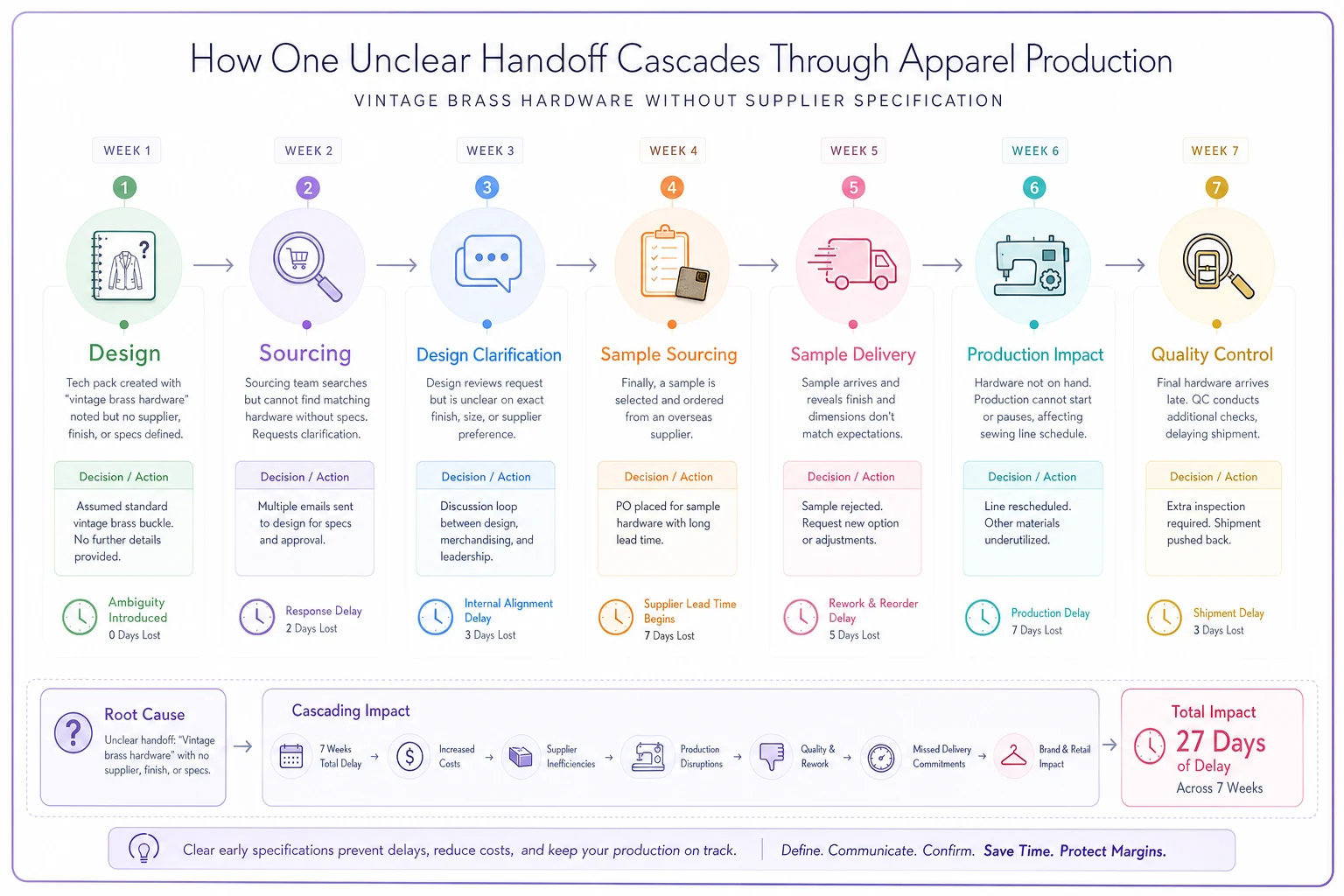
Design hands off a tech pack with "vintage brass" hardware but no supplier specified. Sourcing finds three options, each with different lead times and minimums. They email design, who's now deep in next season. Two weeks pass. Design picks option 2. Sourcing orders, but the supplier only has 70% of needed quantity. Another week of emails. Design approves mixing batches, creating color variation. Production receives mixed hardware, spends three days sorting. Quality control flags the variation. Production manager calls a meeting. Design insists on consistency. Sourcing scrambles for alternatives. Three weeks gone.
That single undefined detail just cost you 6-7 weeks of timeline. Multiply this by 47 decision points across 8 styles, and you understand why brands routinely miss delivery windows by months, not days.
Strong handoffs have three characteristics: Completeness means every required element is present with no "TBD" fields or "confirm later" notes. Clarity means specifications use production language, not creative interpretation. Confirmation means the receiving party explicitly accepts or rejects with written acknowledgment.
The compounding effect works in reverse too. Clean handoffs save time that accumulates across your timeline. Clear specifications prevent questions. Complete requirements eliminate back-and-forth. Confirmed acceptance removes uncertainty.
When this framework breaks (and what to do instead)
This structured approach works beautifully for brands running 6-12 styles per season with relatively stable suppliers. But certain scenarios require different approaches.
Ultra-fast fashion models that drop new styles weekly find formal gates create bottlenecks. Instead, run parallel tracks where design works 3-4 weeks ahead while production handles current releases. The gates become continuous checkpoints rather than hard stops.
Single-piece or small-batch production under 50 pieces per style makes formal gate overhead exceed their value. Focus on a simple two-step confirmation: design complete, materials ready. Everything else becomes fluid coordination.
Capsule collections with retail partners mean you're following their process when Target wants an exclusive 3-piece collection with their timeline. Keep your framework for your mainline and adapt to partner requirements as needed.
Made-to-order models shift gates to customer touchpoints since design happens once, then each order triggers a simplified production flow without repeated approvals.
The framework isn't religious doctrine. It's scaffolding that should support your specific operation.
Don't try to force incompatible business models through the same process. But don't abandon structure entirely just because one collection requires flexibility.
The visibility layer that changes everything
Most brands operate with selective blindness. Design sees design tasks. Production sees production tasks. Nobody sees the full connection from sketch to shipment.
Real design-to-delivery production planning apparel visibility means everyone can answer three questions about any style at any moment: Where is it now? What's blocking forward movement? When will it reach the next gate?
This doesn't require complex software initially. A shared document with daily updates beats sophisticated systems that only two people understand. The key is making status visible by default, not by request.
When information flows automatically, behavior changes. Design stops asking production for updates because they can see status directly. Production stops chasing design for approvals because pending decisions are visible. Sourcing stops sending "urgent" emails because everyone sees material delays immediately. Sales stops promising dates that production hasn't confirmed.
This transparency feels uncomfortable at first. Delays become visible. Bottlenecks get names attached. Decision lag gets measured. But this discomfort drives improvement faster than any amount of process documentation.
Eventually, manual tracking hits its limit. When you're running 30+ styles across multiple seasons, spreadsheets break down completely. That's when AI-powered operational software becomes transformative — not as a crutch for bad processes, but as acceleration for good ones. These platforms can track dependencies you'd never catch manually, flag delays before they cascade, and suggest resequencing when constraints change. But they only work when you already have the fundamental framework in place.
What changes at 20, 50, and 100+ SKUs
The framework scales, but your focus points shift dramatically as complexity grows.
At 20 SKUs, one person can hold the entire system in their head. Gates can be slightly flexible if the Decider understands implications. Weekly reviews catch issues adequately while email and spreadsheets handle coordination fine.
At 50 SKUs, mental tracking breaks down completely. Gates must be rigid or chaos emerges. Daily status updates become mandatory. You need a dedicated coordination role that may not be full-time yet. Communication moves to purpose-built tools, not general channels.
At 100+ SKUs, multiple collections run simultaneously through different gates. You need specialized roles for each gate as gate managers. Exception handling becomes a full workflow. Automation isn't optional since manual tracking will fail. Pattern recognition across styles drives efficiency gains.
The interesting shift happens around 75 SKUs. Below this, a strong operator can power through with determination and long hours. Above this, even superhuman effort can't compensate for system weakness. That's when brands either professionalize their operations or start consistently failing deliveries.
Scale also changes the cost of delays. Missing delivery on 20 SKUs costs you one season's revenue for those styles. Missing delivery on 100+ SKUs can kill cash flow and destroy retail relationships permanently. The stakes justify more sophisticated systems at higher volumes.
Simple implementation: Start with one collection
Don't revolutionize your entire operation overnight. Pick one upcoming collection and run it through this framework. You'll discover which gates matter most for your specific operation and which roles need clarity.
Week 1: Map your current reality. Document who actually makes decisions now, not who should. Track where handoffs happen, even informal ones.
Week 2-3: Define your four gates and assign single names to each role. Create simple templates for gate requirements.
Week 4-8: Run your chosen collection through the framework. Track decision lag religiously. Note every exception and workaround.
Week 9: Adjust based on reality. Some gates might combine. Others might split. Your RACI might need different people.
Week 10+: Roll refined framework to next collection. Keep the feedback loop tight — adjust monthly, not annually.
Most brands see meaningful improvement within one collection cycle. Not perfection, but tangible reduction in delays and rework. The second collection runs smoother. By the third, it feels natural.
Start small but measure everything. The data from your first collection will shape what actually matters in your specific operation.
The difference between creative chaos and operational clarity
Design will always involve creative exploration and last-minute inspiration. That's what makes fashion exciting. But production requires predictability and clear communication. That's what makes businesses profitable.
This framework doesn't eliminate creativity or enforce rigid corporate structure. It creates boundaries within which creativity can thrive while still meeting customer delivery expectations. It's the difference between a jazz ensemble that improvises over solid rhythm and musicians playing different songs simultaneously.
The brands that succeed long-term aren't necessarily the most creative or the most operationally efficient. They're the ones that build bridges between these two worlds. They respect both the designer who needs space to create and the production manager who needs clarity to deliver.
Your design-to-delivery production planning apparel system doesn't need to be perfect. It needs to be clear, consistent, and actually followed. Start with the four gates. Add the simplified RACI. Track decision lag. Make status visible.
Stop accepting the gap between design and production as inevitable. It's not a natural law of fashion business. It's a solvable problem that's destroying your margins and customer relationships. The framework exists. The only question is whether you'll implement it before or after your next missed delivery window.
This framework doesn't eliminate creativity or enforce rigid corporate structure. It creates boundaries within which creativity can thrive while still meeting customer delivery expectations. It's the difference between a jazz ensemble that improvises over solid rhythm and musicians playing different songs simultaneously.
The brands that succeed long-term aren't necessarily the most creative or the most operationally efficient. They're the ones that build bridges between these two worlds. They respect both the designer who needs space to create and the production manager who needs clarity to deliver.
Ready to tailor your apparel operations?
Join 500+ fashion brands using GoTailo to accelerate product launches, reduce waste, and improve supplier collaboration.