

Most RSL programs for small apparel brands fail in the same quiet way. Nobody decides to ignore compliance. It just gets handled as a one-time event — a certificate collected at onboarding, filed somewhere, and forgotten until a retailer's compliance team asks for proof on a specific dye lot you ran eleven months ago. By then the supplier has rotated chemical vendors twice, the original mill certificate covers a fabric construction you no longer use, and you're scrambling to retro-test production that already shipped.
The problem isn't that teams don't care about Restricted Substances Lists. It's that full RSL testing on every component, every run, is genuinely expensive and slow — a single comprehensive panel can run $300–$800 per material and take 7–14 days. No small brand can absorb that across a 40-SKU seasonal drop with mixed trims. So they either over-test a few hero styles and ignore the rest, or they under-test everything and hope.
There's a middle path that actually works for resource-constrained teams: tier your materials by risk, test at the right two moments instead of continuously, and build supplier evidence into the PO process so you're not reconstructing it later. That's what this is.
Why generic "test everything" advice doesn't survive contact with an SMB budget
The RSL guidance published by most standards bodies assumes a compliance department. It tells you to validate every substance group across every material, and technically that's correct. But an apparel brand running 6–10 drops a year with a two-person production team can't execute that, so they do nothing consistent instead.
The real failure point across smaller apparel operations is component-level blindness. A brand tests the main body fabric, gets a clean report, and assumes the garment is compliant. Meanwhile the actual RSL risk is sitting in the cheap stuff nobody looked at — the zipper pulls, the screen-print plastisol, the coated snaps, the elastic with azo dyes, the faux-leather patch. Those low-cost trims carry disproportionate chemical risk precisely because they're sourced from secondary vendors with the loosest documentation.
A typical example looks like this: a knit tee passes its fabric panel cleanly, but the water-based-looking print actually used a plastisol ink containing phthalates above the children's product threshold. The brand only sells it as adult, so it slides — until a retailer applies their stricter blanket RSL and rejects the whole PO at the DC. Now it's a chargeback plus a return plus retesting, all triggered by a $0.14 ink decision.
That's why the matrix below is organized around where risk concentrates, not around material cost or visibility.
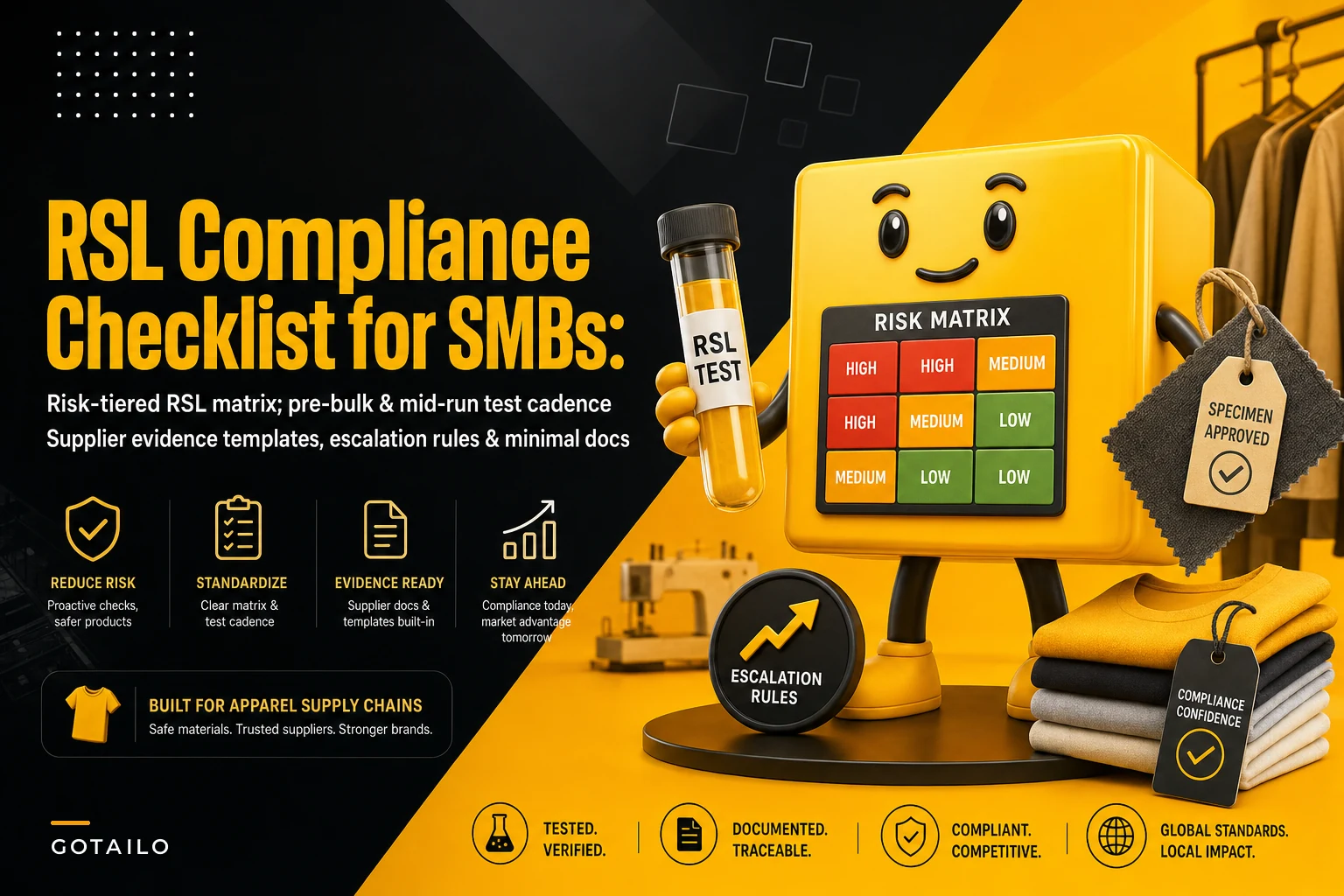
The risk-tiered RSL matrix
Sort every component into one of three tiers. The tier determines how hard you test and how often. This keeps your spend on the materials that actually move the compliance needle.
Eliminate delays in your fashion production cycle.
GoTailo helps you manage designs, orders, and inventory effortlessly, keeping production on schedule.
- Centralized order and inventory management
- Real-time supplier communication
- Integrated production scheduling
No credit card required
| Risk Tier | What goes here | Test depth | Cadence |
|---|---|---|---|
| Tier 1 – High | Prints/coatings (plastisol, PU/PVC coatings), dyed trims with bright/dark shades, faux leather, treated or flame-retardant fabrics, metal hardware with plating, anything contacting skin on kids' product | Full RSL panel relevant to substance class (phthalates, APs/APEOs, heavy metals, azo amines, formaldehyde) | Pre-bulk every season + mid-run spot check on color changes |
| Tier 2 – Medium | Main body fabrics in standard shades, elastics, threads, standard woven labels | Targeted panel (azo, formaldehyde, pH, APEO) | Pre-bulk when construction or mill changes; otherwise annual |
| Tier 3 – Low | Undyed natural fabrics, mechanical-only components (uncoated buttons, clear nylon zippers) | Supplier declaration + document review only | On supplier change |
The point of tiering isn't to skip testing. It's to stop wasting a testing budget on undyed cotton muslin while a Tier 1 metallic foil print goes unexamined. Reallocate, don't reduce.
One pattern worth flagging: shade drives tier more than material type. The same polyester at pale blue is Tier 2; at deep black or fluorescent it jumps to Tier 1 because of the dye load and the azo/heavy-metal risk that comes with it. If your tier assignment ignores colorway, it's assigning risk to the wrong place.
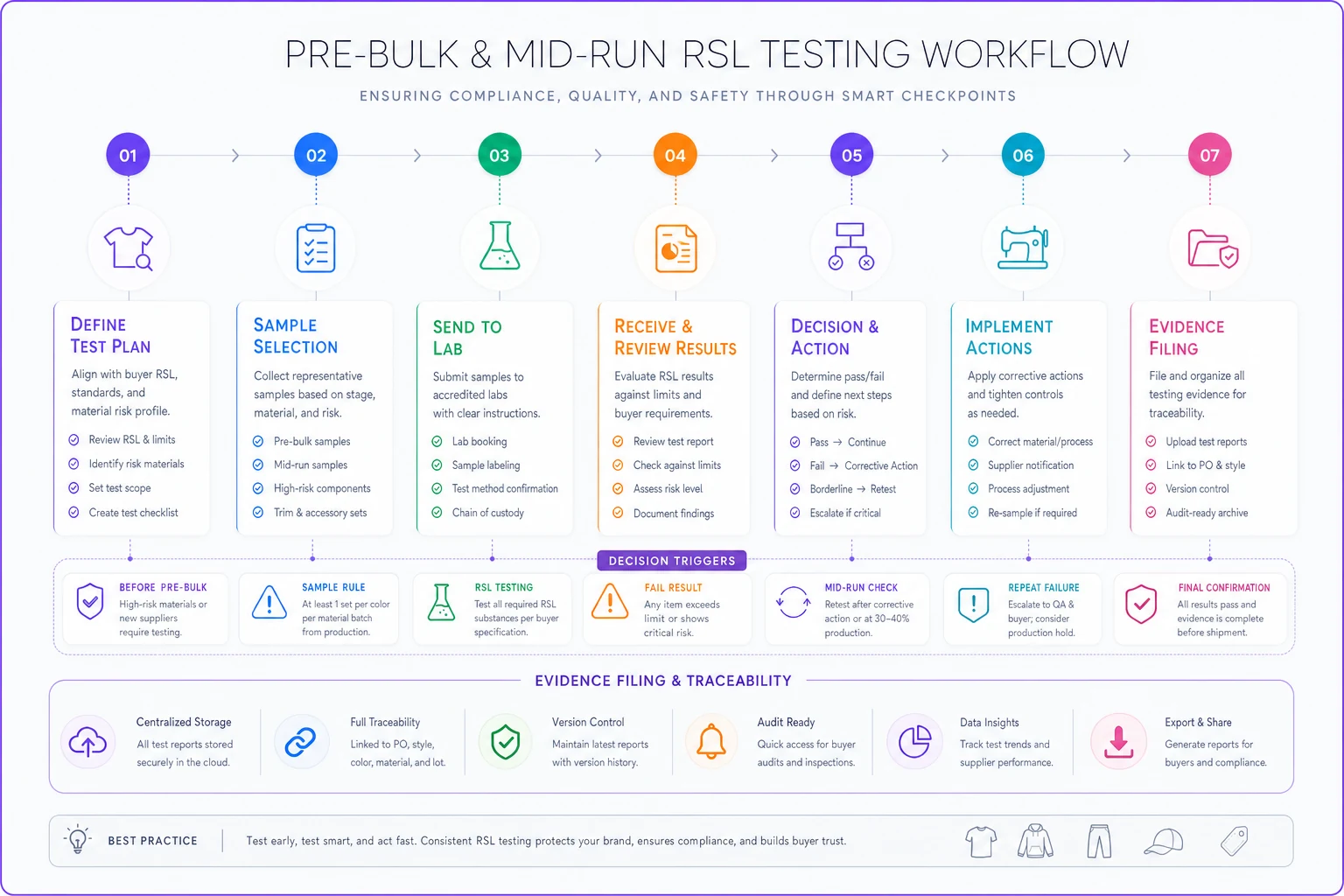
Two test moments that catch almost everything: pre-bulk and mid-run
Continuous testing is unaffordable and, honestly, unnecessary. For small teams, two checkpoints capture the overwhelming majority of real RSL failures.
Pre-bulk testing happens after bulk material is committed but before cutting. This is your gate. It confirms the actual production lot — not the sales swatch, not the development yardage — meets the list. The reason this matters: the material you approved in development is frequently not the material that shows up for bulk. Mills substitute dye recipes, chemical suppliers change, and the "same" fabric arrives with a different finish. If you only tested development yardage, you tested something that no longer exists.
Mid-run testing is a smaller, targeted spot check triggered by specific events during production, not done on a fixed calendar:
-
A colorway change within the same style
-
A mill or dyehouse splitting the order across two facilities
-
A chemical/finish substitution the supplier discloses (or you catch)
-
Any Tier 1 component re-ordered from a different lot
Mid-run isn't a full re-panel. It's one or two targeted tests on the specific thing that changed. A dyehouse split means you test both outputs for azo and heavy metals — nothing else. This is where small teams over-spend out of anxiety or under-spend out of fatigue. Tie the test to the trigger, and the decision makes itself.
Link mid-run tests to documented supplier change notifications so you only trigger targeted panels when something actually changed.
The evidence discipline here mirrors what works for color approvals. The same logic that stops endless back-and-forth in remote lab-dip approvals — fixed acceptance thresholds, documented evidence, no re-litigating settled points — applies directly to RSL. If you define "pass" clearly up front and require the lot-specific report, you stop arguing about whether an old certificate "probably still applies."
Supplier evidence: templates that make the PO do the work
RSL documentation falls apart at audit time because it gets collected separately from production. The fix is making evidence a condition of the PO, not something you chase down afterward.
1. Supplier RSL Declaration (per material, per season) A one-page signed statement listing: material name, construction, colorway(s), the RSL version the supplier is declaring against, the chemical formulation supplier for dyes/finishes, and a commitment to notify you of any change. Cheap, fast, and creates the paper trail that distinguishes "we had a system" from "we hoped."
2. Third-Party Test Report (lot-referenced) The actual lab report, tied to a specific bulk lot or dye batch number — not a generic certificate. The single most common gap is a test report that can't be traced to the material in the garment. If the report doesn't name the lot, it's nearly worthless at audit.
3. Change Notification Log A running record where the supplier logs any chemical, mill, or formulation change. This is the document that saves you mid-season when something shifts quietly.
Keeping these lot-referenced is the same traceability discipline covered in the materials traceability log approach — if you can't connect a report back to the roll, batch, or trim lot in a specific garment, you don't actually have evidence. You have a reassuring PDF.
A compact compliance checklist you can run per style
Size this to a single style, run it every season, keep it to one page:
-
[ ] Every component classified into Tier 1 / 2 / 3, with colorway considered
-
[ ] Current RSL version confirmed (yours and each key retailer's stricter version)
-
[ ] Supplier RSL Declaration on file for all Tier 1 and Tier 2 materials
-
[ ] Pre-bulk test report on file, lot-referenced, for all Tier 1 components
-
[ ] Targeted Tier 2 testing completed where mill/construction changed
-
[ ] Mid-run triggers defined and communicated to supplier
-
[ ] Change Notification Log active and checked before cut
-
[ ] Any kids'/baby components tested against the stricter children's thresholds
-
[ ] Evidence filed against the PO and the lot, not in a loose folder
-
[ ] One named owner accountable for sign-off before bulk cutting
That last line matters most. RSL programs decay when ownership is ambient. If "everyone" watches it, no one does.
Escalation rules: what to do when something fails
A failed test shouldn't trigger a panic meeting every time. Pre-decide the response by severity so the team acts instead of debating.
-
Marginal fail, non-skin-contact, adult product — Hold the lot. Request supplier root cause and a corrective reformulation. Re-test the corrected lot before release. Document the deviation.
-
Clear fail on a regulated substance (phthalates, azo amines, lead) — Stop the order. Quarantine any produced units. Do not ship pending a clean re-test. Notify any retailer whose stricter list is affected before they find it.
-
Fail on children's/baby product — Hard stop, no exceptions, no "sell-through" negotiation. This is the category where a miss becomes a recall.
-
Repeat fail from the same supplier — Move them to mandatory pre-bulk testing on every lot at their cost, and flag for sourcing review. A second failure isn't bad luck; it's a process gap on their side.
Writing these rules down before you need them is what separates a two-day hold from a three-week scramble.
A real scenario
A small activewear brand — roughly 30 SKUs per drop, two people managing production — kept getting flagged on screen-printed graphic pieces at a major retailer's compliance intake. They were testing main fabrics consistently and ignoring prints entirely. Two POs got held at the DC in a single season over plastisol phthalate levels, costing them chargebacks and re-work on roughly 1,800 units, plus airfreight to replace the rejected stock. Mid-single-digit-thousands per incident, before the relationship damage.
They didn't build a lab. They re-tiered: every plastisol print became Tier 1, tested pre-bulk per colorway, with the ink supplier's formulation named on a declaration. Standard body fabric in basic shades dropped to annual testing. Net testing spend barely moved — they just pointed it at the right components. The following two seasons had zero compliance holds, and the retailer stopped sampling their prints as aggressively because the evidence packs came in clean and lot-referenced every time.
When this lightweight approach makes sense — and when it doesn't
This tiered, two-checkpoint model fits brands running meaningful volume across many components without a dedicated compliance function. It's built for the team choosing between imperfect-but-consistent and comprehensive-but-impossible.
It's a bad idea if you're selling primarily into children's/infant categories at scale, or into markets with aggressive regulatory enforcement, where the cost of a single miss dwarfs any testing savings. In those cases, test depth should go up, not sideways. It's also not enough on its own if a specific retailer contractually requires per-lot full-panel testing — their requirement overrides your tiering for those materials.
And it won't help the brand that treats the checklist as a one-time setup and never re-runs it. The entire value is in the cadence. An RSL matrix you built once and never revisited is just a document describing materials you stopped using two seasons ago.
The real takeaway
RSL compliance for a small apparel team isn't about matching the testing budget of a large brand. It's about putting your limited testing dollars exactly where chemical risk concentrates — prints, coatings, dyed trims, plated hardware — and verifying at the two moments that matter: before you cut bulk, and when something changes mid-run. Everything else is paperwork discipline: declarations tied to POs, reports tied to lots, and one person who signs off before the fabric gets cut.
Do that, and you move from reconstructing evidence under pressure to handing it over on request. The teams that get flagged aren't the ones with small budgets. They're the ones testing the wrong components and finding out at the loading dock.
RSL compliance for a small apparel team isn't about matching the testing budget of a large brand. It's about putting your limited testing dollars exactly where chemical risk concentrates — prints, coatings, dyed trims, plated hardware — and verifying at the two moments that matter: before you cut bulk, and when something changes mid-run. Everything else is paperwork discipline: declarations tied to POs, reports tied to lots, and one person who signs off before the fabric gets cut.
Do that, and you move from reconstructing evidence under pressure to handing it over on request. The teams that get flagged aren't the ones with small budgets. They're the ones testing the wrong components and finding out at the loading dock.
Ready to tailor your apparel operations?
Join 500+ fashion brands using GoTailo to accelerate product launches, reduce waste, and improve supplier collaboration.