

A lab-dip that bounces four times isn't a color problem. It's an evidence problem.
Most repeat dips in remote approval workflows happen because two people are looking at the same swatch under completely different conditions and both think they're right. The mill's QC lead approves under a D65 booth. Your designer eyeballs a phone photo in an office with warm LED downlights. The brand owner checks it at home at 9pm under whatever bulb is in the lamp. Nobody's lying. Everyone's just working from garbage evidence.
If you run remote lab dip approval for apparel across time zones, the whole game is standardizing what counts as acceptable proof of color before anyone types "approved" or "please resubmit." Get the evidence standard right and a big chunk of your repeat dips disappear — not because the dyeing got better, but because you stopped rejecting good dips and stopped approving bad ones.
The real reason dips repeat: uncontrolled capture, not uncontrolled dyeing
Walk backwards from a typical rejection and the fault is usually in the photo, not the fabric.
A mill sends a dip. The photo comes in shot on a windowsill, half in shadow, white-balanced to "auto," compressed by WhatsApp down to something like 200KB. Your side pulls it up on an uncalibrated monitor, decides the red "reads orange," and asks for a redo. The mill re-dyes to shift it cooler. Now the actual dye is off, chasing a color error that only existed in the JPEG.
That's the trap. Bad evidence generates real production errors. You're not correcting color anymore — you're correcting a photo — and the mill is physically changing dye chemistry to satisfy a lighting artifact.
In practice this usually shows up in three ways:
-
Metameric surprises — the dip matches under the mill's light and mismatches under yours, and nobody documented which light "counts."
-
Device drift — same physical swatch, three phones, three whites, three verdicts.
-
Compression damage — the messaging app or email pipeline crushes the file and shifts subtle tones before a human even sees it.
None of these are dyehouse skill problems. They're capture-and-transmission problems, and they're fixable with rules instead of re-dips.
Set a non-negotiable capture standard before you approve anything remotely
The fastest way to cut repeat dips is to refuse to evaluate any submission that doesn't meet a fixed capture spec. Sounds harsh. It saves weeks.
Eliminate delays in your fashion production cycle.
GoTailo helps you manage designs, orders, and inventory effortlessly, keeping production on schedule.
- Centralized order and inventory management
- Real-time supplier communication
- Integrated production scheduling
No credit card required
Your capture standard needs to lock down four things: light source, white balance reference, ICC profile, and a physical reference swatch in the same frame.
The minimum capture template
-
Light source D65 (6500K) viewing booth only. No window light, no mixed office light, no "sunny day outside." If the mill doesn't have a booth, that's a conversation before the first dip, not after the fourth.
-
Reference swatch in frame Place the approved standard (or the previous best dip) next to the new dip, touching, in the same shot. Never send the dip alone.
-
Neutral gray card + white patch in the corner of every frame so white balance can be verified, not trusted.
-
Camera settings Fixed white balance to the booth (not auto), lowest ISO available, no flash, no filters, no "beauty" or auto-enhance modes.
-
File output Highest quality JPEG or, ideally, an uncompressed TIFF/PNG. Tag it with the sRGB or Adobe RGB ICC profile and don't strip it. Send via a channel that doesn't recompress — a shared drive link, not an inline chat image.
-
Framing Swatch fills most of the frame, shot straight-on (not at an angle), from roughly 30–40cm.
The single highest-leverage rule here is #2.
The single highest-leverage rule here is #2. A dip photographed beside its reference standard, under the same light, in the same frame, removes most of the guesswork. You're no longer judging absolute color from a screen — you're judging the difference between two swatches that shared identical capture conditions. Cameras and screens both drift, but they drift the reference and the dip together, so the relationship survives.
ICC profiles: the part everyone skips and then pays for
A file gets shot in Adobe RGB, the profile gets stripped somewhere in the pipeline, and your monitor renders it as if it were sRGB. Saturated colors — deep teals, warm reds, anything near the edge of gamut — shift visibly. The mill did nothing wrong. The profile just got lost in transit.
Two rules fix most of this:
-
Everyone commits to one working space. Pick sRGB for a small team on mixed hardware — it's the safest lowest common denominator and survives web pipelines. Use Adobe RGB only if both sides have calibrated wide-gamut monitors and the discipline to keep the profile embedded end to end.
-
The profile must stay embedded. No stripping, no "save for web" that dumps the tag, no messaging apps that recompress. If a file arrives with no embedded profile, treat it as unusable evidence and request a resend. Don't guess.
And calibrate the screens actually making decisions. A hardware monitor calibrator (the puck-style ones) run monthly on the two or three displays where approvals happen costs almost nothing next to one repeated dip cycle. An uncalibrated approval monitor is the equivalent of measuring fabric with a ruler you never checked.
Define acceptance thresholds so "close enough" stops being an argument
"Does this pass?" should not be a vibe. It should be a number.
Delta-E (ΔE) is the practical way to make color tolerance objective. Instead of arguing whether a navy is "a touch too purple," you agree in advance on the maximum acceptable ΔE against the standard, and you decide it per color family — because the human eye and the fabric behave differently across the spectrum.
A realistic threshold table looks something like this:
| Color family / risk | Suggested max ΔE (visual) | Notes |
|---|---|---|
| Neutrals, off-whites, pale grays | ~0.8–1.0 | Eye is brutal here; tighten it |
| Mid-tone solids (most colors) | ~1.0–1.5 | Standard workhorse tolerance |
| Deep saturated (reds, teals, royals) | ~1.5–2.0 | Harder to hit, allow a bit more |
| Blacks / near-blacks | ~1.0 | Watch for cast (blue vs brown black) |
| Fluorescents / neons | case-by-case | Instrument + physical review both required |
These aren't universal law — brands with a strong house color set tighter, and the numbers depend on your substrate and whether you're measuring on-fabric with a spectrophotometer or reading from calibrated photos. The point is that the thresholds exist and are written down before the first dip ships. When a mill knows the target is ΔE ≤ 1.2 against the standard, they stop guessing what "close" means to you.
One honest caveat: photo-based ΔE from a calibrated capture is a strong screening tool, not a replacement for instrument readings on critical programs. Use the photo standard to kill the obvious fails fast and pass the obvious wins fast. Reserve spectrophotometer confirmation for the borderline cases and your hero colors.
The approval workflow that actually reduces cycles
Put together, the flow looks like this — each gate exists to catch a specific failure before it becomes a re-dye:
Step 1 — Pre-dip alignment. Before any dyeing, confirm the mill has a D65 booth, the physical standard in hand, and the capture template. Confirm the working color space. This one conversation prevents more repeat dips than anything downstream.
Step 2 — Capture gate. Submission arrives. Before anyone judges color, check the evidence: Is the reference swatch in frame? Is there a gray card? Is the ICC profile embedded? Is the file uncompressed? Fail any of these → auto-reject on capture grounds, request resend. You are not evaluating color yet.
Step 3 — Threshold check. With clean evidence, compare dip to standard against the agreed ΔE for that color family. Clear pass → approve. Clear fail → reject with the direction of the miss ("too warm / needs to move cooler and slightly darker"), not just "no."
Step 4 — Borderline escalation. Anything inside the gray zone goes to spectrophotometer confirmation or a physical swatch mail, not another photo argument.
Step 5 — Record the decision. Log the approved dip, its capture file, the ΔE reading, the light source, and who signed off. This is the same discipline you'd apply to any sign-off record — the version-control mindset in lightweight tech-pack naming and sign-off rules applies directly to lab-dip approvals, because a dip approval is a versioned decision you'll need to defend at bulk.
A visual summary of the approval flow:
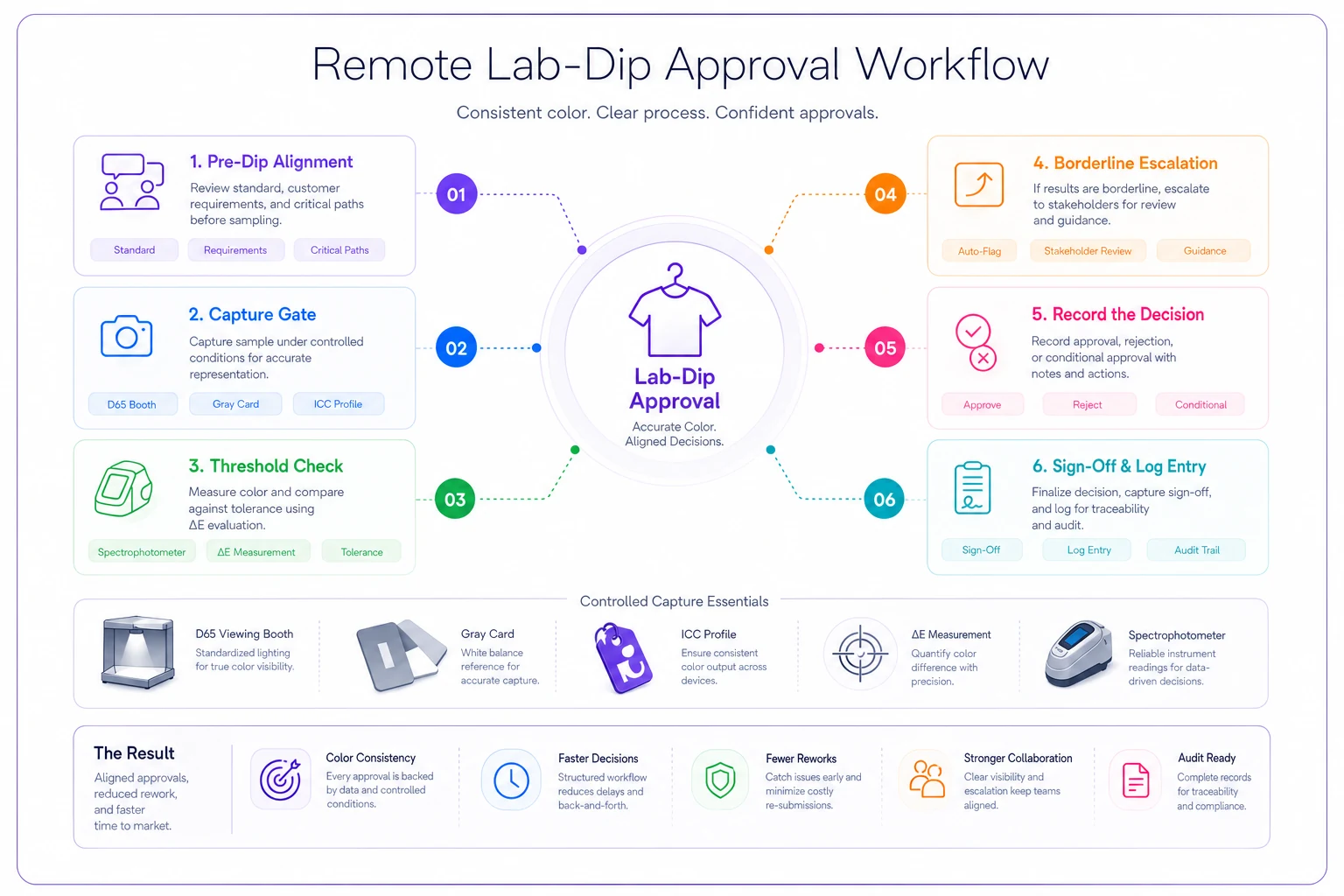
This workflow highlights the gates to stop evidence problems before they become re-dips.
The reason this cuts cycles is Step 2. Most teams jump straight to judging color and skip verifying whether the evidence was even valid. Reject on evidence first, and you stop feeding your dyehouse false corrections.
A quick reject-checklist you can hand your reviewers
Print this and stick it next to the approval monitor. If any box is unchecked, don't evaluate color yet — request a resend.
-
- [ ] Reference standard swatch is in the same frame, touching the dip
-
- [ ] Shot under D65 booth (not window/office/mixed light)
-
- [ ] Gray card / white patch visible for white-balance verification
-
- [ ] ICC profile embedded (sRGB or agreed space), not stripped
-
- [ ] File is uncompressed or highest-quality, not a chat-app thumbnail
-
- [ ] Straight-on angle, swatch fills the frame, in focus
-
- [ ] Approval monitor calibrated within the last month
Half of these get skipped in the average remote workflow, and every skipped box is a future re-dip.
A real scenario: the mid-size knitwear brand and the four-cycle navy
A knitwear brand running production across two overseas mills was averaging around 3–4 dip cycles per color on their seasonal palette, with each cycle running roughly 7–10 days door to door. The worst offenders were always the deep colors — a navy and a burgundy that seemed to never land right.
When they actually looked at the submissions, the pattern was obvious: dips shot alone, on windowsills, sent as compressed chat images, judged on an uncalibrated laptop. The navy that "read too purple" was doing so only in the stripped-profile JPEG. The physical swatch, when it finally arrived by courier, was fine — the brand had been rejecting acceptable dips for two cycles straight.
They didn't buy fancy equipment. They put a cheap D65 booth at each mill, mandated the reference-swatch-in-frame rule, locked everyone to sRGB with embedded profiles, calibrated the two approval monitors, and wrote ΔE thresholds per color family. Nothing exotic, just refusing to judge color from bad evidence.
Next season, average cycles dropped to about 1.5–2 per color. The deep colors still occasionally needed a second dip — that's real dye chemistry — but the phantom rejections vanished. Rough estimate on their end was two to three weeks pulled out of the pre-production calendar and a meaningful cut in sampling spend.
When to tighten this — and when it's overkill
This full standard makes sense when: you're approving remotely across time zones, running deep or brand-critical colors, working with new mills you haven't calibrated trust with yet, or when repeat dips are visibly eating your calendar.
It's overkill when: you're doing in-person approvals in a shared booth, working simple neutrals where tolerance is generous, or running tiny one-off sampling where a physical swatch courier is faster and cheaper than building the whole evidence pipeline. Don't bureaucratize a two-swatch capsule.
Who should not lean on photo-only approval at all: anyone whose brand identity lives or dies on a signature color — a specific corporate red, a heritage green. For those, photos are the screening layer only. Final sign-off belongs to a spectrophotometer and a physical swatch in the standard's own light, full stop.
Keep the paper trail, because dips become disputes later
The last piece people forget: every approved dip is a future argument waiting to happen. When bulk comes in three shades off and the mill says "you approved it," you need the exact capture file, the light source, the ΔE reading, and the sign-off name to settle it in an hour instead of a week.
That's the same logic behind keeping a proper materials traceability log even without full systems — the approval evidence and the material record travel together, and when a color complaint lands at bulk, having both pulled up side by side is the difference between a quick resolution and a finger-pointing standoff.
Repeat lab dips almost never come from mills that can't dye. They come from approval processes that can't see straight. Fix the evidence — the light, the profile, the reference swatch, the threshold — and you stop paying for corrections to problems that only ever existed on a screen.
Ready to tailor your apparel operations?
Join 500+ fashion brands using GoTailo to accelerate product launches, reduce waste, and improve supplier collaboration.