


Most apparel brands treat recovered value as an afterthought — something the finance team scrambles to clean up at year-end when they realize there's $180k of inventory sitting in a corner nobody wants to look at. By then the decisions are already made for you. The product is two seasons old, the resale partners who would've paid 40 cents on the dollar now offer 12, and the only real option left is a liquidator who hauls it away by the pallet.
The brands that actually recover meaningful value don't do it by being clever at the end. They do it by having a disposition system that kicks in the moment a unit stops being sellable at full price — whether that's a return, a cancelled wholesale order, excess production, or damaged goods coming off the line. A real resale strategy for apparel recovered value is less about finding the perfect buyer and more about having a repeatable routine that routes every unit to its highest-value exit before time destroys the economics.
This connects to everything else in your operation. Your returns flow feeds it. Your production overruns feed it. Your QC rejects feed it. And the accounting has to fold cleanly back into your P&L or you'll never know whether any of it is working.
Why recovered value leaks out of growing brands
The leak isn't one hole. It's a dozen small ones that only become visible once volume goes up.
When a brand does $2M a year, the "problem inventory" might be a few hundred units a season. Someone eyeballs it, calls a sample-sale organizer, and moves on. It's inefficient but survivable because the dollars are small and one person holds the whole picture in their head.
Push that same brand to $12M and the picture fractures. Returns are now handled by a 3PL. Overruns live at the factory until someone remembers to ship them. QC rejects get quarantined and forgotten. Cancelled wholesale orders sit in limbo while sales tries to re-place them. Nobody owns the full inventory of recoverable goods, and because no one owns it, no one is measuring the value decaying inside it.
The pattern worth naming: recovered value decays on a clock, and the clock starts the day a unit becomes non-first-quality. A pair of pants that could've gone to an off-price buyer at $14 in month one is worth maybe $6 by month six and around $2 by month twelve. The delay isn't neutral. Every week a disposition decision sits unmade, you're paying for it in realized value — plus storage, plus the opportunity cost of the warehouse space.
The second pattern: brands optimize the wrong exit. They'll obsess over squeezing an extra 8% out of a liquidation deal while ignoring that 30% of those units could've been repaired and restocked at full margin. The channel decision matters far more than the negotiation.
The channels, and when each one actually makes sense
Before you can build a playbook, you need a clear-eyed view of your exits. Most brands have access to more channels than they actually use, usually because they've only ever worked one or two.
Eliminate delays in your fashion production cycle.
GoTailo helps you manage designs, orders, and inventory effortlessly, keeping production on schedule.
- Centralized order and inventory management
- Real-time supplier communication
- Integrated production scheduling
No credit card required
| Channel | Typical recovery (% of wholesale) | Best for | Watch out for |
|---|---|---|---|
| Repair & restock to full price | 70–95% | Minor defects, returns in good condition | Labor cost can exceed recovered value on cheap units |
| Brand-owned outlet / sample sale | 40–60% | Last-season full styles, overruns | Cannibalizes full-price if timed badly |
| Off-price / discount retail | 25–45% | Volume, current-ish styles | Strict packaging & labeling specs, chargebacks |
| Marketplace resale (own storefront) | 35–55% | Returns, singles, odd sizes | Labor-intensive to list and fulfill |
| B-grade / "imperfect" line | 30–50% | Cosmetic defects, dye irregularities | Requires brand comfort selling flawed goods |
| Jobber / liquidator | 8–20% | Aged, bulk, no-story inventory | Last resort; brand-protection terms matter |
| Donation (tax value) | Varies | Truly dead stock | Documentation discipline required |
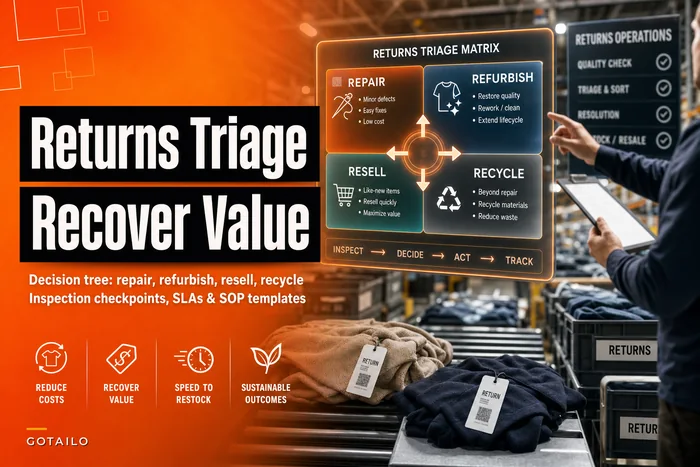
The mistake most brands make is defaulting to liquidation because it's the least effort, when a meaningful slice of the same batch belonged in repair-and-restock or a B-grade line. If you're triaging returns specifically, the logic for sorting repairable from refurbishable from dead is worth getting right at the source — there's a full breakdown in the returns triage matrix that pairs directly with the channel decisions here.
When a dedicated resale channel makes sense
Stand up your own resale storefront or B-grade line when:
-
You consistently generate enough recoverable volume to justify the listing and fulfillment labor — roughly 150+ units a month is where it starts to pay.
-
Your defects are cosmetic and consistent enough to describe honestly to a customer.
-
You have the brand latitude to sell imperfect goods without eroding your main line's positioning.
When it's a bad idea
Don't build a resale operation if your recoverable volume is lumpy and small — you'll spend more on the infrastructure than you recover. And don't route current-season, full-price styles into a discount channel just because a few units came back. That's not recovered value, that's self-inflicted margin erosion. Hold those for restock or a tightly-timed outlet event instead.
Reconditioning SOPs: the part everyone underestimates
Reconditioning is where the biggest recovery gains hide, and it's also where most brands have zero process. A unit comes back, someone glances at it, and it either goes back on the shelf or into the reject pile based on gut feel. That gut feel is costing you.
-
Intake & log. Every recoverable unit gets scanned in against its SKU with a reason code (return, overrun, QC reject, cancelled order) and a condition grade. No unit enters the recovered-value pool without this. This is the entry point for your ledger.
-
Grade against a fixed rubric. A-grade (sellable as-is, back to stock), B-grade (minor cosmetic — pilling, loose thread, light mark), C-grade (repairable defect — seam, button, zipper), D-grade (not economically recoverable).
-
Route by grade. A goes to restock. B routes to your B-grade or outlet channel. C goes to the repair queue. D goes to donation or liquidation.
-
Repair with a time cap. Set a maximum labor-minutes per unit based on its recovery value. If a repair takes more than 12 minutes on a unit you'll recover $9 on, it fails the cap and drops to the next channel. Without this cap, your repair station quietly destroys margin.
-
Re-grade after repair. Confirm the repaired unit meets A or B standard. If it doesn't, it drops channels — it does not go back into the queue for a second attempt.
-
Release to channel with cost attached. The unit leaves reconditioning tagged with its accumulated handling cost so the recovered-value math stays honest.
Track repair minutes per SKU to enforce the time cap and spot loss-making repairs quickly.
A simple flow visualization helps teams follow the SOP without having to read the manual.
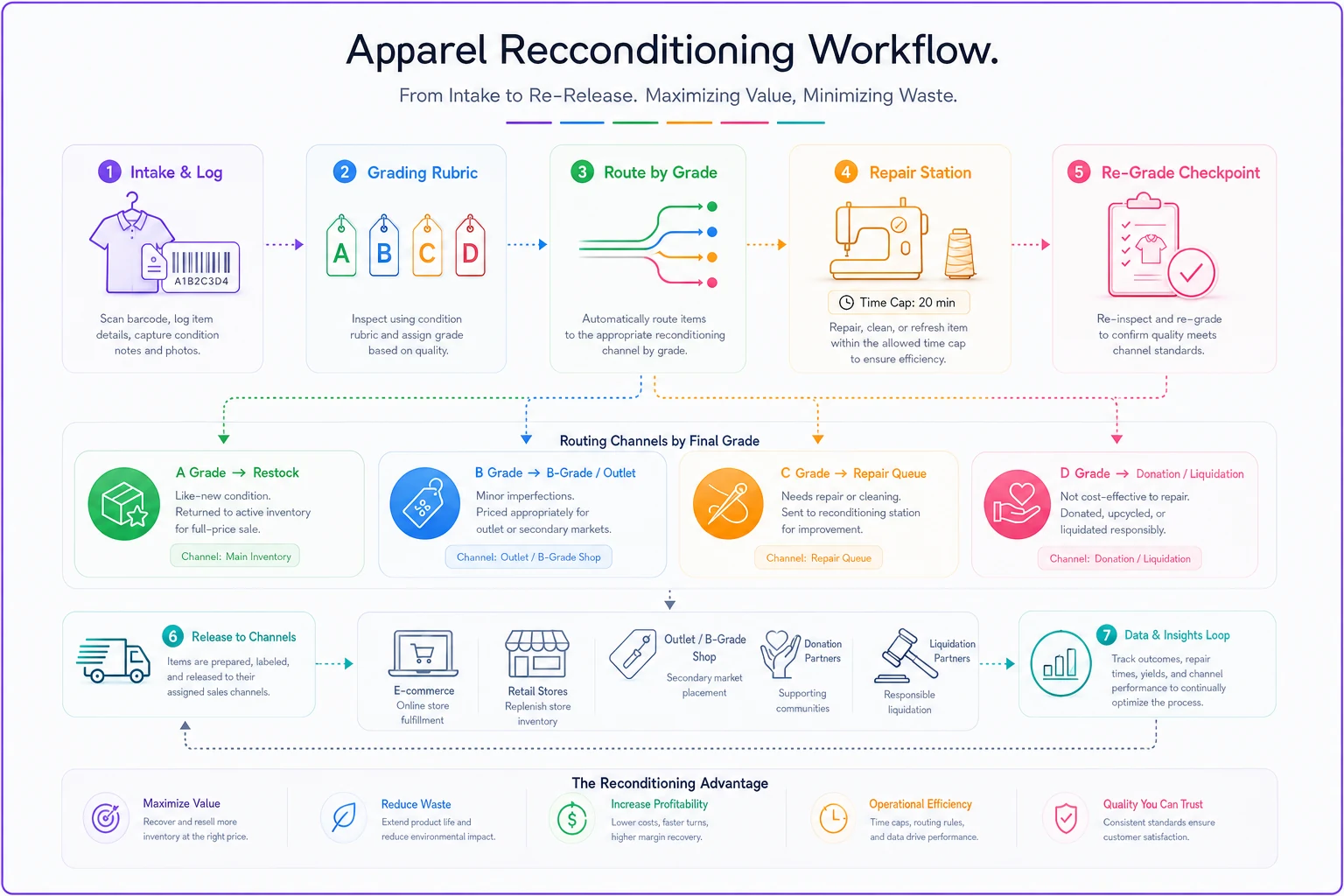
The time-cap rule in step 4 is the single most valuable thing in this SOP. Brands that skip it end up with repair stations that feel productive but are net-negative — a seamstress spending 25 minutes rescuing a $6 tee. Measure it or it will bleed you.
The disposition decision matrix
Once a unit is graded and costed, the disposition decision should be close to automatic. The whole point of a matrix is to take judgment out of the moment and put it into the rules.
-
A-grade, current season → restock at full price. Always.
-
A-grade, last season → outlet or marketplace storefront.
-
B-grade, any season → B-grade line or outlet, whichever clears faster.
-
C-grade, repair passes time cap → repair, then re-grade and route.
-
C-grade, repair fails time cap → drop to B-grade channel or liquidation depending on cosmetic acceptability.
-
D-grade → donation (if tax value exceeds liquidation net) or liquidation.
-
Any grade, aged past your decay threshold → force liquidation. Don't let old stock keep occupying "someday" status.
That last rule matters most at scale. The enemy isn't the bad unit — it's the undecided unit. A disposition matrix with a hard age trigger forces a decision before the value hits zero. Brands that carry "we'll figure it out" inventory for 18 months and then recover 6 cents on the dollar would've gotten 30 with a forced-decision rule at month four. It's one of the more expensive non-decisions a growing brand can make.
Recovered-value accounting that folds into your P&L
This is where strategy becomes real, because if the recovery doesn't show up in your financials in a way you can actually read, you have no idea which channels and SOPs are working.
The core tool is a recovered-value ledger. Every recoverable unit gets a row, and the row tracks it from intake to final sale.
A workable ledger has these columns:
-
SKU & description
-
Reason code (return / overrun / QC reject / cancelled order)
-
Entry date (starts the decay clock)
-
Condition grade at intake
-
Original cost (COGS of the unit)
-
Handling/reconditioning cost accumulated
-
Channel it was routed to
-
Gross recovery ($ received)
-
Net recovered value (gross recovery minus handling cost)
-
Days-to-disposition
The column that changes behavior is net recovered value, not gross. Plenty of brands celebrate a $40k liquidation check without subtracting the $11k in handling, storage, and freight it took to get there. Net is the number that tells the truth.
How it folds into the P&L
-
Net recovered value becomes a credit against your inventory write-down / COGS line. Recovered dollars offset the loss you'd otherwise book.
-
Handling and reconditioning labor gets its own cost line so you can see whether your reconditioning operation is net-positive.
-
Days-to-disposition becomes an operational KPI you watch monthly — rising days means value is decaying faster than you're clearing it.
Run this reconciliation on the same monthly cadence as the rest of your operational finance so recovered value stops being a year-end surprise. The broader reverse-logistics operating model that feeds this ledger — reason-code discipline, channel contracts, the whole inbound side — is covered in turning returns into cash, and it's the natural upstream of everything in this post.
Choosing resale and reconditioning partners
Your channels are only as good as the partners behind them. A liquidator who dumps your branded goods into a market where your wholesale accounts shop can cost you more in relationship damage than you recover. Vet partners the same way you'd vet a factory.
A partner-selection checklist worth running before you sign:
-
Brand protection terms. Can they resell with your labels removed or restricted to agreed geographies and channels? Get it in writing.
-
Payment terms and speed. Net-30 from a jobber who always pays late is worse than a slightly lower offer that pays on pickup.
-
Volume consistency. Will they take your recoverable goods reliably every month, or only cherry-pick the good batches and leave you stuck with the rest?
-
Transparency on resale. Do they tell you where goods end up? Opaque partners are where brand-damage risk lives.
-
Handling of returns-of-returns. If units come back to them, what happens? You don't want them boomeranging back to you.
-
Documentation. Can they provide clean records for your ledger and for donation tax value?
The quiet failure here is signing a single all-purpose partner and routing everything through them. Different channels want different things. The off-price buyer wants clean, labeled, current goods. The liquidator wants volume and doesn't care about story. Trying to serve both with one relationship means neither exit performs well.
A real scenario
A womenswear brand doing around $8M a year had a recovery problem they couldn't see clearly. Returns, cancelled wholesale, and overruns were all landing in the same 3PL corner, and twice a year they'd call a liquidator to clear it. Recovery was running somewhere around 11–14% of wholesale value, and the finance team booked the rest as a write-down nobody questioned.
The fix wasn't exotic. They put intake scanning and reason codes at the front, ran a grading rubric, stood up a modest B-grade storefront on their own site, and set a 10-minute repair time cap. They also added a hard 90-day decay trigger — anything past 90 days forced a disposition decision instead of drifting indefinitely.
Over the next three quarters, net recovered value climbed into the low-to-mid 30s as a percentage of wholesale. The repair station — which they'd assumed was a cost center — turned net-positive once the time cap stopped it from rescuing cheap units at a loss. Days-to-disposition dropped from "whenever we remember" to a median of around five weeks. The write-down line on their P&L shrank noticeably, and for the first time they could actually see which channels earned their keep.
Nothing in that turnaround was a breakthrough. It was just a system where there hadn't been one.
Where this breaks without connected data
The reason recovered value is hard at scale isn't the individual steps — any one of them is simple. It's that the information lives in five different places. Returns data is in the 3PL system. Overruns are in a factory email thread. QC rejects are on a clipboard. Resale sales happen on a separate storefront. The ledger is a spreadsheet one person maintains and nobody else touches.
When those don't talk to each other, the decay clock runs invisibly and the P&L reconciliation becomes a manual archaeology project every quarter. This is where a workflow platform that centralizes disposition records — tying intake, grading, reconditioning cost, channel, and net recovery into one ledger that reconciles against your financials — stops the leaks that volume creates. The value isn't automation for its own sake. It's that every recoverable unit stays visible and costed from the day it enters the pool until the day it clears, so decisions get made on time instead of too late.
Pulling it together
A resale and recovered-value strategy isn't a channel you find — it's a routine you run. The brands that recover 30–40% instead of 10% aren't negotiating harder. They're grading at intake, capping repair labor against recovery value, forcing disposition decisions before value decays, and keeping a ledger honest enough to fold straight into the P&L.
Start with the intake discipline, because nothing downstream works without it. Add the grading rubric and the time cap. Build the ledger before you build the fancy channels. Once you can see net recovered value and days-to-disposition month over month, the channel and partner decisions stop being guesses — and the money that used to vanish into a write-down line starts showing up where you can actually use it.
Once you can see net recovered value and days-to-disposition month over month, the channel and partner decisions stop being guesses — and the money that used to vanish into a write-down line starts showing up where you can actually use it.
Ready to tailor your apparel operations?
Join 500+ fashion brands using GoTailo to accelerate product launches, reduce waste, and improve supplier collaboration.