

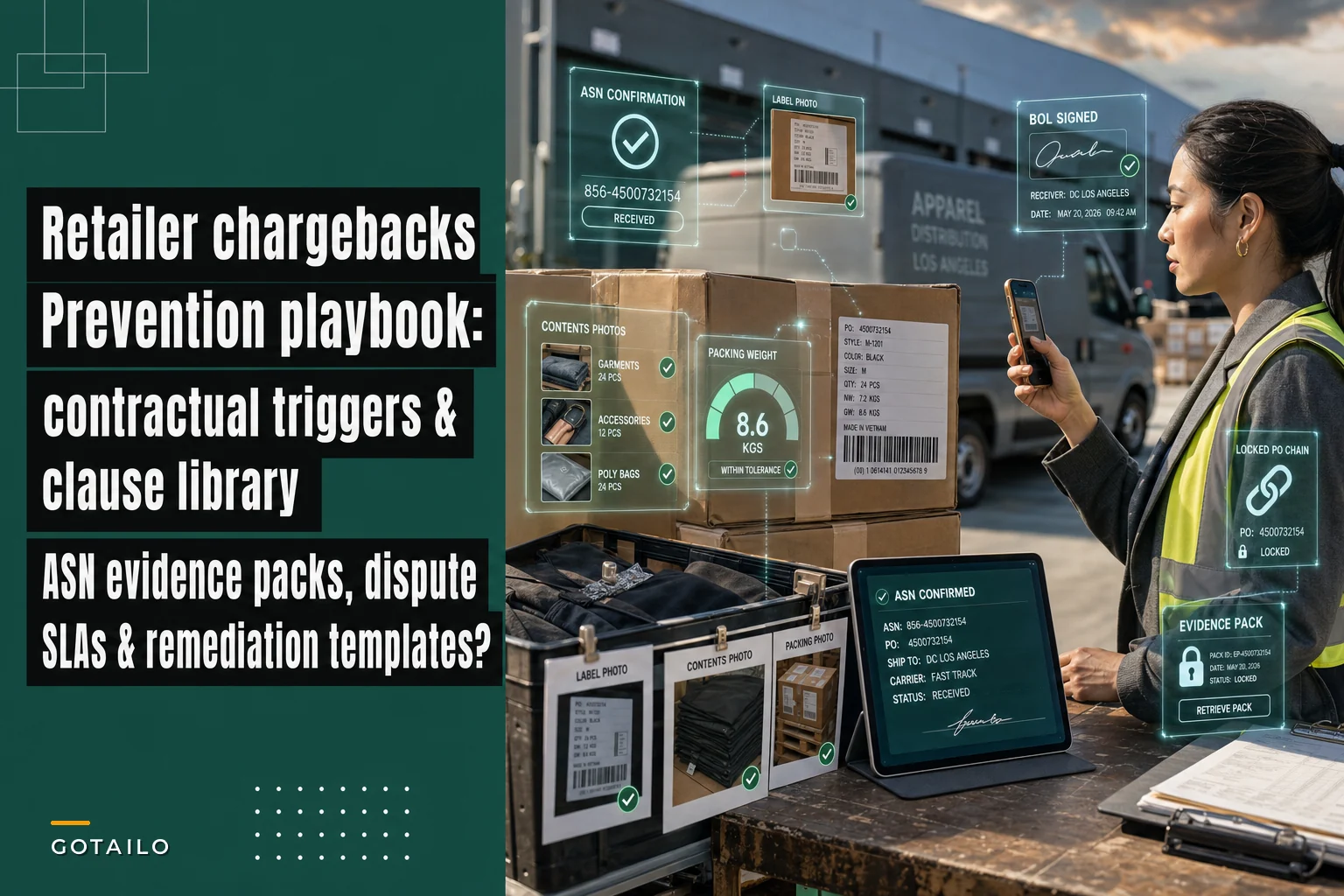

Chargebacks are where wholesale apparel margins quietly bleed out. Not in one dramatic hit, but in a $180 fine here, a $340 "non-compliant carton label" deduction there, a 2% markdown allowance you never actually agreed to. By the time your bookkeeper reconciles the season, you're looking at deductions that eat 4–8% of a program's revenue — and the frustrating part is that most of them were either preventable or at least contestable, if you'd had the paperwork.
The reason apparel suppliers lose these fights isn't that the retailer is always right. It's that the retailer has a routing guide, a vendor compliance manual, and a deduction workflow that runs on autopilot. You have an email thread, a packing list somewhere, and a vague memory of the ASN going out on time. When it's process versus memory, process wins.
This post is about closing that gap — specifically: what clauses to push for in your terms, what evidence to capture at receiving and shipping so a dispute is actually winnable, and how to structure a remediation SLA so a retailer can't just keep deducting while you scramble.
Why apparel suppliers lose chargebacks they should win
The pattern is almost always the same. A deduction shows up on a remittance — "PO #44821, ASN accuracy violation, $250." You know the shipment was fine. But when you go to fight it, you realize:
-
The ASN was sent, but you can't prove the timestamp relative to the delivery appointment.
-
The cartons were labeled correctly, but you have no photo showing label placement at time of packing.
-
The retailer claims a shortage of 14 units, your packing list says full quantity — but there's no third-party count or weight record to break the tie.
Wholesale chargeback prevention in apparel is fundamentally an evidence problem, not a quality problem. Suppliers who ship into major department stores and big-box retail with low net-deduction rates aren't shipping better product — they're documenting better. They win disputes on a timestamped photo and a compliant ASN, not on argument.
The second failure mode is contractual. Most small apparel suppliers sign the retailer's terms as-is, which means they've agreed to a deduction schedule with no dispute window defined, no cap on ambiguous "administrative" fees, and no requirement for the retailer to provide proof. When the terms are silent, the routing guide fills that silence — and it's not written in your favor.
The three things that actually reduce net deductions
Before getting into the templates, it helps to be clear about what you're building. Three layers, each doing a different job:
Eliminate delays in your fashion production cycle.
GoTailo helps you manage designs, orders, and inventory effortlessly, keeping production on schedule.
- Centralized order and inventory management
- Real-time supplier communication
- Integrated production scheduling
No credit card required
-
A clause library — pre-negotiated contract language that caps ambiguous fees, defines a dispute window, and shifts the burden of proof back onto the retailer for certain deduction categories.
-
An ASN / receiving evidence pack — the specific artifacts you capture at pack-out and hand-off so that any shortage, damage, or compliance claim can be contested with actual proof.
-
A dispute-flow with remediation SLAs — a defined process and timeline for how you respond to a deduction, and what the retailer must do in return, so disputes don't sit unresolved for 90 days.
Skip any one of these and the others get weaker. Great evidence is worthless if your contract gives you no window to submit it. A tight dispute SLA means nothing if you have no proof to attach. They work as a set.
Clause library: sample language you can actually negotiate
You won't win every clause, especially against a large retailer. But you'll almost always win some, and simply redlining the agreement signals that you track deductions — which changes how loosely a compliance team applies them.
Below are clause categories worth pushing on, with sample text you can adapt. Have your own counsel review anything before it goes into a signed agreement; this is a starting point, not legal advice.
1. Deduction documentation requirement
> "For any deduction, offset, or chargeback exceeding $100, Buyer shall provide Supplier with written documentation identifying the specific PO, the compliance provision allegedly violated, and supporting evidence (including, where applicable, receiving records, photographs, or count sheets) within fifteen (15) business days of applying the deduction. Deductions lacking such documentation upon Supplier's request shall be reversed."
2. Dispute window and standstill
> "Supplier may dispute any deduction within sixty (60) days of the remittance date. Upon a good-faith written dispute, Buyer agrees not to apply further deductions of the same category against open invoices until the disputed item is resolved."
3. Cap on administrative and handling fees
> "Administrative, handling, or processing fees associated with any single compliance event shall not exceed the greater of $75 or 5% of the affected merchandise value."
4. ASN accuracy cure period
> "In the event of an ASN discrepancy, Buyer shall notify Supplier within two (2) business days of receipt. Supplier shall have the opportunity to correct or reconcile the ASN prior to any deduction being assessed."
5. Shortage verification standard
> "Claimed shortages exceeding 2% of shipped units shall be verified by a documented physical count or weight reconciliation, records of which shall be made available to Supplier upon request."
| Clause | What it protects against | Realistic win-rate with mid-size retailers |
|---|---|---|
| Deduction documentation | Unsupported "phantom" deductions | Moderate–high |
| Dispute window + standstill | Deductions stacking during a dispute | Moderate |
| Admin fee cap | Runaway processing fees | Low–moderate |
| ASN cure period | Automated ASN-timing penalties | Moderate |
| Shortage verification | One-sided shortage claims | Moderate |
The admin-fee cap is the hardest to land against a large account — their compliance program is standardized and they won't customize fee schedules for individual suppliers. The documentation requirement is the easiest to get, and honestly the most valuable of the bunch.
The ASN / receiving evidence pack
This is the part most suppliers under-invest in, and it's the part that wins the most money back. The idea is simple: at the moment of pack-out and hand-off, capture a small, consistent set of artifacts per shipment. Not for every carton — for a defined sample plus every high-risk shipment.
The evidence has to be contemporaneous (created at the time, not reconstructed later) and timestamped. A photo taken three days after the retailer complained is nearly worthless. A timestamped photo from the pack line is decisive.
Evidence pack checklist — capture per shipment:
-
- [ ] PO number and ship-to confirmed against the routing guide before pick
-
- [ ] Timestamped photo of GS1-128 carton label placement (at least one carton per SKU)
-
- [ ] Timestamped photo of carton contents before sealing (sample cartons)
-
- [ ] Master packing list with unit counts per carton and SKU
-
- [ ] Total shipment weight and carton count recorded
-
- [ ] ASN transmission confirmation with timestamp (the 856 acknowledgment)
-
- [ ] Bill of lading with pickup date/time and carrier signature
-
- [ ] Photo of the loaded/sealed trailer or handoff to carrier where possible
-
- [ ] Delivery appointment confirmation, if scheduled
For high-value or historically-disputed accounts, add:
-
- [ ] Third-party count or independent weigh-ticket for the full shipment
-
- [ ] Carton dimensions confirming compliance with pack specs
The single most common winning artifact is the timestamped carton-content photo paired with the packing list. When a retailer claims a shortage, that combination — full counts sealed at your dock, plus a weight record — usually reverses the deduction, because it places the loss squarely in the retailer's receiving process, not yours.
How your evidence, cartonization, and shipping windows connect is worth thinking about as a whole system. Compliant labeling and pack specs tie directly into your cartonization and consolidation rules, and on-time ASN transmission depends heavily on whether your design-to-delivery production planning is actually hitting ship windows in the first place. A late shipment generates its own chargeback category that no evidence pack can fix.
A workflow that makes evidence capture actually happen
The reason evidence packs fall apart isn't that people don't understand them — it's that capturing evidence is friction on a busy pack line, and friction gets skipped. The workflow has to be lightweight enough to survive a chaotic ship day.
[Shipment pulled] → [Label photo captured at pack] → [Contents photo before seal] ↓ [Packing list + weight entered] → [ASN sent + confirmation logged] ↓ [BOL signed + photographed] → [Record locked to PO] ↓ [Deduction received] → [Evidence pack retrieved in ~30 seconds]
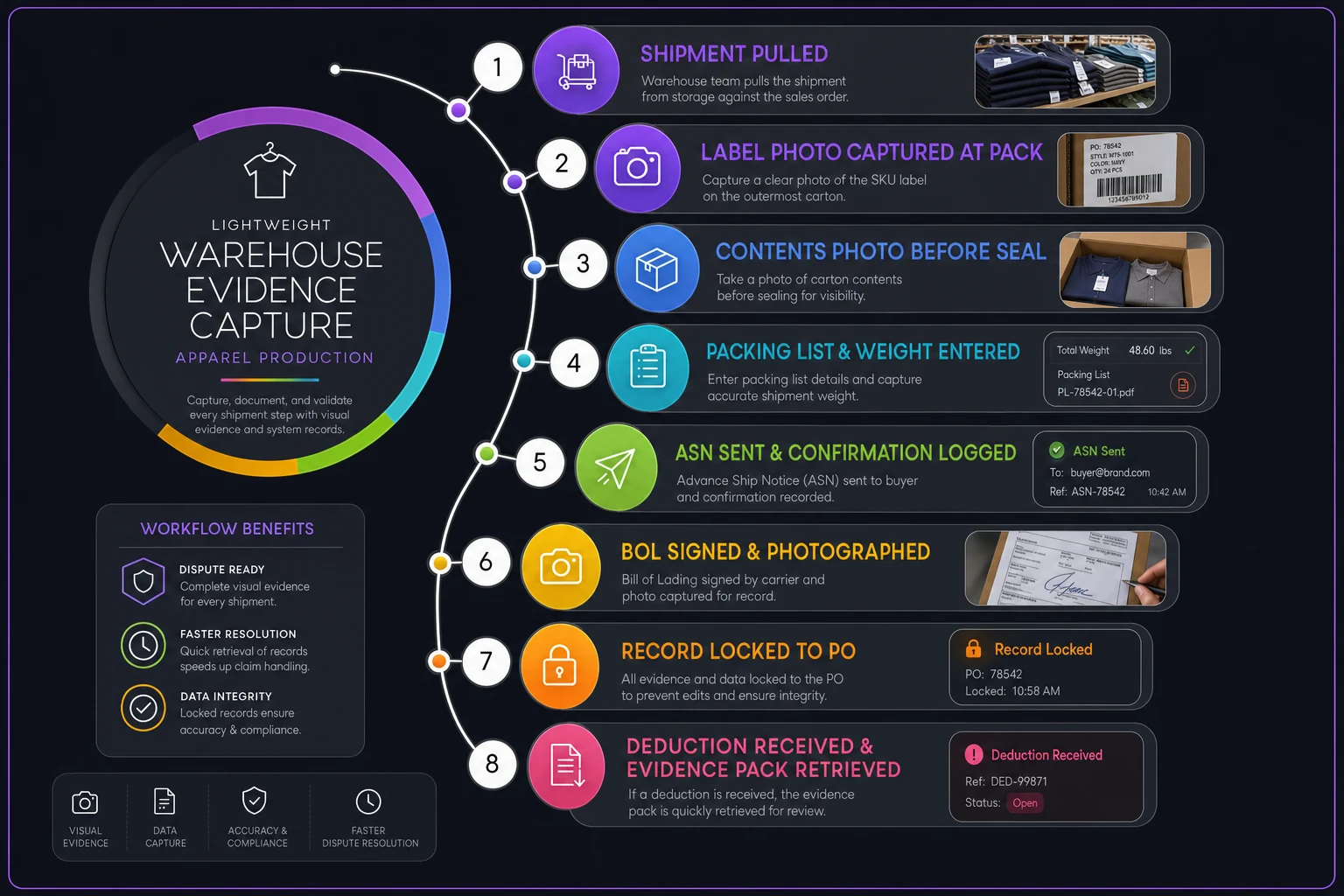
The pack lead pulls up the shipment on a tablet at the start of pack-out. As cartons are labeled, they snap the required label photo directly into the shipment record — not a separate camera roll that gets lost later. When sample cartons are filled, the contents photo goes in before sealing. Once the shipment is complete, the packing list, weight, and carton count are entered and the record is locked. The ASN goes out and its confirmation timestamp attaches to the same record. When the BOL is signed, it gets photographed in too.
One record per shipment, everything attached, timestamped, locked. When a deduction hits six weeks later, pulling the full evidence pack for PO #44821 takes thirty seconds, not a two-hour scavenger hunt across email, phone photos, and a filing cabinet.
This is where operational software with light AI automation earns its place — not as a gimmick, but as the thing that flags a missing evidence artifact before the truck leaves ("PO 44821: no carton-label photo captured"), auto-matches incoming deductions on the remittance to the right shipment record, and drafts the dispute packet by pulling the relevant photos, ASN confirmation, and packing list together. The value isn't automation for its own sake; it's that the boring, easy-to-skip steps stop getting skipped, and disputes get filed inside the window instead of after it closes.
Dispute-flow and remediation SLA
Once a deduction lands, speed and consistency decide whether you recover. A defined flow with internal SLAs keeps disputes from dying in someone's inbox.
Dispute process:
-
Deduction logged within 3 business days of appearing on the remittance, categorized by type (shortage, ASN, label, late, markdown, admin).
-
Triage against evidence — pull the shipment record. If evidence supports a dispute, proceed. If evidence shows a genuine miss, log it as a real cost and route it to root-cause; don't dispute it.
-
Dispute packet assembled within 5 business days — cover letter citing the contract clause, remittance reference, and all supporting artifacts.
-
Submit within the contractual window (whatever you negotiated — 60 days is a common target).
-
Follow-up SLA — if no response in 15 business days, escalate; if no resolution in 30, escalate to the account manager with the standstill clause referenced.
-
Close and categorize — won, lost, or partial. Feed lost/legitimate ones back into operations.
The remediation SLA cuts both ways. Internally, you commit to filing within a set window. Externally, your negotiated clauses commit the retailer to responding and documenting. Track your net deduction rate (deductions minus recoveries, as a % of program revenue) as the real scoreboard. Gross deductions will fluctuate; net is what hits margin.
Real scenario: a contemporary womenswear supplier
A mid-size womenswear supplier shipping into two department-store accounts was running gross deductions around 6.5% of wholesale revenue on one program — a mix of shortage claims, ASN-timing penalties, and label-placement fines. They were disputing almost nothing, partly because retrieving proof took too long to be worth the effort.
The fixes were unglamorous. They added the documentation-requirement and dispute-window clauses at the next term renewal (the admin-fee cap got rejected, as expected). They started capturing timestamped label and content photos on every shipment to those two accounts, plus a weigh-ticket on anything over a set dollar value. And they committed to the 3-day-log, 5-day-file internal SLA.
Over the following two seasons, most shortage claims got reversed on the strength of the sealed-carton photos and weight records — the losses were happening in the retailer's DC, not at their dock. ASN penalties dropped once late transmissions became visible and got fixed at the source. Net deductions on that program fell to somewhere in the 2–3% range. Not zero — some deductions were legitimate and got treated as real costs — but the preventable and contestable ones stopped compounding.
When this makes sense — and when it doesn't
This full stack is worth building when you ship regularly into retailers with formal vendor compliance programs and routing guides, where deductions are automated and recurring. If deductions are eating more than 3–4% of a program, the evidence-pack effort pays for itself quickly.
When it's overkill: if you're doing small DTC-adjacent wholesale or selling to independent boutiques who pay on clean invoices without a deduction program, a packing list and a couple of photos is plenty. Don't build a heavy dispute apparatus for accounts that don't run one.
Who should not lead with the clause library: brand-new suppliers desperate to land a first major account. Redlining hard on your first PO can cost you the relationship. Ship a season, prove reliability, capture evidence quietly, then negotiate terms at renewal from a position of trust.
The uncomfortable truth is that some deductions are your fault, and the discipline of building evidence packs surfaces exactly which ones. That's not a downside — it tells you where your pack line, labeling, or ship-window planning is actually failing, so you can fix the root cause instead of arguing about the symptom. Suppliers who get this right end up disputing less over time, because they're generating fewer real violations and winning the contestable ones. That's the whole game.
Ready to tailor your apparel operations?
Join 500+ fashion brands using GoTailo to accelerate product launches, reduce waste, and improve supplier collaboration.