



Your freight costs aren't just about weight and distance anymore. Two shipments with identical SKU counts heading to the same retailer can vary by 40% in shipping costs purely because of how items get packed into cartons. The problem multiplies when you're shipping mixed apparel batches — different fabrics, varying SKU dimensions, seasonal items with different packing requirements — all fighting for space in boxes that directly determine your dimensional weight charges.
Most apparel brands discover their cartonization problems backwards, when the freight invoice arrives. By then, the damage is done. Your t-shirts are rattling around in oversized boxes while your puffy jackets got crammed into cartons too small, requiring extra boxes and doubling your shipment volume.
It gets messier when you factor in consolidation windows. Miss the optimal packing moment by two days and suddenly you're shipping partial cartons at full rates because next week's production isn't ready yet. Or worse, you hold inventory waiting for consolidation that never materializes, missing delivery windows you already committed to.
Why cartonization fails specifically for apparel batches
Apparel cartonization breaks differently than other product categories. Unlike electronics with uniform packaging or home goods with predictable shapes, clothing creates packing challenges that standard cartonization logic genuinely can't handle.
The core issue is SKU variability within single shipments. A typical apparel batch might include lightweight scarves at 80 grams alongside winter coats at 1.2 kilograms, tank tops that compress to nothing next to structured blazers that can't be folded without damage. Standard cartonization software treats these items equally, optimizing purely for space without considering fabric care requirements or weight distribution.
Then there's the seasonal swing problem. Spring shipments pack efficiently — light fabrics, minimal bulk, high compression tolerance. Winter batches blow up your cubic dimensions with items that look deceptively small on the shelf but require significant carton space to avoid crushing. One brand shipping both seasons simultaneously saw freight costs swing by around 60% between March and September shipments of identical unit quantities.
Consolidation timing adds another layer. Apparel production rarely aligns perfectly. Denim might finish Tuesday, knits on Thursday, accessories scattered throughout the week. The decision becomes: ship partially filled cartons now to hit retail delivery windows, or wait for full consolidation and risk penalties? Most operations default to shipping immediately, leaving money on the table with every partial carton.
Pre-carrier documentation requirements for apparel complicate this further. Mixed apparel batches need detailed packing lists specifying not just quantities but color variants, size distributions, and often country-of-origin details for each SKU. Getting this wrong means customs delays or retailer chargebacks that dwarf any savings from better cartonization.
The actual cost breakdown when cartonization goes wrong
Poor cartonization creates cascading costs beyond just higher freight rates.
Eliminate delays in your fashion production cycle.
GoTailo helps you manage designs, orders, and inventory effortlessly, keeping production on schedule.
- Centralized order and inventory management
- Real-time supplier communication
- Integrated production scheduling
No credit card required
Take a medium-sized apparel brand shipping 300 cartons monthly to various retailers. With inefficient packing, they average 68% carton utilization — meaning nearly a third of what they ship is air. At current dimensional weight pricing, that translates to roughly $8,000-9,000 monthly in unnecessary freight charges. That's just the visible cost.
Retailer compliance penalties hit harder. Major retailers charge between $25-100 per incorrectly packed carton. Mixed SKUs in wrong ratios, improper labeling due to last-minute repacking, damaged goods from poor weight distribution — each violation adds up. One brand tracked over $3,000 monthly in compliance fees directly tied to cartonization errors.
Labor costs multiply in warehouses dealing with poor cartonization. Workers spend extra time repacking orders that don't fit planned cartons, building custom boxes for odd combinations, or unpacking and repacking at destination to meet retailer requirements. This typically adds 15-20% to fulfillment labor costs.
Then consider inventory implications. Poor cartonization often means shipping partial quantities to fit available box sizes, leaving remnants that become dead stock. Those last three units that didn't fit in the carton? They sit in inventory until the next order, if it ever comes. For seasonal apparel, that's often a write-off.
Oversized boxes for small orders make brands look wasteful. Crushed items from overcrowded cartons trigger returns. Split shipments because items wouldn't consolidate properly confuse customers and drive up service contacts.
Building your cartonization rules matrix by SKU characteristics
Weight-to-volume ratios form your foundation:
Heavy-dense items (denim, leather, thick knits): These ship best at 15-18kg per carton maximum. Beyond this, boxes become unwieldy and risk bottom blow-out during handling. These items also pack predictably — you can hit 85-90% carton utilization consistently.
Light-bulky items (puffer jackets, sweaters, fleece): Dimensional weight kicks in hard here. Your target shifts to maximizing carton size up to carrier limits (typically 130-160cm combined dimensions) while staying under 10kg actual weight. Compression tolerance varies wildly — technical fabrics bounce back, natural fibers might not.
Light-dense items (t-shirts, underwear, socks): These create your best consolidation opportunities. They fill gaps, even out weight distribution, and compress without damage. Target 90-95% utilization, but watch for weight concentration creating handling problems.
Structured items (blazers, dress shirts, formal wear): These can't compress and need breathing room to prevent wrinkles. Accept 70-75% utilization as optimal — the alternative is returns and repairs that cost far more than shipping air.
| Category | Guidance |
|---|---|
| Heavy-dense items | These ship best at 15-18kg per carton maximum. Beyond this, boxes become unwieldy and risk bottom blow-out during handling. These items also pack predictably — you can hit 85-90% carton utilization consistently. |
| Light-bulky items | Dimensional weight kicks in hard here. Your target shifts to maximizing carton size up to carrier limits (typically 130-160cm combined dimensions) while staying under 10kg actual weight. Compression tolerance varies wildly — technical fabrics bounce back, natural fibers might not. |
| Light-dense items | These create your best consolidation opportunities. They fill gaps, even out weight distribution, and compress without damage. Target 90-95% utilization, but watch for weight concentration creating handling problems. |
| Structured items | These can't compress and need breathing room to prevent wrinkles. Accept 70-75% utilization as optimal — the alternative is returns and repairs that cost far more than shipping air. |
Size mix within cartons matters more than you'd expect:
The worst cartonization mistake happens when systems treat a size small the same as a size XXL. A men's XXL jacket takes up nearly 2.5 times the volume of a small. Mixed-size cartons need careful ratio planning.
-
Single-size cartons when possible (highest efficiency)
-
S/M together, L/XL together (minimal volume variance)
-
Full size runs only for coordinated sets going to the same destination
Never mix adult and children's sizes in the same carton unless specifically requested by the retailer. The volume differences create unstable packing that shifts during transport.
Consolidation timing rules that actually reduce costs
The consolidation window calculation for apparel runs on three variables: production completion, delivery requirements, and freight cost breaks.
Map your production flow reality first. Track when different categories actually finish production, not when they're supposed to. Knits typically run 2-3 days behind wovens. Accessories arrive sporadically. Embellished items need extra quality checks. Your consolidation windows have to account for these patterns or you'll consistently miss opportunities.
The 48-72 hour rule works for most apparel operations: if items finishing production fall within a 72-hour window AND ship to the same destination, hold for consolidation. Beyond 72 hours, the inventory carrying cost and delivery risk usually outweigh the freight savings.
Modify this based on destination and value though. High-value items (leather goods, designer pieces) justify longer holds — up to 5 days — because the per-unit freight impact is proportionally smaller. Fast-fashion basics need to move immediately; a 3-day delay might mean missing the trend window entirely.
Create specific triggers for breaking consolidation:
-
Carton reaches 85% capacity
-
Oldest item in consolidation hits 48 hours
-
Next production batch is more than 72 hours away
-
Customer specifically requests partial shipment
International shipments flip the equation. The consolidation window expands to 5-7 days because freight costs jump dramatically and transit times already run long. One extra week rarely matters on a 4-week ocean shipment, but splitting that shipment doubles your documentation work and often triggers minimum charges.
One extra week rarely matters on a 4-week ocean shipment, but splitting that shipment doubles your documentation work and often triggers minimum charges.
Here's a simple consolidation decision workflow.
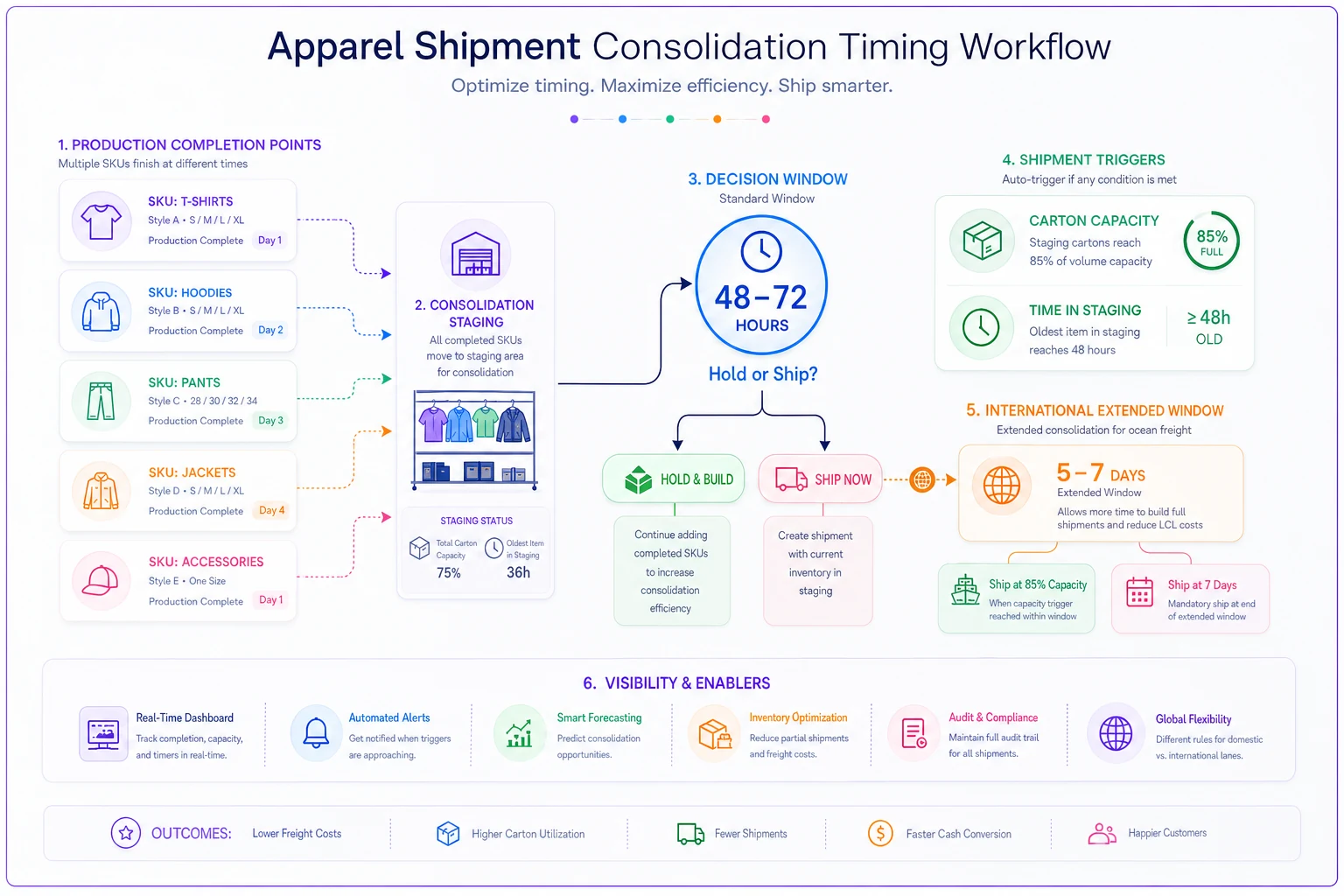
If items finishing production fall within a 72-hour window and ship to the same destination, holding for consolidation usually pays off.
International shipments flip the equation. The consolidation window expands to 5-7 days because freight costs jump dramatically and transit times already run long. One extra week rarely matters on a 4-week ocean shipment, but splitting that shipment doubles your documentation work and often triggers minimum charges.
Pre-carrier documentation setup for mixed batches
Documentation errors cost more than freight inefficiencies ever will. A single incorrect commercial invoice can trigger weeks of customs delays, storage fees, and missed delivery penalties that dwarf your entire month's freight budget.
Start with a packing list template that captures apparel-specific requirements:
Essential fields often missed:
-
Fiber composition percentages (not just "cotton blend")
-
Country of origin by component (fabric, trim, assembly)
-
Harmonized System codes at the 10-digit level
-
Care instruction codes
-
Color names in both your system and the customer's system
-
Size scales with actual measurements, not just S/M/L
Build separate templates for different destinations. Domestic shipments need basic information. International requires exponentially more detail. One universal template is a trap — you'll either over-document domestic shipments or under-document international ones.
SKU-level detail that prevents problems:
-
Exact quantity by size and color (not just total units)
-
Weight per piece and per carton
-
Fabric content in percentages that add to exactly 100%
-
Manufacturer ID numbers that match purchase orders
-
Batch or lot numbers for quality tracing
For mixed batches, sequence matters. List items in the order they're actually packed, not alphabetically or by SKU number. This helps warehouse teams verify contents without unpacking entire shipments.
Keep photography documentation for high-risk shipments. Before sealing cartons containing multiple SKUs over $50 per unit value, photograph the packed contents. It resolves disputes faster than any written documentation.
A complete cartonization checklist for apparel batches
This checklist covers every decision point from SKU selection through final shipping. Each item includes the specific check and the consequence of skipping it.
Pre-packing phase
-
Group by fabric weight category
-
Separate items requiring special handling (hanging, flat-pack)
-
Identify compression-sensitive items
Skip this: Mix incompatible items, damage goods, trigger returns
Weight distribution planning
-
Calculate total weight across all SKUs
-
Plan heavy items for bottom placement
-
Distribute weight evenly across cartons
Skip this: Boxes collapse, handling injuries, freight recalculations
Consolidation window check
-
Review production completion times
-
Identify same-destination shipments
-
Calculate hold vs. ship decision
Skip this: Ship partial cartons at premium rates
Carton selection phase
Size optimization
-
Measure largest item's minimum box requirement
-
Check carrier dimensional weight tables
-
Select smallest viable carton size
Skip this: Pay for shipping air, exceed dimension limits
Weight capacity verification
-
Check manufacturer's box weight limit
-
Factor in handling stress (usually 70% of max)
-
Account for tape and packing material weight
Skip this: Box failure, product damage, reshipment costs
Packing execution phase
Layer sequence
-
Heavy items bottom
-
Structured items middle (with support)
-
Light/compressible items top
-
Fill voids with light items
Skip this: Crushing, shifting, presentation issues
Documentation placement
-
Packing list in clear sleeve outside
-
Copy inside for international shipments
-
Invoice separate from packing list
Skip this: Customs delays, receiving rejection
Final verification phase
Weight and dimension check
-
Weigh packed carton
-
Measure all dimensions
-
Calculate dimensional weight
-
Compare actual vs. dimensional weight
Skip this: Freight cost surprises, carrier rejection
Label placement
-
Shipping label flat, readable
-
Fragile/orientation stickers if needed
-
Retailer compliance labels per requirements
Skip this: Misrouting, handling damage, compliance fines
Real cartonization examples with actual calculations
Here's exactly how cartonization decisions play out with real SKU mixes and their freight impact.
Example 1: Mixed seasonal batch
The shipment:
-
50 lightweight summer dresses (200g each)
-
50 winter sweaters (600g each)
-
100 basic t-shirts (150g each)
Poor cartonization approach:
-
Using uniform boxes, packing by product type
-
Box 1
All dresses (10kg, 60% utilization)
-
Box 2
All sweaters (30kg, 95% utilization — too heavy)
-
Boxes 3-4
T-shirts split (15kg each, 70% utilization)
Result: 4 boxes, one overweight requiring repack, dimensional weight penalty on dress box
Optimized approach:
-
Mixed packing by weight distribution
-
Boxes 1-3
Each contains 17 dresses, 17 sweaters, 33 t-shirts
-
Weight per box
18.3kg (safe handling range)
-
Utilization
88% average
Result: 3 boxes, no overweight issues, reduced freight by 25%
Example 2: Rush order consolidation decision
The scenario:
-
Monday
200 units of style A complete
-
Wednesday
150 units of style B expected
-
Thursday
Retailer delivery required
-
Freight cost
$120 for partial, $140 for consolidated
The calculation:
-
Ship Monday
$120 freight + $0 holding cost
-
Wait for consolidation
$140 freight + $15 holding cost (warehouse space) + $50 late delivery risk
Decision: Ship partial on Monday. The $20 freight savings doesn't justify the delay risk.
Example 3: International mixed-category shipment
The batch:
-
100 cotton shirts (India origin)
-
50 polyester jackets (Vietnam origin)
-
75 cotton/poly blend pants (Bangladesh origin)
Documentation requirements:
-
Three separate origin certificates
-
Mixed HS codes requiring detailed breakdown
-
Different duty rates by category
Cartonization approach:
Instead of mixing origins (documentation nightmare), pack by origin:
-
Carton 1
All India-origin items
-
Carton 2
All Vietnam-origin items
-
Carton 3
All Bangladesh-origin items
This adds one extra carton but saves hours of customs clearance time and reduces error risk considerably.
When cartonization optimization actually pays off (and when it doesn't)
Not every apparel operation benefits equally from detailed cartonization rules. Understanding when to invest effort versus when to keep things simple prevents over-engineering your packing process.
Cartonization optimization makes sense when:
-
You ship more than 100 cartons monthly. Below this volume, the time spent optimizing rarely recovers enough savings to justify the effort. Focus on basic accuracy rather than sophisticated rule-building.
-
Your product mix includes significant size and weight variance. Shipping only t-shirts in standard sizes? Complex rules won't move the needle. Mixing accessories with outerwear? That's where optimization earns its keep.
-
You face strict retailer compliance requirements. Major retailers' chargeback structures mean one poorly packed shipment can wipe out months of freight savings. Optimization becomes risk mitigation as much as cost savings.
-
International shipping makes up more than 30% of your volume. Customs delays and international freight rates magnify every inefficiency. Proper cartonization can mean the difference between profitable and unprofitable international orders.
Keep cartonization simple when:
-
You're shipping direct-to-consumer. Individual order fulfillment has different economics than bulk retail shipments. Speed matters more than perfect box utilization.
-
Your entire catalog fits similar dimensions. If everything packs roughly the same way, complex matrices just slow your warehouse down without meaningful savings.
-
You're still figuring out product-market fit. Focus on production planning and quality first. Perfect cartonization on products that might discontinue next month wastes resources better spent elsewhere.
Cartonization optimization makes sense when: You ship more than 100 cartons monthly. Below this volume, the time spent optimizing rarely recovers enough savings to justify the effort. Focus on basic accuracy rather than sophisticated rule-building.
Software and systems that handle the cartonization burden
Manual cartonization calculation breaks down around 50 cartons per week. Beyond that, the complexity of tracking SKU dimensions, optimizing combinations, and maintaining documentation accuracy overwhelms spreadsheet-based systems.
The progression typically looks like this: brands start with intuition-based packing, move to basic spreadsheet templates, then hit a wall where errors multiply faster than volume grows. That's when systematic cartonization becomes necessary.
Modern AI-powered operational software transforms cartonization from a daily puzzle into an automated workflow. Instead of manually calculating every shipment's optimal packing configuration, these platforms learn from your historical shipping data and automatically generate packing instructions that account for your specific constraints — weight limits, dimensional thresholds, retailer requirements.
The real value comes from integration. When your cartonization system connects with production planning, inventory management, and freight booking, the entire fulfillment process moves faster. The software knows what's coming off production, what's already in inventory, and what ships together. It surfaces consolidation opportunities you'd never catch manually.
For mixed apparel batches specifically, AI automation handles the complex decision trees that human workers struggle with at scale. Should those heavy jeans ship with lightweight scarves to balance dimensional weight? Can next Tuesday's accessories consolidate with today's basics? The system runs through scenarios quickly and picks the optimal configuration based on your actual costs and constraints.
The documentation component alone justifies systemization for international shippers. Automated platforms generate accurate packing lists, commercial invoices, and origin certificates without manual data entry — one error prevented can pay for months of software costs.
The bigger impact though is operational visibility. You start seeing patterns — certain SKU combinations consistently create problems, specific retailers drive most of your cartonization inefficiency, seasonal shifts hit harder than expected. Those insights drive strategic changes that spreadsheets will never surface.
Moving forward with your cartonization improvement
Cartonization might seem like a minor detail in your overall operation, but those minor details compound into real margin impact. Every poorly packed carton represents money left with carriers that should have stayed in your business.
Start with the basics: measure your current carton utilization rate and track your dimensional weight penalties for one month. You need baseline data before implementing changes. Most brands discover they're shipping at 60-70% utilization without realizing it.
Pick one product category and build your first cartonization matrix. Don't try to optimize everything at once. Get one category running efficiently, prove the savings, then expand. Mixed seasonal goods or high-value items usually offer the best initial returns.
Test your consolidation windows with actual data. Theory says wait 72 hours, but your operation might differ. Track what actually ships together versus what could have shipped together with better timing. Adjust based on what you observe, not just on general rules.
Document everything, even if your current system is purely manual. Every cartonization decision, every consolidation choice, every packing exception — write it down. This becomes the foundation for training new staff or implementing software automation later.
Perfect cartonization doesn't exist. You're optimizing across multiple variables — freight cost, delivery speed, labor efficiency, compliance requirements — that frequently conflict. The goal isn't perfection; it's measurable improvement that scales with your growth.
The apparel brands that thrive long-term treat operational efficiency as a competitive advantage. Cartonization isn't glamorous, but it directly impacts every order you ship. Get it right, and you're not just saving on freight — you're building an operation that can scale profitably while others struggle with rising logistics costs.
The apparel brands that thrive long-term treat operational efficiency as a competitive advantage. Cartonization isn't glamorous, but it directly impacts every order you ship. Get it right, and you're not just saving on freight — you're building an operation that can scale profitably while others struggle with rising logistics costs.
Ready to tailor your apparel operations?
Join 500+ fashion brands using GoTailo to accelerate product launches, reduce waste, and improve supplier collaboration.