
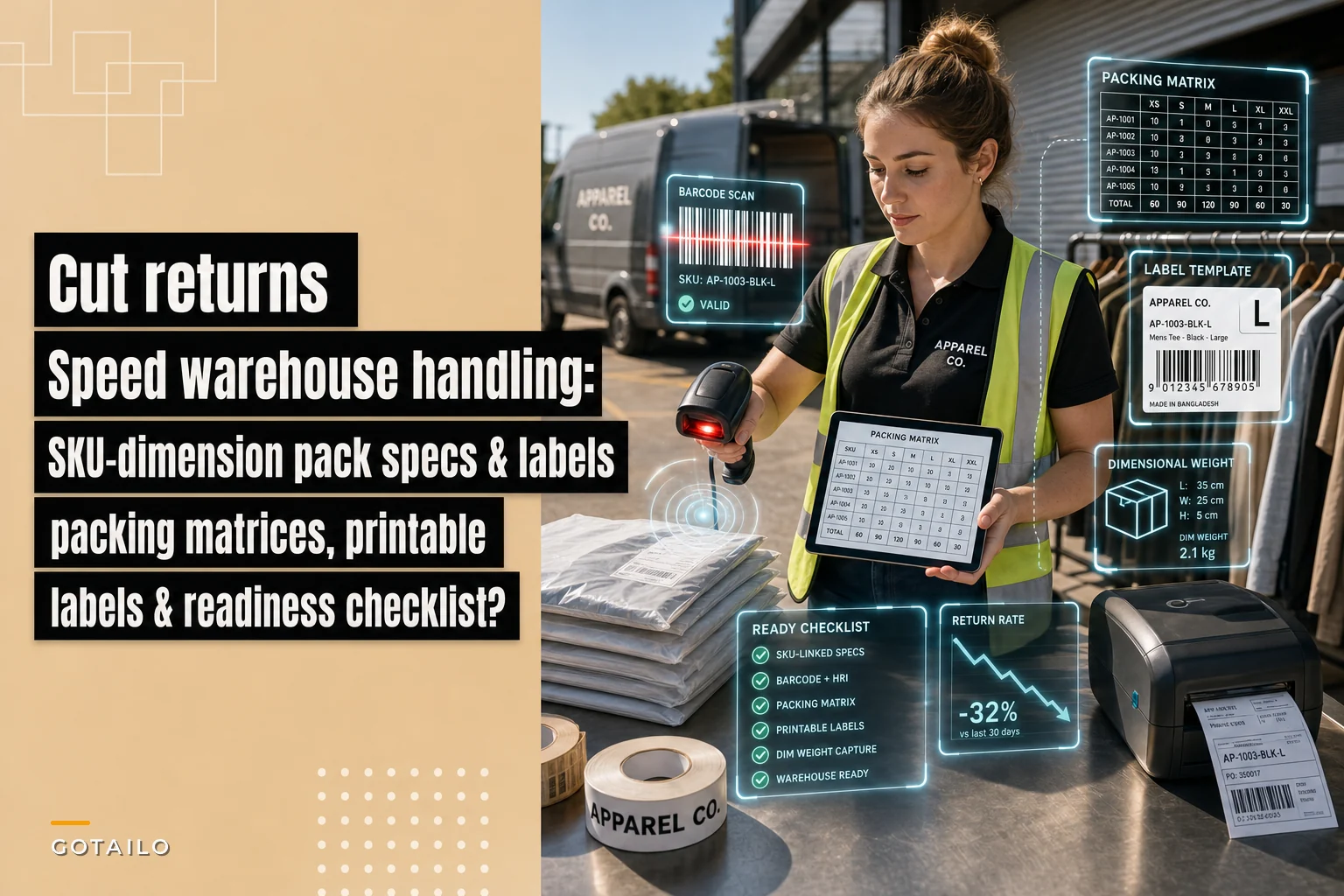

Most apparel returns don't start at checkout. They start on the packing bench, when someone grabs a polybag that's technically "close enough," folds a size M into a bag meant for an XS, and slaps on a label that says the right SKU but doesn't physically match what's inside. Multiply that across a season and you get mispicks, swollen dim weight, and a return reason code that quietly reads "not as described" when the product was fine — it was just packed wrong.
This piece is narrow on purpose. It's about the pack spec and label layer sitting between your tech pack and your carton. Not freight strategy, not reverse logistics — just the specs, templates, and matrices that make ecommerce packaging and apparel labeling consistent enough that a warehouse temp with zero fashion background can pack a drop correctly on day one.
The real failure: your pack spec lives in three different heads
This pattern shows up constantly in small apparel operations. The designer knows a certain knit dress needs tissue and a flat fold. The warehouse lead knows which polybag "usually works." The 3PL account manager has a spreadsheet from eight months ago. None of those three sources agree, and none of them are tied to the SKU at the dimension level.
So when volume spikes — a drop, a wholesale PO, a holiday push — the tribal knowledge breaks. The person who "just knew" is on vacation. The temp picks the nearest bag. And the spec that was never written down becomes a return.
This usually happens because pack specs get treated as a warehouse problem instead of a product attribute. The fix is treating pack requirements the way you treat fabric composition or care instructions: as data that belongs to the SKU and travels with it.
Tie the pack spec to SKU dimensions, not product type
The most common mistake is writing pack specs by category — "all tees get a 10x13 bag" — when the thing that actually determines packing is the folded footprint of the garment.
Eliminate delays in your fashion production cycle.
GoTailo helps you manage designs, orders, and inventory effortlessly, keeping production on schedule.
- Centralized order and inventory management
- Real-time supplier communication
- Integrated production scheduling
No credit card required
Two tees in the same style can fold to very different sizes. A boxy XS and a longline 3XL are not the same object on a bench. If your spec is keyed to "tee," you overbuy bags for the small sizes and jam the large ones. Both create problems: loose garments shift and wrinkle (more "looks used" returns), and overstuffed bags split in transit.
| Field | Example value | Why it matters |
|---|---|---|
| SKU | TEE-CRW-BLK-M | Links spec to the exact size/color |
| Folded dims (L×W×H) | 25 × 20 × 3 cm | Drives bag/box selection |
| Pack method | Flat fold, 3-fold | Removes bench guesswork |
| Primary pack | Polybag 28×22, recyclable | Exact SKU of the packaging itself |
| Protective layer | None / tissue / collar stay | Prevents crushing on delicate items |
| Units per inner | 1 | Ecomm single vs. wholesale multi |
| Label placement | Back, lower-left, 2cm margin | Scan consistency |
| Insert required | Care card, return QR | Avoids "missing info" complaints |
The key insight here: packaging itself should have a SKU. If your polybags, boxes, tissue, and cards aren't inventoried items, you can't check availability, you can't cartonize accurately, and you can't audit when the wrong bag gets used. Treat packaging like a BOM line.
Labeling: stop making people choose between barcode and human-readable
Warehouses lose time when a label is scannable but unreadable, or readable but unscannable. You need both on the same label, in a fixed layout, every time.
The barcode exists for the scanner. The human-readable block exists for the three moments a scanner isn't enough:
-
A damaged or smudged barcode that won't read
-
A packer doing a visual sanity check before sealing
-
A returns clerk eyeballing the box without opening it
A label standard that works across benches and 3PLs includes:
-
Barcode
GTIN/UPC or your internal SKU in Code 128 or GS1-128, quiet zones respected, minimum X-dimension so cheap thermal printers still scan it
-
Human-readable SKU directly under the barcode, same string, no abbreviations the packer has to decode
-
Style / color / size spelled out — "Crewneck / Black / M," not "CRW-BLK-M" only
-
Packed-for flag — ecomm single vs. wholesale pack, because they route differently
-
Batch / lot if you need traceability back to a cut order
-
Orientation marker — a small arrow or notch so labels always land the same way
Keep a printed label proof at each packing station so packers can visually confirm layout when a scan fails.
The mistake teams make is letting each printer station design its own label. Within a month you have four layouts, and the returns team can't train against any of them. Lock one template. Version it. Ship the same artifact to every packing location.
E-comm packing rules that actually reduce "not as described"
Returns coded as "not as described" or "looks used" are frequently a packing-presentation problem, not a product problem. A garment that arrives wrinkled, loose, or with a bent collar reads as lower quality than the photos even when it's identical to what the customer ordered.
-
Fold to match the listing photos. If the product shot shows a flat, crisp fold, the bench fold should produce the same silhouette out of the bag.
-
Match bag to folded dims. No more than roughly 15% slack. Too much slack = shifting and wrinkles; too little = seam stress and split bags.
-
Protect the failure points. Collars, pleats, embellishments, and leather trim get tissue or a stay. These are the items that generate the most presentation returns.
-
Insert placement is fixed. Care card and return QR go in the same spot every time so customers always find them — "where do I return this" tickets drop fast.
-
Seal and label orientation is standardized. Label faces out, same corner, so the receiving customer and the returns clerk both see it instantly.
-
No mixed SKUs in a single ecomm bag unless it's a defined bundle with its own SKU and its own pack spec.
Every point of variability in the pack process becomes a return reason you can't diagnose later. Standardize the variable, and your return reason codes finally start telling the truth.
A packing matrix the bench can actually use
A packing matrix is a one-page lookup that turns "what do I do with this SKU" into a scan-and-read action. The packer scans the SKU, the matrix returns bag, fold, protection, insert, and units-per-pack. No judgment calls.
A simplified matrix row set:
| SKU pattern | Fold | Primary pack | Protection | Insert | Units/pack |
|---|---|---|---|---|---|
| Tees (all) | 3-fold flat | Poly 28×22 | None | Care + QR | 1 |
| Knit dresses | Roll + flat | Poly 35×28 | Tissue | Care + QR | 1 |
| Structured blazers | Hanger-fold | Box 40×30×8 | Shoulder tissue | Care + QR | 1 |
| Wholesale tees | 3-fold flat | Inner poly ×6 | None | None | 6 |
Printed, laminated, taped to the bench. The knowledge leaves people's heads and lives where the work actually happens.
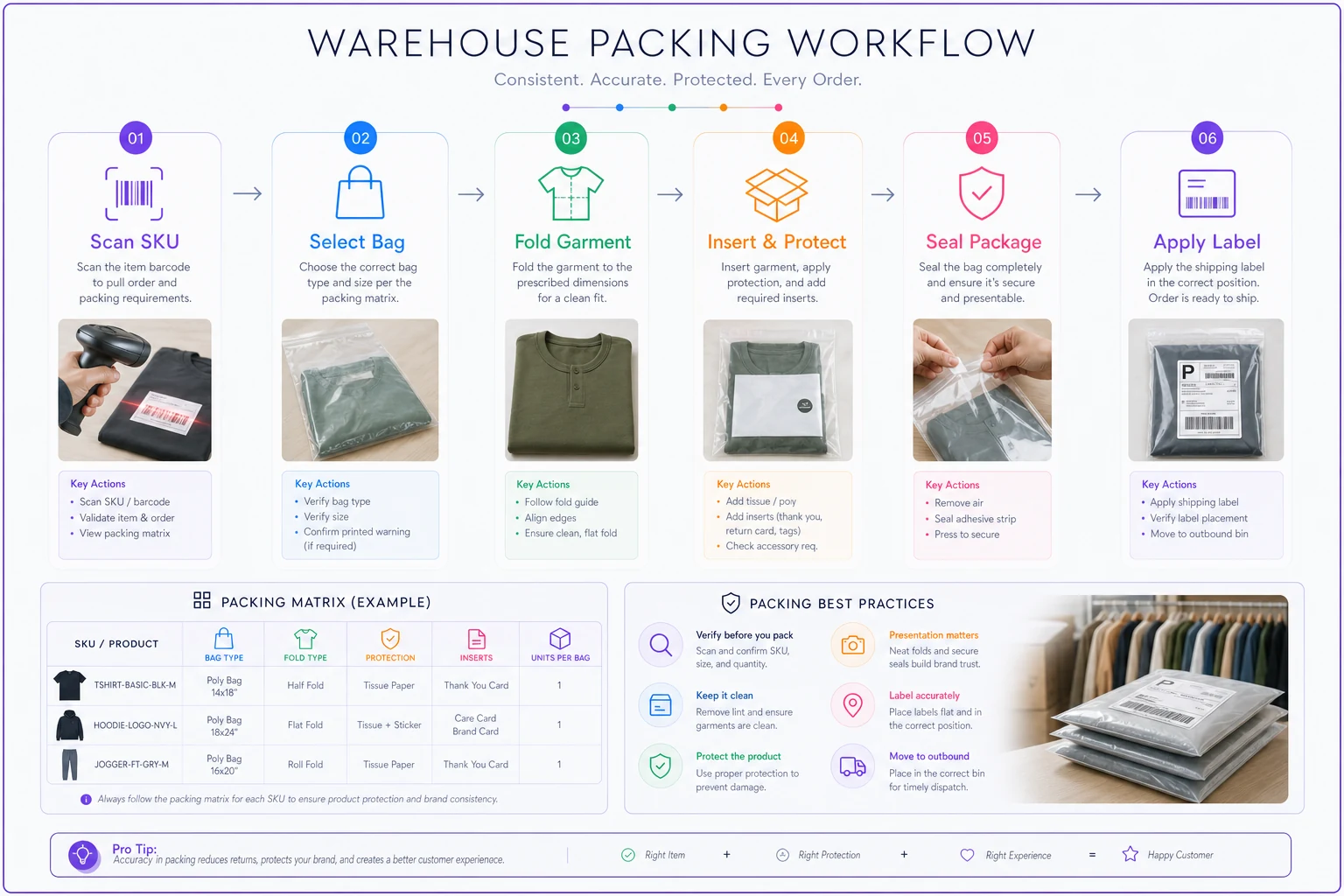
This visual maps the scan-and-follow workflow a packer uses when the matrix is posted at the bench.
A warehouse-readiness checklist before a drop goes live
Run this before the first unit of a new style hits the pack bench:
-
[ ] Every SKU has folded dimensions recorded (not estimated — actually measured)
-
[ ] Packaging items (bags, boxes, tissue, inserts) exist as inventoried SKUs with on-hand counts
-
[ ] Pack spec template filled for every SKU/size combination, not just the sample size
-
[ ] Label template locked, test-printed, and scan-verified on the actual thermal printer in use
-
[ ] Human-readable block proofread for abbreviations the bench won't recognize
-
[ ] Packing matrix printed and posted at every station
-
[ ] Ecomm vs. wholesale pack rules clearly flagged per SKU
-
[ ] Insert placement documented with a photo, not just text
-
[ ] A short first-article pack done and photographed as the reference standard
-
[ ] Return reason codes mapped so "packing" failures are separable from "product" failures
If you can't check all ten, you're shipping variability.
Real scenario: a 40-SKU spring drop
A small womenswear brand, roughly 40 SKUs across a spring drop, was running around 11–12% returns, with a chunk landing in vague buckets like "not as described" and "quality." Nobody could tell product problems from packing problems because the labels didn't carry enough info and the bench packed from memory.
They did three unglamorous things:
-
Measured folded dims for every size and tied a bag SKU to each
-
Locked a single label template with barcode plus a readable style/color/size block
-
Posted a packing matrix at each station, with a photographed first-article pack per style as the reference
Over the next two drops, the "not as described / looks used" portion of returns dropped by roughly a third. Total returns didn't vanish — real fit issues are still fit issues — but the presentation-driven returns, the avoidable ones, shrank noticeably.
The bigger operational win was quieter: packing throughput improved because nobody was stopping to ask "which bag?" and the returns team could finally sort what was a product defect versus a packing miss. That separation matters more than people realize. Once packing failures are isolated in the data, you can actually fix them — and you stop quietly refunding good product.
When this level of rigor makes sense (and when it doesn't)
When it's worth it: You're shipping across multiple SKUs and sizes, using a 3PL or temp labor, or seeing return reason codes you can't trust. The moment packing knowledge lives in one person's head and volume is rising, you're one vacation away from a bad week.
When it's overkill: A single-style operation packing 20 orders a week from a kitchen table doesn't need a dimension-tied matrix for every size. One clear sheet is enough. Build the structure when variability — SKUs, locations, people — starts outrunning memory.
Who should hold off: Brands still working through fit and sizing problems. Fix the product return drivers first. Packing specs reduce presentation and handling returns, not fundamental fit issues.
How this connects to the rest of your outbound flow
Dimension-tied pack specs don't just cut returns — they feed everything downstream. Accurate folded dimensions are exactly what you need to cartonize properly and avoid overpaying on dim weight, which ties directly into a disciplined cartonization and consolidation approach. And when returns do come back, labels carrying barcode plus batch info make triage far faster, which plugs straight into a returns triage matrix for repair, refurbish, or restock.
The through-line is simple: when pack specs and labels are tied to the SKU as data rather than living in people's heads, the warehouse stops guessing, the customer gets a package that matches the listing, and your return reasons finally become something you can act on instead of something you just absorb.
The through-line is simple: when pack specs and labels are tied to the SKU as data rather than living in people's heads, the warehouse stops guessing, the customer gets a package that matches the listing, and your return reasons finally become something you can act on instead of something you just absorb.
Ready to tailor your apparel operations?
Join 500+ fashion brands using GoTailo to accelerate product launches, reduce waste, and improve supplier collaboration.