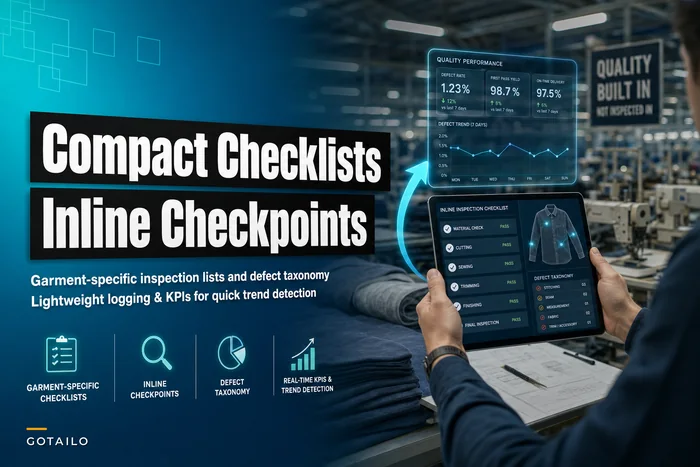



Here's the moment that wrecks a shipment window. An inline inspector flags something at the sewing line — maybe skipped stitches on a side seam, maybe a shade variance on a sleeve panel — and then everyone stops to talk about it. The line supervisor radios the floor manager. The floor manager WhatsApps the QA lead. The QA lead screenshots it to the brand's production manager, who's asleep in a different timezone. Twelve hours vanish while people debate whether this is a real problem.
By the time someone decides, the line has produced another 400 units with the same defect. Now you're not making a quality call anymore — you're managing a crisis that eats your buffer.
The fix isn't more inspection. Most teams already have decent checklists (and if you don't, start with compact cut/sew inspection lists and a defect taxonomy). The fix is removing the decision latency between finding a defect and acting on it. That's what a binary defect-to-action matrix does — it converts fuzzy judgment calls into yes/no routing that anyone on the floor can execute without waiting for someone to wake up.
Why defect decisions stall (it's not laziness)
The delay almost never comes from people not caring. It comes from ambiguity about authority and threshold.
-
Is this bad enough to act on? (threshold)
-
Who's allowed to make the call? (authority)
When both are unclear, the default behavior is to escalate upward and wait. That feels safe — nobody wants to stop a line and be wrong. But waiting is the most expensive option, because defects on a running line compound. A 2%-at-piece-rate problem becomes a lot-level problem in a single shift.
The teams who consistently protect ship dates aren't the ones with stricter inspectors. They're the ones who've pre-decided the answers to those two questions before the defect shows up. The inspector isn't deciding anything — they're matching what they see against a lookup table that already contains the decision.
The binary defect-to-action matrix
The word that matters here is binary. Every defect maps to one of two states: continue or stop-and-route. No "maybe," no "let me check with someone." Ambiguity is the enemy of a ship date.
Eliminate delays in your fashion production cycle.
GoTailo helps you manage designs, orders, and inventory effortlessly, keeping production on schedule.
- Centralized order and inventory management
- Real-time supplier communication
- Integrated production scheduling
No credit card required
A workable matrix looks like this:
| Defect class | Example | Immediate action (binary) | Who executes |
|---|---|---|---|
| Critical – safety/compliance | Needle fragment, broken snap on kidswear, mislabeled fiber content | STOP lot, quarantine, auto-escalate Tier 3 | Any inspector, no approval needed |
| Major – function/fit | Seam slippage, misaligned panels, zipper failure | STOP affected bundle, route to repair, flag at threshold | Line QA |
| Minor – cosmetic | Loose thread, faint press mark, small shade drift within tolerance | CONTINUE, log, review at AQL gate | Inspector logs only |
| Borderline – measurement | Spec out by 0.5–1cm on a non-critical POM | CONTINUE under watch, recheck next bundle | Line QA |
The part most teams miss: the matrix has to specify who executes, not just what happens. A critical defect — any inspector can halt the lot, no approval required. A minor defect — nobody halts anything, they just log it. The authority is baked into the row.
Here's a simple workflow showing how a defect flows through the binary matrix and escalation tiers.
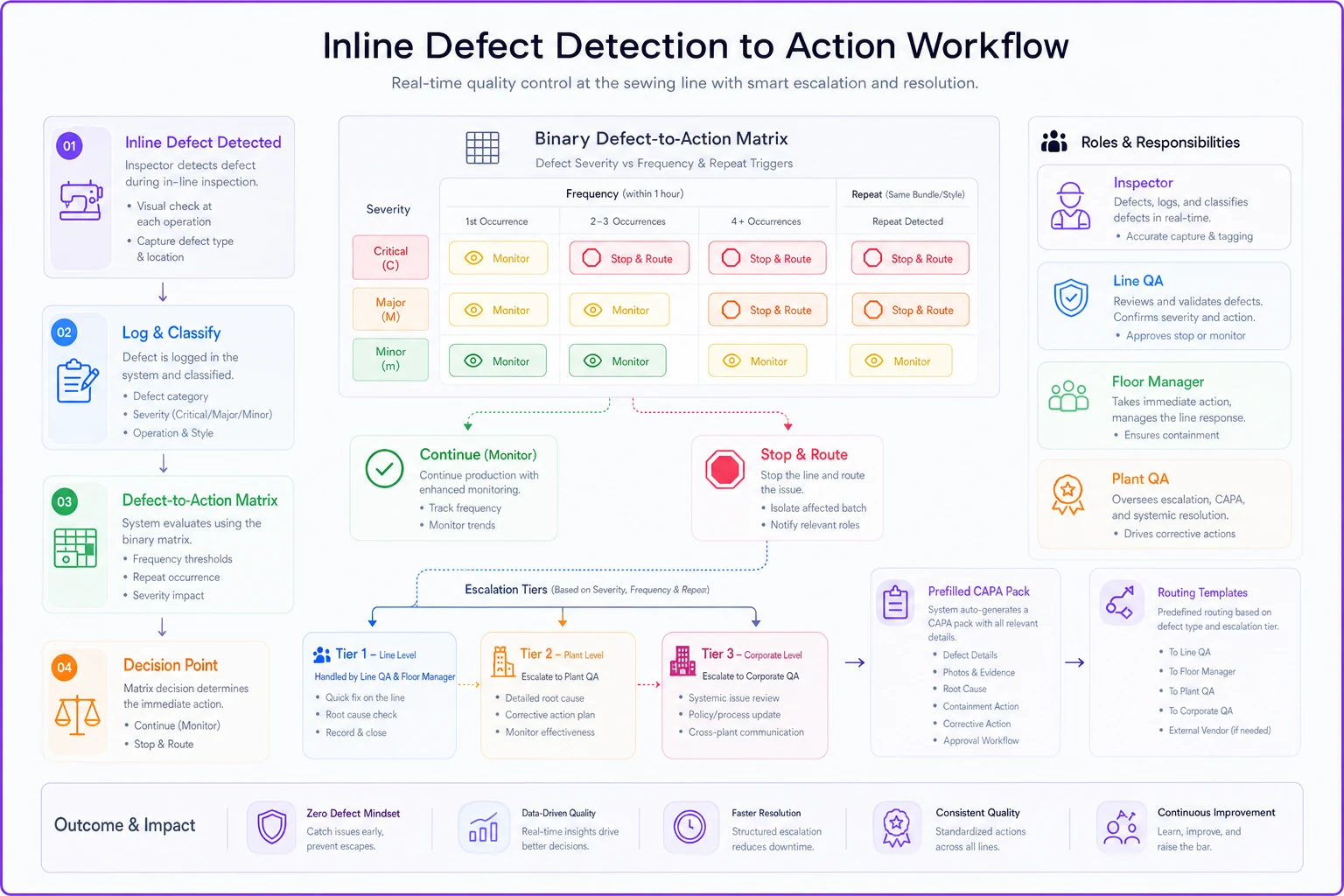
This also kills the two classic failure modes: the over-escalator who stops the line for a loose thread, and the under-escalator who waves a compliance defect through because "it's just one." Both are decisions the matrix has already made for them.
Auto-escalation rules: stop the WhatsApp relay
This is the part that actually saves the hours. Escalation can't depend on someone deciding to escalate — it has to trigger on a rule.
-
Severity trigger — any critical-class defect escalates immediately to Tier 3, no counting required. One is enough.
-
Frequency trigger — a major defect appearing more than X times per bundle or exceeding a running rate (say, 3 occurrences in 2 consecutive bundles) auto-escalates from line QA to the floor manager.
-
Repeat trigger — the same defect type recurring after a corrective action was already logged jumps straight to the brand's production manager, because it means the first fix didn't take.
Frequency and repeat triggers matter more than severity for protecting ship dates. Critical defects are rare and obvious. The ones that quietly blow your window are major defects drifting upward in frequency while everyone assumes it's under control. A rule that fires at "3 in 2 bundles" catches that drift before it becomes a lot-level rework problem.
A simple escalation tier structure:
| Tier | Owner | Response window | Authority |
|---|---|---|---|
| Tier 1 | Line QA | Immediate, at station | Halt bundle, route repair |
| Tier 2 | Floor manager | Within 30 min | Halt line section, reassign |
| Tier 3 | Plant QA + brand PM | Within 2 hrs | Hold lot, re-AQL, CAPA |
The 30-minute and 2-hour windows aren't decoration. Put them in writing and escalation stops being a favor someone does — it becomes a commitment someone's accountable for.
AQL-adjusted gating that respects the calendar
Standard AQL sampling tells you whether a lot passes or fails. It doesn't tell you what to do when a lot marginally fails three days before a vessel cutoff. That gap is where ship dates die, because teams either reject the whole lot and miss the window, or wave it through and eat a chargeback later.
AQL-adjusted gating means the acceptance decision factors in time remaining, not just defect count. Not by lowering your quality bar — by routing differently depending on where you are in the window.
A practical gating logic:
-
Run the standard AQL inspection and get your defect count against the acceptance number.
-
If it passes clean — release, done.
-
If it marginally fails on minors only — check the calendar. Inside buffer? Reject and rework. Outside buffer, tight to cutoff? Trigger a 100% sort on the specific minor defect rather than rejecting the whole lot, so good units still ship.
-
If it fails on majors — reject regardless of calendar. No time pressure justifies shipping functional defects.
-
If it fails on criticals — stop everything. Calendar is irrelevant.
The calendar only ever influences the minor path. Majors and criticals ignore the clock completely. That's what keeps gating from becoming an excuse to ship bad product under deadline pressure — which is exactly the kind of shortcut that turns into the QMS mistakes that quietly cost programs time and margin.
A 100% sort sounds expensive, but on a cosmetic minor it's often faster and cheaper than a full lot reject plus a re-cut. On a 2,400-unit order with roughly a 3% minor cosmetic rate, sorting pulls maybe 70 units for touch-up and ships the rest on time — versus rejecting the lot and blowing a two-week window.
Prefilled CAPA packs: the real time thief
Corrective action paperwork is where recovery time quietly leaks away. Someone has to describe the defect, photograph it, pull the PO and style number, name a root cause, assign an owner, set a due date. Done manually, mid-crisis, that's 45 minutes to an hour per CAPA — and it usually gets done after the shipment decision instead of driving it.
Prefilled CAPA packs flip that. The moment a Tier 2 or Tier 3 escalation fires, the pack is already populated with:
-
Defect class and description (pulled from the matrix row)
-
Style, PO, cut order, line, and bundle reference
-
Photo attachment from the inspection log
-
The escalation trigger that fired and the timestamp
-
A root-cause prompt list tied to that defect type (needle, tension, operator, fabric lot, pattern)
-
Owner auto-assigned by tier
-
A due date calculated backward from the ship cutoff
The person doesn't write the CAPA. They confirm it and pick the root cause. That turns an hour into a few minutes — which matters enormously when you're trying to figure out whether a fix fits inside your remaining window.
One thing worth noticing: when CAPA packs are prefilled, root-cause quality actually goes up, not down. People aren't exhausted from data entry, so they spend their attention on the part that actually needs judgment — the cause — instead of burning it on retyping a PO number.
Auto-routing templates and escalation playbooks
The matrix decides what. Routing templates decide where it goes next. These are short, repeatable scripts for each defect class so nobody improvises under pressure.
> Trigger: Same major defect, 2nd occurrence after CAPA logged. > Route: Hold affected bundles → notify floor manager + plant QA → attach prefilled CAPA with prior CAPA reference → re-AQL the holding lot → brand PM notified with ship-date impact flag. > Clock: Resolution target = ship cutoff minus 48h.
Build one of these for your top 8–10 recurring defects and you've covered the large majority of real floor events. The long tail of rare defects can default to Tier 3 and a human.
The escalation playbook is the companion doc that answers "and then what?" for each tier — who gets called, what decision rights they have, what the fallback is if the owner doesn't respond inside the window. Its one job is to guarantee no escalation ever sits in limbo waiting on someone who's offline.
A real scenario
A mid-sized contract manufacturer running women's woven tops had a recurring collar-point puckering issue — a major defect, fixable, but one that kept surfacing late. Their old process: inspector flags it, messages fly around, a decision lands roughly 8–10 hours later, and by then a full day's output carries the same fault.
On one order of about 3,200 units for a retailer with a hard vessel cutoff, that lag cost them a 9-day delay and a split shipment with air freight on the balance — somewhere in the range of $4k–$5k in unplanned freight plus a partial chargeback.
After putting in a binary matrix with a frequency trigger (3 in 2 bundles) and prefilled CAPA packs, the same defect on a later order got caught and escalated inside the first hour. The line section stopped, the tension setting was corrected, and roughly 180 units needed touch-up instead of 900+. The lot shipped on the original window. No air freight, no chargeback. The difference wasn't better inspectors — it was that the decision had already been made before the defect appeared.
When this makes sense — and when it doesn't
This works well when:
-
You run inline inspection and have a defect taxonomy already in place.
-
Your ship windows are tight enough that decision latency actually costs money.
-
You work across timezones, so waiting on a human approval is structurally slow.
This is overkill when:
-
You're doing short domestic runs with the decision-maker standing on the floor. If the person who can halt the line is ten feet away, a formal matrix adds process without saving time.
-
Your volumes are small and defects are rare enough that each one genuinely deserves a conversation.
Who should NOT bolt this on yet: teams without a reliable defect taxonomy or a working inline checkpoint routine. The matrix is only as good as the classification feeding it. If "major" and "minor" mean different things to different inspectors, binary routing just automates inconsistency faster. Fix the taxonomy first.
Where software quietly helps
None of this requires software — plenty of factories run a printed matrix and a phone tree and do fine. But the moment you want auto-escalation to fire on frequency triggers, or CAPA packs to prefill from the inspection log, or escalations to reassign automatically when an owner doesn't respond inside their window, you're describing workflow automation.
An AI-powered operational platform with inspection logging, rule-based escalation, and templated CAPA can run these triggers without anyone remembering to. The value isn't the dashboard — it's that the clock-sensitive decisions happen on time even when the right human is asleep.
The takeaway
Protecting a shipment window during an inline defect event is almost never about catching more defects. It's about collapsing the gap between found and acted on.
A binary matrix removes the ambiguity. Auto-escalation rules remove the waiting. AQL-adjusted gating keeps the calendar from forcing bad shortcuts. Prefilled CAPA packs give you the fix without the paperwork tax. Decide the answers before the defect shows up, and the defect stops being the thing that kills your date.
Ready to tailor your apparel operations?
Join 500+ fashion brands using GoTailo to accelerate product launches, reduce waste, and improve supplier collaboration.