

You check a batch of hoodies at 9am. Find defects in 18% of them. Now what?
Most apparel quality management systems stop right there. Inspection done, defects logged, move on to the next batch. But the real damage happens in the space between finding those defects and your next production run. That's where schedules collapse, margins evaporate, and small problems compound into major operational failures.
The disconnect between quality control and actual production operations kills more apparel businesses than bad designs or slow sales ever will. Not because quality isn't important — everyone knows it matters — but because the systems most manufacturers use treat quality as a separate function instead of an integrated operational component.
Why traditional QMS approaches break down in apparel manufacturing
Traditional quality management came from industries where production stays relatively stable. Make the same widget thousands of times, measure defect rates, adjust the machine settings, repeat. But apparel production operates differently. You're dealing with fabric variations, seasonal changeovers, different sewing operators across shifts, constantly shifting SKU mixes, and customers who expect both speed and perfection.
The standard approach looks something like this: inspection happens at predetermined points, someone records defects in a spreadsheet or basic database, quality reports get generated weekly or monthly, and management reviews them in meetings where they discuss "continuous improvement." Meanwhile, your production floor keeps running with the same problems because there's no real connection between what inspection finds and what production actually does tomorrow morning.
Think about what happens when you discover those defective hoodies. First, someone needs to decide whether to rework them or scrap them. That decision depends on the defect type, available capacity, deadline pressure, and rework cost versus replacement cost. But who makes that call? How fast? Based on what data?
Then comes the scheduling impact. If you rework, you need operator time. But those operators were already scheduled for the next batch. So either you delay the next batch, pull in overtime, or let quality slide. Each choice cascades through your operation. Delayed batches affect shipping dates. Overtime inflates labor costs. Lower quality standards damage your reputation.
Cost tracking gets even messier. That 18% defect rate translates to real money, but most operations can't tell you exactly how much. There's the obvious material waste, sure. But what about the inspection time, the rework labor, the scheduling disruption, the expedited shipping to make deadlines, the customer service time handling complaints? These costs hide across different departments, different spreadsheets, different systems.
The hidden multiplication effect of disconnected quality data
Quality problems multiply when your systems don't talk to each other. A cutting error that creates fit issues might not get caught until final inspection. By then, you've invested sewing time, pressing time, finishing time into defective pieces. The earlier you catch problems, the less they cost — everyone knows this. But knowing it and building systems that actually enable it are completely different things.
Eliminate delays in your fashion production cycle.
GoTailo helps you manage designs, orders, and inventory effortlessly, keeping production on schedule.
- Centralized order and inventory management
- Real-time supplier communication
- Integrated production scheduling
No credit card required
I walked through a mid-size manufacturer's operation last year where they were producing athletic wear for several regional brands. They had inspection stations, quality metrics, even fancy charts on the walls showing defect trends. Looked professional. But when we traced what actually happened after inspections, the reality was chaos.
Quality inspectors logged defects in one system. Production supervisors scheduled work in another. The accounting team tracked costs in QuickBooks. Customer service handled complaints through email. Nobody had visibility into the complete picture. The owner thought their defect rate was around 8% because that's what final inspection showed. But when we connected all the data points — including customer returns, rework time, and internal rejections — the real quality cost was consuming 23% of their gross margin.
The multiplication happens because each quality failure triggers multiple downstream actions that never get properly tracked or connected. A batch with sewing defects doesn't just need rework. It disrupts the cutting schedule for the next style because operators are tied up fixing problems. It delays shipments which triggers expedited freight charges. It increases customer complaints which consume service hours and damage reorder rates.
Where inspection and production scheduling actually collide
Production scheduling in apparel already involves juggling fabric availability, operator skills, equipment capacity, and delivery deadlines. Add quality issues to this mix without proper integration, and scheduling becomes pure reactive firefighting.
Monday morning inspection flags color matching issues on 200 units scheduled to ship Thursday. The fabric team says they can get replacement material by Tuesday afternoon. But the sewing line scheduled for this rework is already committed to a rush order. The supervisor makes a gut call — delay the rush order, eat the penalty, fix the color issue. Except nobody told the cutting room, so they prep the rush order materials anyway. Tuesday afternoon arrives, the replacement fabric is slightly different than expected, requiring pattern adjustments nobody planned for.
By Wednesday, both orders are behind, overtime is mounting, and everyone's pointing fingers. The quality team says they flagged the issue immediately. Production says they weren't given realistic options. Planning says nobody communicated the changes. Accounting just sees labor costs spiraling with no clear attribution.
The real problem isn't any individual decision. It's that inspection results don't automatically flow into scheduling logic. When your QMS operates separately from production planning, every quality issue becomes a manual scramble to reorganize work that's already in motion.
This diagram shows how inspection results should feed into scheduling, rework routing, and cost calculation to avoid cascading delays.
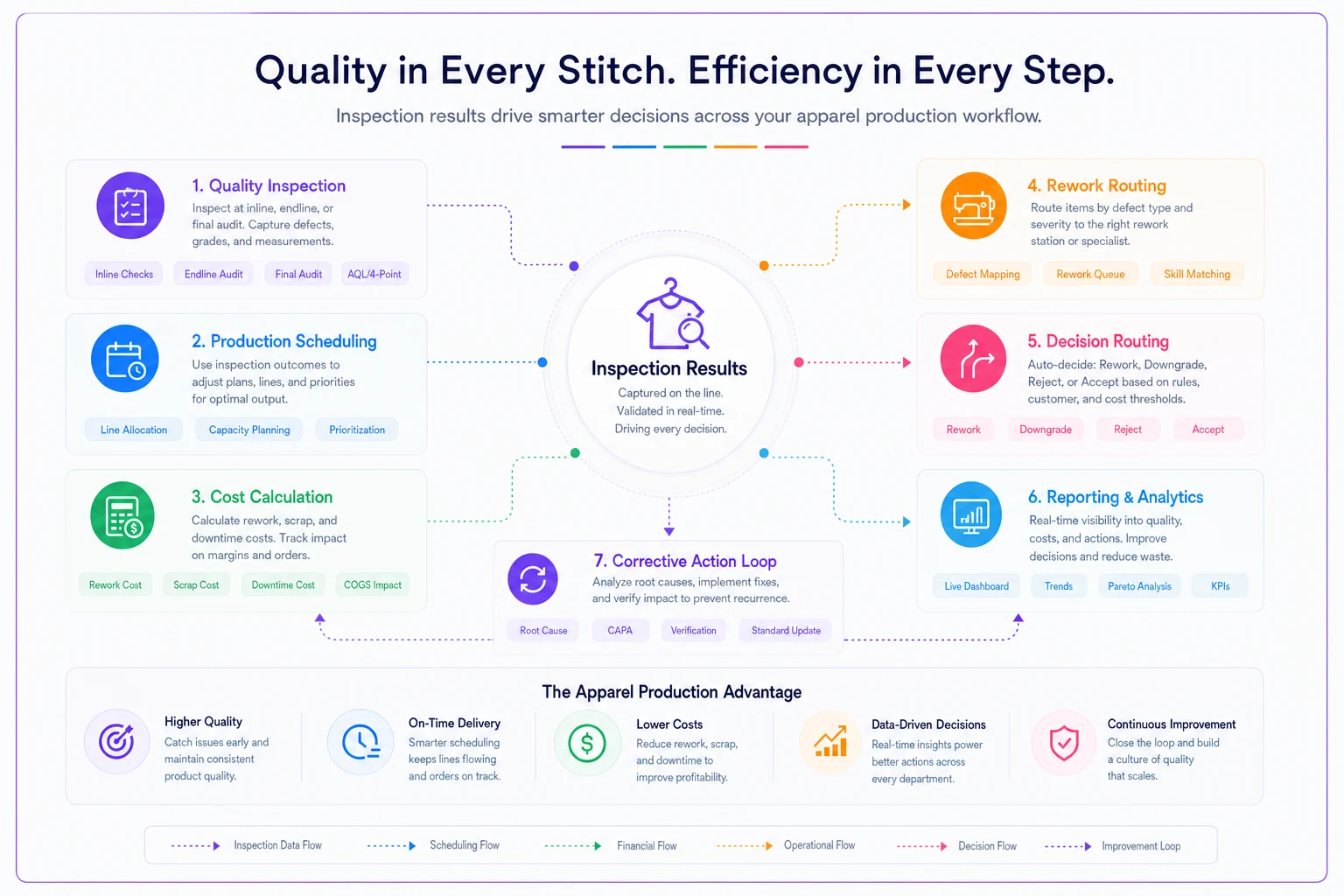
When inspection results flow directly into scheduling logic, decisions are faster and trade-offs are clearer, reducing the need for reactive firefighting.
Building cost-per-defect visibility that actually matters
Most apparel operations track defect rates but not defect costs. They'll tell you "we had 8% defects last month" but can't answer "what did those defects cost us?" or more importantly, "which defects cost us the most?"
Real cost-per-defect tracking needs to capture:
Direct rework costs:
-
Labor hours for fixing
-
Additional material if needed
-
Equipment time consumed
-
Quality re-inspection time
Indirect operational costs:
-
Schedule disruption impacts
-
Expedited shipping charges
-
Overtime premiums triggered
-
Opportunity cost of delayed orders
Customer impact costs:
-
Return processing
-
Replacement shipments
-
Service team time
-
Lost repeat business
Without connecting these elements, you're making quality decisions blind. You might spend hours perfecting minor stitching issues while color consistency problems that actually drive returns go unaddressed.
A sportswear manufacturer I worked with discovered their highest defect count came from loose threads — nearly 40% of all issues flagged. Management wanted a major initiative to address it. But when we built proper cost tracking, loose threads averaged $1.20 per defect to fix (quick trimming), while zipper problems, only 3% of defects, averaged $24 per defect because they required complete garment disassembly. Guess which problem actually mattered to profitability?
The corrective action flow nobody actually follows
Every QMS includes corrective action procedures. Documents get filled out, root causes get identified, preventive measures get documented. Then the same problems happen next month because the corrective action system operates in isolation from daily production reality.
Standard corrective action flows assume problems have clear causes that can be permanently fixed through training or process changes. But apparel production faces constantly shifting variables. New fabric batches behave differently. Seasonal humidity affects material handling. Operator skill varies with turnover. Customer requirements evolve with fashion trends.
Effective corrective action in apparel needs to be dynamic and connected to real operations. When cutting discovers fabric flaws, that information should immediately flow to purchasing for supplier feedback, to planning for order adjustments, and to quality for inspection priority changes. When sewing finds construction issues, it should trigger pattern reviews, operator coaching schedules, and automatic flagging of similar styles in production.
Standard procedure: Someone writes up a corrective action report. It goes into a folder or database. Maybe there's a meeting about it. Perhaps some training gets scheduled for next month. Meanwhile, production keeps running with the same issues because the corrective action system doesn't actually connect to how work gets scheduled and executed today.
Creating inspection triggers that prevent cascade failures
The most expensive quality problems aren't the ones you catch — they're the ones that cascade through your operation before detection. A cutting error that affects 500 pieces. A dye lot variation that makes three days of production unmatchable. A pattern problem that doesn't show up until customer try-ons.
Smart apparel quality management systems create inspection triggers at cascade prevention points, not just traditional checkpoints. This means thinking about where problems multiply rather than where they're convenient to check.
For example, instead of just inspecting after cutting, you build triggers based on:
-
New fabric roll starts
-
Operator shift changes
-
Style changeovers
-
Equipment maintenance windows
-
Environmental condition changes
These triggers should automatically generate focused inspection requirements that feed directly into production decisions. Not another report that gets reviewed next week, but real-time guidance that affects what happens in the next hour.
Prioritize triggers for new fabric rolls and style changeovers since those are common multiplication points.
A children's wear manufacturer restructured their inspection triggers around multiplication points and saw dramatic improvements. Instead of standard hourly checks, they triggered inspections based on material changes and style complexity. High-risk combinations (new fabric + complex construction) got intensive early inspection. Low-risk combinations (repeat materials + simple styles) got streamlined checking. Defects caught before cascade points dropped their total quality costs by roughly 30% without adding inspection labor.
The rework ledger that tells the truth about your operation
If you want to understand where an apparel operation really struggles, look at their rework patterns. Not the defect log — the actual rework ledger that tracks what gets fixed, when, by whom, and at what cost. Most operations don't maintain this visibility because rework gets buried in general production time.
A proper rework ledger connects several data streams:
| Rework Element | What to Track | Why It Matters |
|---|---|---|
| Defect Origin | Which operation created the issue | Identifies training needs and equipment problems |
| Detection Point | Where the problem was found | Shows inspection effectiveness gaps |
| Rework Method | How the issue gets fixed | Reveals cost and time requirements |
| Operator Assignment | Who does the rework | Highlights skill gaps and capacity constraints |
| Time Investment | Actual hours spent | Exposes true cost impact |
| Success Rate | First-time fix percentage | Indicates problem complexity |
This ledger shouldn't be another isolated report. It needs to feed into production planning, operator scheduling, and cost accounting. When rework patterns show certain operators consistently fix specific problems faster, scheduling should automatically route that work to them. When certain defect types show low first-time fix rates, quality should flag them for different handling.
Connecting quality data to customer experience outcomes
Most apparel quality management systems miss the connection between internal defects and actual customer experiences. You might track that 5% of products have minor stitching irregularities, but do you know if customers actually care? Meanwhile, sizing inconsistencies that barely register in quality reports might drive 30% of your returns.
Building this connection requires linking quality data with:
-
Return reasons and rates
-
Customer complaint categories
-
Review sentiment analysis
-
Repeat purchase patterns
-
Customer lifetime value impacts
One athletic apparel brand found their highest internal defect category (slight color variations between panels) generated almost no customer complaints. But fit inconsistencies, which they considered acceptable within tolerance ranges, drove 60% of negative reviews. They restructured their entire QMS priorities around customer-perceived quality rather than technical perfection.
Why AI-powered operational software changes the quality equation
Traditional quality management software treats data as something to store and report. You log inspections, generate reports, review metrics. But modern AI-powered operational software can actually analyze patterns, predict problems, and automatically adjust workflows based on quality trends.
The key difference is integration and intelligence. When quality data flows directly into scheduling systems, cost tracking, and corrective action workflows, AI automation can spot patterns humans miss. It notices that defect rates spike every time humidity exceeds 70% and automatically adjusts inspection frequencies. It recognizes that certain fabric-operator combinations consistently cause problems and flags them for additional oversight. It calculates the real-time cost impact of quality decisions and guides better choices.
This isn't about replacing human judgment — it's about connecting information that traditionally sits in silos. When an inspector finds defects, the system immediately calculates rework costs, checks available capacity, evaluates deadline impacts, and presents options with clear trade-offs. When patterns emerge across batches, the system triggers preventive actions before problems multiply.
Building quality systems that scale with growth
Small apparel operations often start with simple quality checks and basic tracking. This works when you're producing 100 pieces a week with two product lines. But as you scale to thousands of pieces across dozens of styles, those simple systems break down. The challenge is building quality infrastructure that can grow with your operation without becoming bureaucratic overhead.
Scalable apparel quality management systems share certain characteristics:
-
They integrate deeply with production operations rather than running parallel to them. Quality data directly affects scheduling decisions, cost calculations, and capacity planning.
-
They automate routine decisions while escalating complex ones. The system handles standard rework routing while flagging unusual patterns for human review.
-
They connect upstream and downstream impacts. A cutting problem triggers immediate downstream inspections and upstream supplier notifications.
-
They provide role-specific visibility. Operators see quality requirements for their current work. Supervisors see trend patterns. Managers see cost impacts.
-
They adapt to changing conditions. Seasonal variations, new product introductions, and customer requirement changes automatically adjust quality parameters.
Most importantly, they treat quality as an operational function, not a compliance exercise. Every quality action connects to real production decisions that affect real business outcomes.
The path from reactive to proactive quality management
Moving from firefighting quality problems to preventing them requires more than better inspections or stricter standards. It needs systems that connect quality data to every aspect of your operation — from material purchasing through customer delivery.
Start by mapping where quality information currently stops flowing. Usually, it's at the handoff between inspection and production scheduling. Build connections there first. Make inspection results immediately visible to production planners. Create automatic triggers that adjust schedules based on defect patterns. Track the real costs of quality decisions.
Then expand the connections. Link quality trends to supplier scorecards. Connect customer complaints to specific production batches. Build feedback loops that turn quality insights into operational improvements.
The goal isn't perfection — it's building systems where quality information drives better decisions throughout your operation. When everyone from cutting room operators to shipping coordinators understands how their work affects quality costs and customer satisfaction, the entire operation improves.
Modern operational platforms make these connections possible through AI automation that continuously analyzes patterns and adjusts workflows. But the fundamental shift is thinking about quality as an integrated operational system rather than a separate inspection function.
Making quality management work in real apparel operations
The apparel operations that maintain both quality and profitability don't have perfect products — they have connected systems. Their inspection results flow directly into scheduling. Their cost tracking captures true quality impacts. Their corrective actions actually prevent recurring problems.
Building these connections doesn't require massive technology investments or operational overhauls. Start with one connection — link inspection results to rework scheduling. Track the time and cost impacts. Use that data to make better production decisions. Then add another connection, and another.
The difference between apparel operations that struggle with quality and those that master it isn't about inspection frequency or defect standards. It's about building systems where quality information drives operational decisions in real-time, where problems get caught before they multiply, and where the true cost of quality guides priority decisions.
Your quality management system should tell you not just what went wrong, but what it cost you, how to fix it efficiently, and how to prevent it tomorrow. When inspection, scheduling, cost tracking, and corrective action work as an integrated system rather than isolated functions, quality becomes a competitive advantage rather than an operational burden. The question isn't whether you need better quality management — it's whether your current approach actually connects to how your operation runs, scales, and makes money. If quality data sits in reports while production scrambles to fix problems, you're leaving both margin and reputation on the table.
Ready to tailor your apparel operations?
Join 500+ fashion brands using GoTailo to accelerate product launches, reduce waste, and improve supplier collaboration.