


Most small cut-and-sew lines don't have a productivity problem. They have a coordination problem that shows up as a productivity number. The line hits 68% efficiency on Tuesday, 91% on Thursday, and nobody can tell you why. Same operators. Same style. Something in between broke, and because no one wrote it down, it stays broken — nobody notices until payroll and output stop making sense together.
That gap between what your line could produce and what it actually produces on a random Wednesday is where the real money hides. And in a shop running 20 to 60 machines, the tools to close it aren't fancy. A handful of worksheets, a skills grid, an incentive calc that doesn't lie, and audit routines short enough that a supervisor will actually run them.
This is the system view. Not tips to speed up your line, but how scheduling, skills, pay, and checking all feed each other — and what specifically breaks as you add styles, people, and volume.
Why workforce productivity drifts in the first place
Throughput on a small line is really the output of four things talking to each other: who's working which operation, how good they are at it, whether the day is planned in small enough chunks to catch drift early, and whether pay is pointed at the behavior you actually want.
When one of those four goes quiet, the other three start compensating in ways that look fine short-term and cost you long-term.
-
90 minutes of unrecorded downtime nobody will investigate
-
a WIP bubble that piled up at the closing operations
-
a batch of units that skipped inspection and will bounce back next week
The daily number lied because it was measured too coarsely. This is the core failure mode: measurement resolution too low to catch problems while they're still cheap to fix.
Micro-scheduling: breaking the day into windows the line can actually manage
Micro-scheduling just means you stop planning in "days" and start planning in 90-to-120-minute windows with a target and a WIP cap for each one. It sounds like overkill until you see what it catches.
Eliminate delays in your fashion production cycle.
GoTailo helps you manage designs, orders, and inventory effortlessly, keeping production on schedule.
- Centralized order and inventory management
- Real-time supplier communication
- Integrated production scheduling
No credit card required
| Approach | Target unit | When you find a problem | Cost to fix |
|---|---|---|---|
| Daily target | 400/day | End of day, or next morning | High — day is gone, WIP has piled up |
| Shift-split | 200/half-day | Midday, after 4 hrs | Medium — half a shift lost |
| Micro-window | ~70–90 per 2-hr block | Within the block | Low — you adjust the next block |
The magic isn't the smaller number. It's that a 2-hour window is short enough that a supervisor can react to it. If block 1 came in at 55 units against a target of 80, you don't wait until tomorrow. You look now: which operation is starving, which operator is buried, is a machine down.
A basic micro-scheduling worksheet has five columns and nothing more:
-
Window (e.g., 8
00–10:00)
-
Target units for that window per key operation
-
WIP cap allowed to accumulate before an operation (so bundles don't pile 3 deep at the buttonholer)
-
Actual filled in at window close
-
Variance note — one line, plain language ("Op 4 down 20 min, needle")
That last column is the one people skip and the one that matters most. A number without a reason is just anxiety. A number with a reason is a fixable pattern. After two weeks of variance notes, you can usually spot the same three problems repeating — and that's your improvement backlog.
Pro-tip: Make the variance note one plain-language line; it's the key to spotting repeat problems.
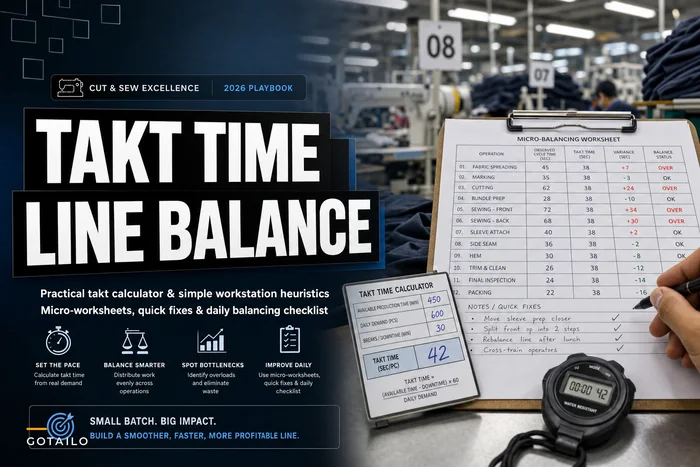
If your windows keep missing because bundles bottleneck at the same station, the issue is upstream in how the line is balanced. Worth reading our takt-time and line-balancing playbook for small cut-and-sew factories before you blame the schedule. A schedule can't fix a line that's structurally lumpy.
The skills matrix: the thing that makes everything else flexible
Here's what breaks at scale that nobody warns you about: a line runs beautifully with a fixed crew on a familiar style, then one person calls in sick, or you take on a second style, and efficiency falls off a cliff. Not because your people got worse — because your coverage was invisible and you're now finding out the hard way that only one operator can run the collar setting.
-
0 — can't do it
-
1 — can do it slowly, needs checking
-
2 — solid at standard pace
-
3 — fast, and can train others
The moment you fill this in, two things jump off the page. First, your single points of failure — operations where only one person scores a 2 or 3. Those are your fragility. If that person is out, the whole line stalls. Second, your cross-training targets — the operators sitting at 2s who could reach a 3, and the 0s and 1s next to operations you desperately need backup on.
On well-run small lines, the pattern is consistent: they aim for at least two operators at level 2 or above on every critical operation, and they treat anything with only one capable person as a live risk, not a background fact. It changes hiring, training, and who you put where when someone's out.
The skills matrix also feeds the schedule directly. When block 3 needs the line rebalanced because a machine's down, the supervisor isn't guessing who can move — she looks at the grid and knows.
A lightweight cross-training template
-
Operation to cover (the single-point-of-failure one)
-
Trainee (an operator currently at 0 or 1)
-
Trainer (your level-3 on that op)
-
Practice window 30–45 min at end of a slow block, twice a week
-
Target reach level 2 within 6 weeks
-
Check trainer signs off, supervisor spot-verifies on a real bundle
The mistake is training during a rush. You can't. Cross-training has to live in the slow windows your micro-schedule now makes visible — which is exactly why these tools reinforce each other. The schedule surfaces the slack; the matrix tells you where to spend it.
Incentive calculators that don't quietly wreck quality
Piece-rate and bonus schemes are where good intentions go to die. The classic failure: you pay per unit completed, output jumps 15%, and defects jump 20% because operators learned that the pay system doesn't care about rework. You didn't get more good garments. You got more garments and more returns.
A workable incentive calc has to net out the bad units, or it's paying people to create work for the QC table.
Bonus-eligible units = units passed inline check − units returned for rework
-
Operator standard
80 units/day at 100% efficiency, base pay covers this
-
Actual completed
96 units
-
Returned for rework at inline
7
-
Net good units above standard
96 − 7 − 80 = 9 units eligible for bonus
-
Bonus rate
a modest per-unit rate that makes those 9 units worth chasing without blowing your labor cost
The key design choice: the rework subtraction is what protects quality. Without it, speed always wins. With it, an operator pushing junk through earns less, because returns eat their bonus. That single mechanic aligns pay with the thing you actually sell.
-
Baseline standards get reviewed quarterly, not adjusted mid-week when someone has a good day — that kills trust fast
-
Rework attribution has to be fair — a defect caused by a bad bundle from cutting isn't the sewer's fault, and if you charge it to them anyway, the whole scheme loses credibility
-
Bonus math should be visible to operators daily, ideally posted per window, so people can see where they stand and self-correct
-
Team-based components help on lines where one operation feeds another — pure individual incentive can make people hoard easy work and starve the next station
That last point is subtle but important. If your incentive rewards individuals only, operators optimize their own station and let bundles pile up wherever it suits them. A blended scheme — part individual, part line-level throughput — keeps people caring about flow, not just their own count.
Quick audit routines: short enough that they actually get done
Every shop has audit checklists that looked great in a binder and got run twice. The problem is always the same: too long. A 40-point audit is a document, not a routine. Nobody runs a 40-point audit at 10am on a busy Thursday.
The audit routines that survive are the ones you can finish in under five minutes and run several times a day. Three of them cover most of the ground.
-
1. WIP-position audit (per window, ~2 min) Walk the line, count bundles waiting at each station. You're looking for the pile-up. If bundles are stacking 3-deep before one operation and the operation after it is idle, you've found your bottleneck for the block and you can rebalance before it swallows the next window. Chronic WIP imbalance usually points back at your reconciliation habits too — if your counts drift, our WIP reconciliation routine and sample forms for small apparel factories covers how to keep those numbers trustworthy.
-
2. Quality spot audit (a few units per operation, ~3 min) Pull two or three units mid-window from each critical operation, check the same handful of failure points every time. Don't check everything — check the things that come back. The point isn't full inspection; it's early warning that an operation started drifting before it produces a whole bundle of the same defect.
-
3. Standstill audit (glance, continuous) Is anything not running that should be? A stopped machine, an operator waiting on bundles, a jammed feed. On a small line this is often the biggest single source of lost throughput and the easiest to miss because everyone's heads-down. Whoever's running the floor should be counting stopped stations every time they walk past.
A combined quick-audit checklist a supervisor can carry on one card:
-
Bundles piling up anywhere? (note the station)
-
Any station idle waiting for work?
-
Any machine stopped? For how long, why?
-
Spot-check 2–3 units at each critical op — same failure points every time
-
Current window on pace vs target?
-
Anything from the last window still unresolved?
Six lines. Runnable in five minutes. The audit that gets done beats the thorough one that doesn't.
How the pieces actually connect
Any one of these tools helps a little. Together they form a loop that compounds, and that loop is the real system.
[Micro-Schedule] → sets window targets + WIP caps ↓ [Quick Audit] → catches why a window missed (bottleneck, drift, stopped machine) ↓ [Skills Matrix] → shows who can move right now + where coverage is thin long-term ↓ [Cross-Training Plan] → uses slow windows to close fragile spots ↓ [Incentive Calc] → keeps speed and quality pulling in the same direction ↑___|
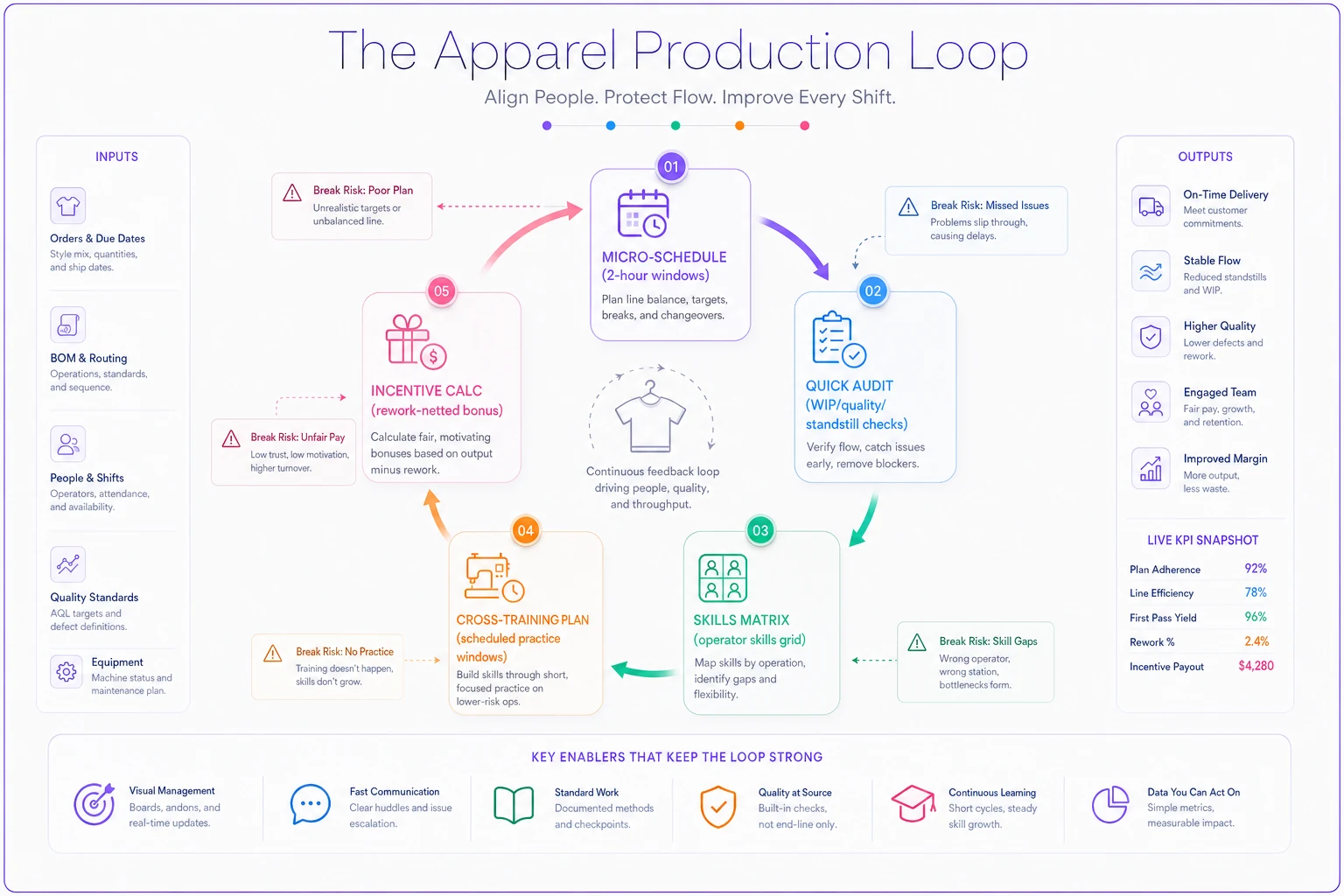
Break the loop anywhere and the rest degrades. Micro-schedule with no audit? You get precise numbers and no idea why they're bad. Skills matrix with no cross-training? A nice document that never changes. Incentives with no quality netting? Faster production of returns.
A real scenario
A small activewear cut-and-sew shop, around 34 machines, two styles running at a time. They were tracking output daily and living at roughly 70–74% line efficiency, with numbers swinging wildly day to day and a WIP pile that seemed to relocate to a different station every week. Returns for rework were running higher than they wanted but nobody could pin down where they originated.
They didn't buy anything new. They split the day into 2-hour windows with per-operation targets and WIP caps, filled in a skills matrix in an afternoon, and started running the six-line quick audit three times a shift. The incentive scheme they'd been considering got the rework-netting rule bolted on before launch.
The variance notes did most of the early work. Within about two weeks it was obvious that two specific operations were the recurring choke points, and that the same three operators were the only ones who could run one of them. Cross-training got pointed straight at that. WIP variance between windows tightened up noticeably — the wild swings flattened out. Line efficiency settled into the low-to-mid 80s and, more importantly, stayed there instead of yo-yoing. Rework dropped because the quality spot audit caught drift within a window instead of after a full bundle. Nothing dramatic in any single move — the gain came from the loop running, week after week.
When this makes sense — and when it doesn't
This model earns its keep on lines with real variability: multiple styles, changeovers, a crew where skill levels differ, and output numbers you can't quite explain. If your throughput is unpredictable and you're managing by daily totals, micro-scheduling and quick audits will pay off fast.
When it's probably overkill: a very small line — say under 10 machines — running one steady style for weeks, where the supervisor can already see everything from where they stand. At that size the whole line is the micro-schedule; formalizing it adds paperwork without adding visibility.
Who should not rush into the incentive piece: any shop that hasn't got its inline quality checks working first. Incentives amplify whatever system they're bolted onto. Point them at a line with weak QC and you'll just produce defects faster. Get the audit routines and quality gates stable, then turn on the pay incentive.
Where teams get it wrong: trying to install all four at once, overwhelming the supervisor, and abandoning the whole thing in three weeks. Sequence it. Start with micro-scheduling and the standstill/WIP audit — that's the fastest visibility win and the least disruptive. Add the skills matrix next. Layer in quality spot-audits. Save the incentive calc for last, once you trust your numbers.
Workforce productivity on a small cut-and-sew line isn't unlocked by pushing people harder. It's unlocked by seeing problems while they're still small and cheap, and having the coverage and pay structure to fix them without breaking something else. Micro-scheduling gives you resolution. Audits give you cause. The skills matrix gives you options. Cross-training builds resilience into the slow hours. An incentive calc with quality baked in makes sure speed and quality pull in the same direction instead of fighting.
None of these are hard to build. The discipline is in running them every day, in short honest bursts, until the loop becomes just how the floor works. That's the difference between a line that hits 90% one day and can't repeat it, and a line that lives in the 80s and rarely surprises you — which, in a small shop, is worth far more than the occasional great Thursday.
Ready to tailor your apparel operations?
Join 500+ fashion brands using GoTailo to accelerate product launches, reduce waste, and improve supplier collaboration.