
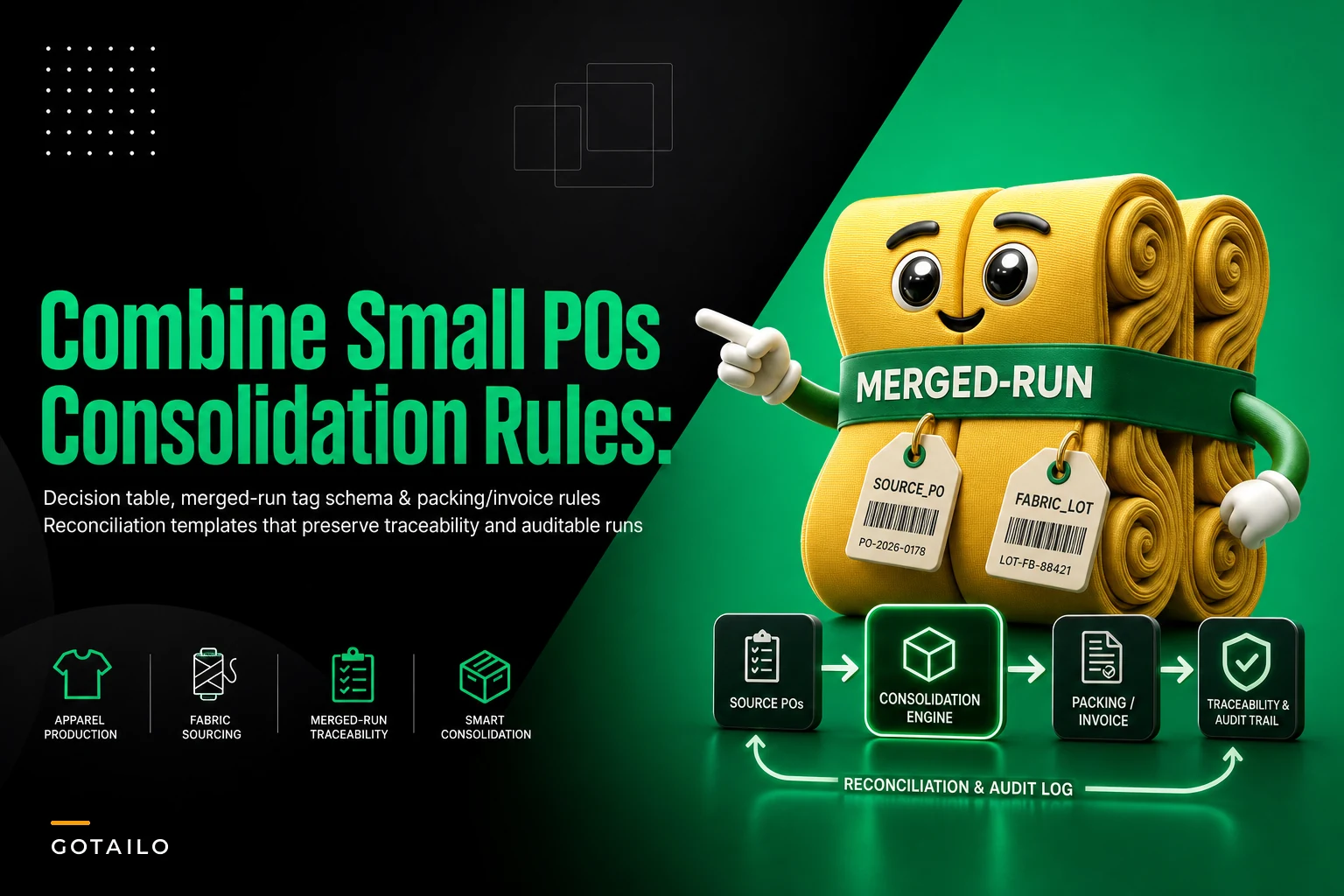

Most consolidation goes wrong at the exact moment it looks like a win. You've got three small POs — 180 units, 240 units, and 120 units — all in the same fabric, same base pattern, and it feels absurd to run three separate cut tickets when one marker could swallow all 540. So you merge. Marker efficiency jumps, you save fabric, the cutting room is happy.
Then a defect claim comes in six weeks later on 40 units from one of those POs, and nobody can tell you which bundles those units came from, which spreader lay they were on, or whether the shade lot matched. The merge saved you fabric and cost you traceability. That trade is the whole problem, and it's avoidable if you build the merge decision and the tagging around it deliberately — instead of on the cutting floor by feel.
This is specifically about cut-order consolidation apparel teams do to hit marker efficiency and minimums, and how to do it without turning your downstream records into mush.
Why merged cut orders quietly destroy traceability
The issue isn't the merge itself. It's that a cut order is usually the last point where PO identity is cleanly separated. Before the cut, everything lives under a PO number — the fabric allocation, the BOM, the shade approval. After the cut, garments become physical bundles moving through sewing, finishing, and packing. If you don't carry PO identity into the bundle, it's gone the second the fabric hits the knife.
In practice, this usually happens when the cutting room merges to optimize a lay and then labels bundles by size and color only — "M / Navy / Bundle 14" — with no reference to which PO those pieces belong to. Sewing doesn't care about PO. Finishing doesn't either. It only matters again at packing and invoicing, and by then you're reverse-engineering it from quantities, which never quite reconciles.
-
Proportional guessing at packing. You cut 540 as one run, and at packing you split back to 180/240/120 by just counting off units. If yield varied by size or you had a few rejects, the split no longer matches the original POs and someone eats the difference.
-
Shade-lot blindness. Two POs merged onto one lay, but the fabric came from two dye lots spread on the same table. Without lot tagging on the merged run, a shade complaint can't be traced to a lot, and you can't isolate the affected units.
-
Invoicing drift. Customer A's PO said 180, you delivered 176 good units after rejects, but the merged run makes it hard to prove where the 4 went — rejected at inspection, or shorted at cut spread. That ambiguity is where chargebacks live.
If you've built any kind of operational state machine for SKUs from tech-pack to obsolescence, you already know the principle: every unit needs a state and a lineage. Merging cut orders breaks lineage unless you design for it.
The merge / no-merge decision table
Not every small PO should be merged, and the decision shouldn't be made by whoever's spreading fabric that morning. Below is the table we'd actually use to gate it. The rule: if any row lands in the "No / Conditional" column, the merge needs a supervisor sign-off, not a default yes.
Eliminate delays in your fashion production cycle.
GoTailo helps you manage designs, orders, and inventory effortlessly, keeping production on schedule.
- Centralized order and inventory management
- Real-time supplier communication
- Integrated production scheduling
No credit card required
Use this as an operational gate: if any factor hits Conditional/Do not merge, require escalation.
| Factor | Merge freely | Conditional (needs sign-off) | Do not merge |
|---|---|---|---|
| Fabric roll/dye lot | Same lot across all POs | Different lots, lot-taggable per bundle | Different lots, can't segregate on lay |
| Delivery dates | Within same ship window | 1–2 weeks apart | Different seasons / drops |
| Customer | Same customer | Different customers, same terms | Different customers, different QC standards |
| Marker/pattern | Identical block & grade | Same block, minor spec diff | Different fit or construction |
| Size curve overlap | Heavy overlap | Partial overlap | No overlap (merge saves nothing) |
| Costing/pricing | Same cost basis | Different price, same currency | Different currency or cost model |
The most common mistake is merging across customers because the fabric matches, while ignoring that Customer B has a stricter AQL. When B's inspection rejects at a tighter threshold, you've got mixed bundles and no clean way to pull B's units for re-inspection without touching A's.
Merged-run tag schema: how to carry PO identity through the cut
The fix is a tag schema that survives the merge. Every merged run gets a run ID, and every bundle inside it carries both the run ID and its original PO reference. You never lose the parent-child link.
Here's a schema that works without any fancy system — just barcodes or printed bundle tickets:
``
RUN-2409-017
  ├─ cutdate: 2024-09-11
  ├─ markerid: MK-NVY-JKT-034
  ├─ fabriclots: [LOT-A2291, LOT-A2293]
  ├─ sourcePOs: [PO-4471, PO-4472, PO-4488]
  └─ totalcutqty: 540
``
``
RUN-2409-017 / B-14
  ├─ parentrun: RUN-2409-017
  ├─ sourcePO: PO-4472        ← the critical field
  ├─ size: M
  ├─ color: Navy
  ├─ fabriclot: LOT-A2293     ← which lot this bundle was cut from
  ├─ qty: 30
  └─ spreadposition: lay 2, ply 8–14
``
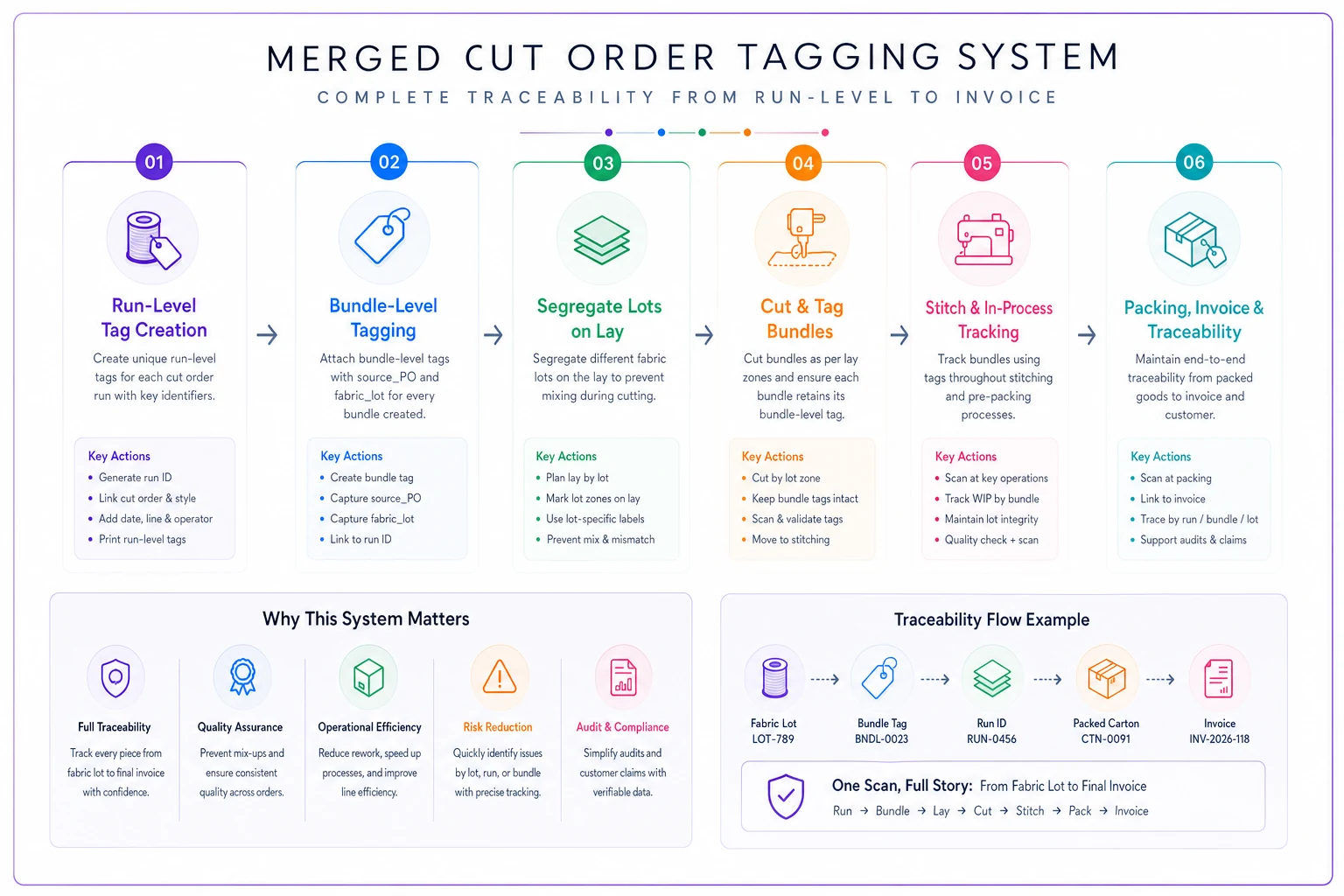
The diagram shows run creation, bundle tagging, and how sourcePO and fabriclot travel with bundles through packing.
Use barcode scanning at packing to rapidly sort bundles by
source_POrather than by size.
The two fields that save you later are sourcePO and fabriclot at the bundle level. Everything else is convenience. Once those two live on the bundle ticket, a defect claim or shade complaint can be traced to a lot and a PO in minutes instead of a forensic afternoon.
One practical note on tagging when merging different lots on one lay: physically segregate lots into separate lay sections and don't interleave them. If you spread LOT-A2291 as plies 1–7 and LOT-A2293 as plies 8–14, the spread_position field alone tells you which lot any bundle came from — even if a ticket gets smudged.
Packing and invoicing adjustments that keep the split honest
The merge is upstream. The pain is downstream, at packing and invoicing, because that's where you have to un-merge back to PO boundaries. If the bundle tags carried source_PO, this is mechanical. If they didn't, this is where you start making things up.
-
At packing, sort by
source_POfirst, not by size. Pull all bundles tagged PO-4471 together, regardless of which run they came from. This is the reverse of how packing usually works, but it's what keeps each customer's shipment clean. -
Reconcile good units per PO against ordered quantity. PO-4472 ordered 240, its bundles summed to 234 good after inspection. Record the variance now — don't smooth it into another PO.
-
Adjust the invoice to actual good delivered, with the variance reason coded. 234 shipped, 6 rejected at final inspection (defect code + bundle IDs attached). The invoice reflects 234, and the backup ties every missing unit to a bundle and a reason.
-
Handle overage separately. If a merged run yields extra good units — say the 540 cut produced 548 good — don't quietly stuff overage into whichever PO has room. Log it as run overage and dispose of it per your overage agreement with each customer.
The invoicing rule that prevents chargebacks: never let a merged run's total quantity be the reconciliation unit — reconcile per source PO, every time. Merged runs are for cutting efficiency only. The financial and customer boundary is always the original PO.
If your consolidation is also touching how you batch and ship — combining these runs into shared cartons — the same discipline about preserving identity applies to your carton records too. The logic overlaps with what's covered in the cartonization and batch consolidation rules for freight, where mixing SKUs in a carton without a clean packing manifest creates the same downstream ambiguity as mixing POs in a cut run.
Reconciliation rules and templates
Here's the reconciliation logic as a set of rules that should hold true for every merged run. If any one fails, the run doesn't close.
-
Rule 1 — Conservation Sum of good units + rejects + wastage per
source_POmust equal that PO's cut allocation. No PO's numbers borrow from another's. -
Rule 2 — Lot integrity Every bundle's
fabriclotmust appear in the run's declaredfabriclots. An unexpected lot means a spreading error and the run gets flagged. -
Rule 3 — Variance coding Every unit shortfall against ordered quantity carries a reason code (reject, short-cut, sample pull) and a bundle reference. Uncoded variance is not allowed to close.
-
Rule 4 — Invoice match Invoiced quantity per PO = good units per PO. Any deliberate difference (e.g., agreed tolerance shipment) is a separate coded line, not a silent adjustment.
| Source PO | Ordered | Cut Alloc | Good | Reject | Short | Invoiced | Variance Reason |
|---|---|---|---|---|---|---|---|
| PO-4471 | 180 | 180 | 178 | 2 | 0 | 178 | 2 defect (B-03,B-09) |
| PO-4472 | 240 | 240 | 234 | 4 | 2 | 234 | 4 defect, 2 short-cut |
| PO-4488 | 120 | 120 | 119 | 1 | 0 | 119 | 1 defect (B-21) |
| RUN TOTAL | 540 | 540 | 531 | 7 | 2 | 531 | closes: YES |
The RUN TOTAL row is a check, not the reconciliation unit. You close on the per-PO rows.
When merging cut orders actually makes sense
Same fabric lot, same customer, same ship window — this is the clean case. Merge without hesitation.
Beyond the obvious case, it makes sense when fabric minimums or marker efficiency genuinely suffer at small quantities and the POs share a block. A 120-unit solo cut running 12% end loss versus 3% on a merged lay is real money, not a rounding error. It also works when you have bundle-level tagging discipline already in place. If you can carry source_PO on the ticket, most of the traceability risk evaporates.
When it's a bad idea
Different customers with different QC standards or currencies. The reconciliation surface and dispute exposure isn't worth the fabric saving — it rarely is.
Different dye lots you can't physically segregate on the lay. A shade complaint you can't trace is a full-order liability, and you won't know it until the complaint lands.
Different seasons or drops. You'll blur delivery windows, and someone's early PO ends up waiting on someone else's late one.
One group that should not do this at all: any team without bundle tickets that can hold a PO reference. If your bundles only carry size and color, merging cut orders is just deferring a traceability problem to packing day. Fix the ticket first, then merge.
A real scenario
A mid-size contract manufacturer running outerwear for three small brands kept merging cut orders on shared wool-blend fabric to hit marker efficiency — completely reasonable, since solo cuts on 100–200 unit POs were burning fabric. The problem was every merged run reconciled at the run total, then split back to POs by proportional counting.
Over a season this produced a steady drip of chargebacks: units short on one brand's PO, mystery overage on another's, and one shade complaint that took most of a week to trace because nobody knew which dye lot went to which brand. Rough cost landed somewhere in the range of a few thousand a season in chargebacks, plus the labor to argue them.
The fix was small. They added two fields to the bundle ticket — sourcePO and fabriclot — segregated lots by lay section, and switched packing to sort by PO before size. Marker efficiency stayed exactly where it was. Reconciliation moved to per-PO, chargebacks on quantity disputes basically stopped, and the next shade issue was traced to a lot in under an hour because the bundles pointed straight at it.
The one thing to hold onto
Merging cut orders is a good habit that turns into a liability the moment PO identity stops traveling with the physical bundle. Keep the merge for what it's actually good for — fabric and marker efficiency — and never let it become the unit you reconcile or invoice against.
Two fields on a bundle ticket and a per-PO reconciliation rule are the difference between consolidation that saves money and consolidation that quietly bleeds it back out in disputes you can't win.
Two fields on a bundle ticket and a per-PO reconciliation rule are the difference between consolidation that saves money and consolidation that quietly bleeds it back out in disputes you can't win.
Ready to tailor your apparel operations?
Join 500+ fashion brands using GoTailo to accelerate product launches, reduce waste, and improve supplier collaboration.