

Most sampling delays don't come from any single slow step. They come from the order things happen in. Fabric gets locked first, then lab-dips start, then trims get sourced against the approved color — and every time one of those upstream decisions moves, everything downstream has to re-run. That's the serial trap, and it's where weeks quietly disappear.
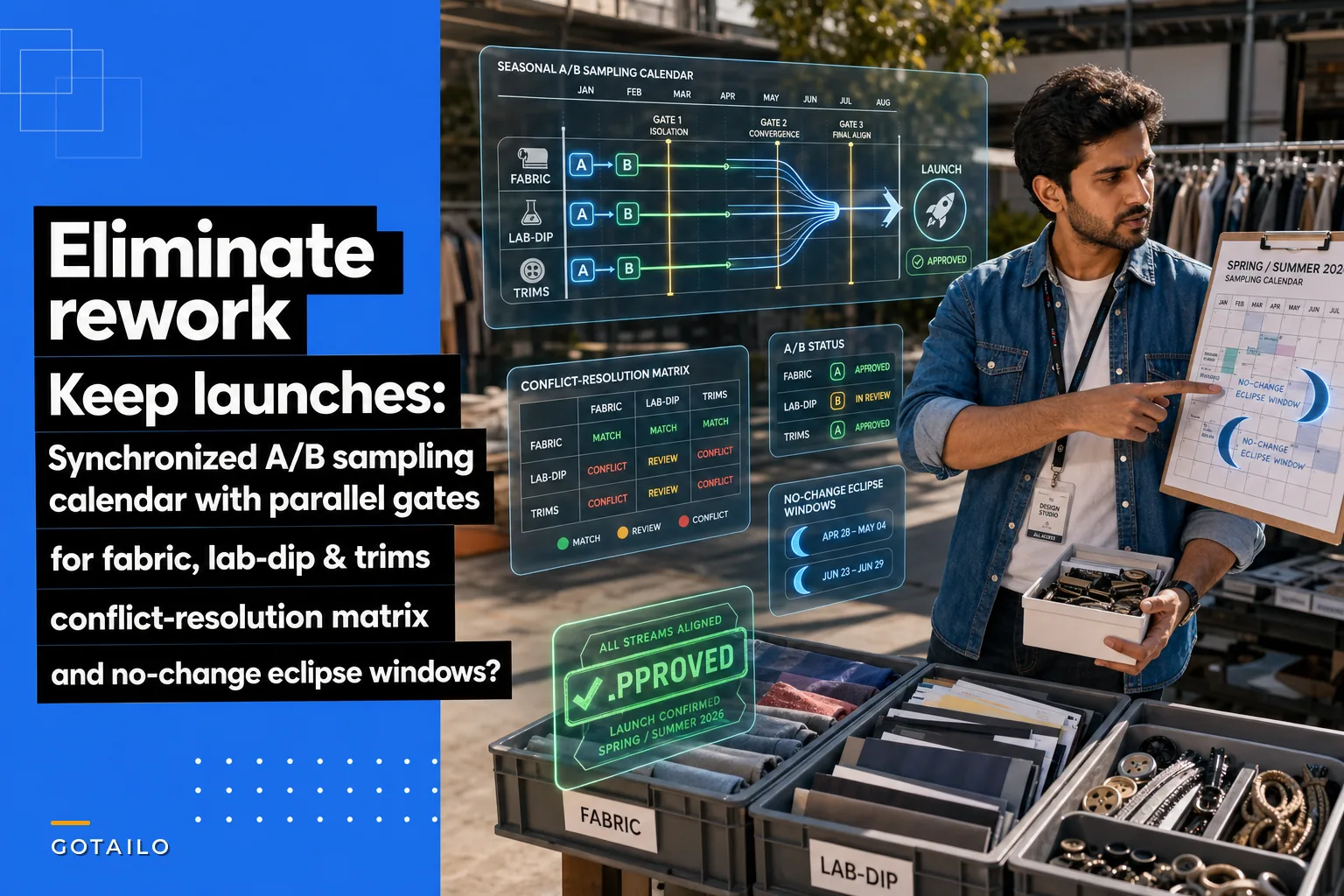
The fix isn't "move faster." It's running fabric, color, and trim approval tracks in parallel, with gates that explicitly define when one track is allowed to influence another — and when it isn't. A proper lab dip sampling calendar for apparel does this with parallel gating rules, a conflict-resolution matrix, and locked windows around launches where no changes are permitted.
The serial rework loop, broken down step by step
Here's the sequence that plays out on most programs, in the order it usually happens:
-
Designer picks a fabric base and sends it for development.
-
Team waits for fabric handfeel approval before kicking off lab-dips, because "we need the right substrate to dip on."
-
Lab-dips come back, go through rounds, finally land on an approved color standard.
-
Now trims get sourced — zippers, drawcord tips, labels, elastic — and matched to the approved color.
-
A trim supplier can't hit the color on a dyed-to-match zipper pull. Or minimum order quantities force a substitution.
-
The substitution shifts the color reference slightly, which means the lab-dip standard gets revisited.
-
Fabric, color, and trim are now all back in motion. Round counts reset. Calendar slips two to three weeks.
The problem is structural. Each stage waits for the previous one to "finish," so a late discovery at stage 5 detonates everything behind it. In a serial setup, a trim MOQ problem discovered in week 6 is just as expensive as a fabric failure discovered in week 2 — both force the same full re-run.
Trims are almost always the detonator. Fabric and lab-dip teams tend to have mature processes. Trims get treated as an afterthought, sourced last, and that's exactly why they trigger the most rework.
Why parallel gating changes the math
Parallel gating means all three tracks start at roughly the same time, each with its own internal gate sequence, and you define interfaces between them instead of hard dependencies.
Eliminate delays in your fashion production cycle.
GoTailo helps you manage designs, orders, and inventory effortlessly, keeping production on schedule.
- Centralized order and inventory management
- Real-time supplier communication
- Integrated production scheduling
No credit card required
The key insight: fabric, color, and trims don't actually need to be sequential. They need to converge at specific checkpoints. A dyed-to-match trim doesn't need the final approved lab-dip — it needs the color target and a tolerance. You can run trim development against a target standard in parallel, as long as you've gated when the target is allowed to shift.
Here's the difference in practice:
| Dimension | Serial sampling | Parallel-gated sampling |
|---|---|---|
| Track start timing | One after another | All three start together |
| Trim sourcing begins | After color approval | Against color target + tolerance |
| Late discovery impact | Resets everything downstream | Contained to its own track |
| Color standard changes | Freely, any time | Only through a gate decision |
| Typical rounds per color | 3–5 | 2–3 |
| Calendar exposure | High, cascading | Bounded per track |
The parallel model doesn't eliminate problems. It stops one track's problem from automatically becoming three tracks' problem. That containment is the entire point.
If your lab-dip rounds themselves are the bottleneck — not the sequencing — that's a different fix. The evidence standards in remote lab-dip approvals that stop repeat dips are worth reading alongside this. Parallel gating assumes your individual approval steps are already reasonably tight.
The gating rules that actually hold the tracks apart
Parallel tracks collapse back into serial chaos the moment someone lets an upstream change ripple without a gate. You need explicit rules for when a track is allowed to affect another track.
Convergence gates — points where two tracks must agree before either proceeds. Example: the trim color target must be confirmed against the lab-dip's current best standard before trim lab submissions go out. This is a scheduled checkpoint, not an ad-hoc "let me just check with the color team" message.
Isolation gates — points where a track is explicitly protected from upstream noise. Once a lab-dip standard is approved and a trim is in physical development against it, the color target is frozen for that trim. If someone wants to tweak the color, it doesn't automatically flow — it goes through the conflict matrix below.
Release gates — the final convergence where all three tracks sign off together before the sample is cut. Nothing proceeds to the full garment sample until fabric, color, and trims have all cleared their own sequences and passed the shared release gate.
Teams typically build the convergence gates but skip the isolation gates. They let tracks talk freely, which feels collaborative but reintroduces the cascade. Isolation is what makes parallelism actually work.
The conflict-resolution matrix
When two tracks disagree — the approved fabric shifts the achievable color, or a trim substitution pulls the color reference — you need a predefined answer for who yields. Without it, every conflict becomes a meeting, and meetings are where calendars go to die.
| Conflict | Default resolution | Who decides | Max allowed delay |
|---|---|---|---|
| Fabric shifts achievable color | Color target re-anchored to fabric reality; trims re-target | Color lead + designer | 3 days |
| Trim can't hit color (MOQ/dye limit) | Adjust color tolerance on trim, not the fabric standard | Trim lead | 2 days |
| Lab-dip fails on approved fabric | Re-dip against fabric; trims held at last target | Color lead | 5 days |
| Designer requests color change mid-track | Blocked if inside eclipse window (see below) | Design director | N/A |
| Trim substitution for supply reasons | Re-target against frozen standard; no color re-open | Sourcing | 2 days |
The principle underneath this: the fabric-anchored color standard wins by default. Trims flex to the color, not the other way around. The only time the color standard moves is when the fabric physically can't hold it. This single rule kills most of the back-and-forth because it removes the negotiation — trims don't get to drag color back into development.
The "max allowed delay" column matters too. Each conflict has a time box. If a resolution can't land inside it, it escalates rather than sitting open and silently blocking the release gate.
'No-change' eclipse windows tied to launches
The most destructive rework comes from changes made close to the launch date — the "one small color tweak" that lands three weeks before you need production approvals. Eclipse windows prevent this by freezing specific decisions for a defined period before a launch milestone.
-
The approved color standard is locked. No re-dips except for defect correction.
-
Trim targets are frozen. Substitutions only for hard supply failures, and only against the existing standard.
-
Fabric base is locked. No substrate changes.
The window length should scale with how much downstream work a change would trigger:
-
Color eclipse opens ~4 weeks before production color approval
-
Trim eclipse opens ~3 weeks before trim PO placement
-
Fabric eclipse opens ~6 weeks before bulk fabric commitment
The exact numbers are less important than the fact that the window is declared in advance and visible on the calendar. When everyone can see "color locks on the 14th," the last-minute requests arrive before the 14th, when they're cheap, instead of after, when they're not.
A common objection: "but what if we genuinely need a change inside the window?" You can allow it — through a single, explicit exception path with director sign-off that acknowledges the full downstream cost. The window doesn't make changes impossible. It makes them deliberate instead of casual.
A real scenario
A small contemporary womenswear brand — roughly 40–50 SKUs per season, split across two factories — kept missing drop dates by two to four weeks, and almost every slip traced back to color and trim rework.
Their pattern was textbook serial. Trims got sourced only after final color approval, and dyed-to-match zipper pulls kept failing on MOQ or shade, which reopened the color standard. On a typical style they were running four to five lab-dip rounds and still landing trims late.
They restructured into three parallel tracks with a convergence gate at the color-target stage, isolation on approved standards, and a four-week color eclipse before production approval. They also adopted the "fabric-anchored color wins, trims flex" rule from the matrix.
No single step felt dramatic. Lab-dip rounds dropped to around two or three per color because trims stopped dragging the standard backward. Trim substitutions got resolved inside their own track instead of cascading. Over two seasons, their average sample-to-approval timeline tightened by roughly two to three weeks, and the late-stage surprise changes mostly stopped showing up because the eclipse windows pushed requests earlier in the calendar.
Nothing exotic. They just stopped letting one track's problem become every track's problem.
Calendar templates to prevent serial rework
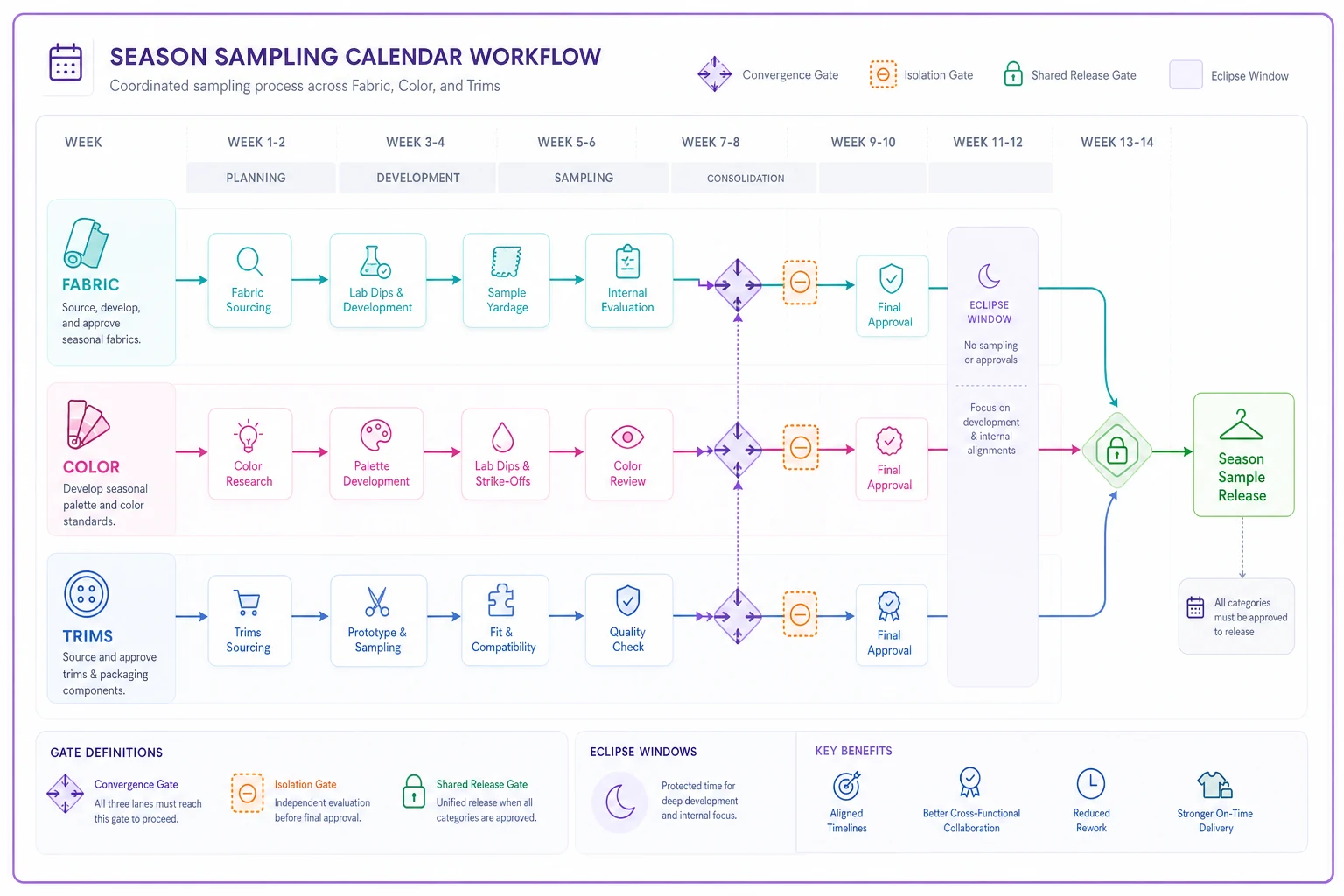
The template is where this becomes operational instead of theoretical. Build a season calendar with three parallel swimlanes — fabric, color, trims — each with its own gate markers, plus shared convergence and release gates drawn across all three.
Visualize the season calendar workflow.
-
[ ] Three swimlanes mapped, each starting on the same date
-
[ ] Each track's internal gates marked (dev → round 1 → round 2 → approval)
-
[ ] Convergence gate at color-target confirmation (color ↔ trim)
-
[ ] Isolation markers showing where standards freeze
-
[ ] Shared release gate before garment sample cut
-
[ ] Three eclipse windows drawn backward from launch milestones
-
[ ] Conflict matrix attached with named decision owners
-
[ ] Max-delay time boxes on each conflict type
Reuse the template across styles so the gate positions become muscle memory. The teams that get the most out of this treat the calendar as a contract — the gates mean something because everyone agreed to them up front.
If you're also trying to compress the overall sample cycle timeline around these gates, the time-boxed approach in cut weeks from sample-to-production pairs directly with the parallel structure here.
When this makes sense — and when it doesn't
This works well when you run multiple colorways per style, use dyed-to-match or color-critical trims, and have a repeatable seasonal cadence. The more trims depend on color, the more parallel gating saves you.
This is overkill when you're doing one or two colors, using stock trims in neutral colors, or running small one-off capsule drops. The gating overhead costs more than the rework it prevents at that scale.
Who should skip it entirely: brands where trims are genuinely independent of color — all-black programs, basics with standard black/white labels and stock hardware. If your trims never chase color, the whole color-trim conflict dimension doesn't apply, and your time is better spent elsewhere.
The judgment call comes down to one question: how often does a trim or fabric problem force your color standard to reopen? If rarely, you don't need this. If it's most styles, parallel gating is probably the highest-leverage change you can make to your sampling calendar.
Closing thought
Serial sampling feels safe because each step waits for certainty before the next begins. But that certainty is mostly an illusion — the late discoveries still happen, they just happen at the worst possible point, with maximum downstream damage. Running fabric, color, and trims in parallel, with gates that define exactly when tracks are allowed to touch, replaces that false safety with real containment. One track breaking stays one track's problem. That's the whole game, and it's what turns a sampling calendar from a source of slippage into something you can actually plan around.
Ready to tailor your apparel operations?
Join 500+ fashion brands using GoTailo to accelerate product launches, reduce waste, and improve supplier collaboration.