


Sampling is where seasonal timelines quietly die. Not in one big blowup — in the slow bleed of "we're still waiting on round two," "the factory sent the wrong fabric weight," "let's just do one more fit sample to be safe." Each of those sounds harmless. Stacked together across 40 styles, they push your production start date three weeks past where it needed to be, and now you're paying air freight to hit the same delivery window you planned for months ago.
If you want to reduce sample to production lead time apparel programs run on, the fix isn't "sample faster." It's structural. You put hard time boxes around each sample round, define exactly what "approved" means before you start, run tasks in parallel that most teams run in sequence, and refuse to let evidence standards slip just because someone's in a hurry. That's what this playbook covers.
Why sample cycles drift (and it's rarely the factory)
The default assumption is that slow sampling is a vendor problem. Sometimes it is. But when you actually map where the days go, most of the delay sits on the brand side — decision latency, unclear acceptance criteria, and rounds that were never scoped to a deadline.
A typical pattern: proto sample arrives, the designer flags six things, comments go into an email thread, the tech pack gets updated three days later, the factory reads the update the following Monday, and now you've lost a full week on a round that produced maybe two hours of actual work. Multiply that gap across proto → fit → PP and you've burned two to three weeks on nothing but handoff lag.
The second driver is scope creep inside rounds. There's a very human instinct to keep polishing. "One more fit sample" feels responsible. But an uncapped number of rounds means the cycle has no natural end — it ends when someone runs out of patience, which is a terrible way to hit a ship date.
The third is fuzzy approval. If "approved" isn't defined in advance, every reviewer applies their own bar. The designer approves the drape, the merchant approves the price, nobody explicitly signs off on the actual measurements, and you find out at PP that the armhole was never right.
Time-boxing: put a clock on every round
Every sample round gets a fixed number of calendar days for each side, and the clock doesn't stop for weekends or "I was busy." If a round blows its box, it escalates — it doesn't silently extend.
Eliminate delays in your fashion production cycle.
GoTailo helps you manage designs, orders, and inventory effortlessly, keeping production on schedule.
- Centralized order and inventory management
- Real-time supplier communication
- Integrated production scheduling
No credit card required
Here's a workable structure for a mid-complexity seasonal style (think a lined jacket, not a basic tee):
| Round | Factory make + ship | Brand review + comment | Hard cap |
|---|---|---|---|
| Proto (design intent) | 7 days | 2 days | 9 days |
| Fit sample | 6 days | 2 days | 8 days |
| PP sample (production-ready) | 6 days | 3 days | 9 days |
About 26 days end-to-end if things run clean. The two-day brand review cap is the part most teams push back on and the part that saves the most time. It forces comments to be consolidated and sent as one package instead of trickling in across three days.
The caps aren't there to punish anyone. They exist so that a slip becomes visible immediately instead of surfacing three rounds later when you can't recover. A round that misses its box on day 3 is a scheduling conversation. A round that quietly slips is a launch that misses the floor set.
When time-boxing actually makes sense
This works best when you're running a defined collection with a fixed drop date — seasonal work, planned launches, anything with a real deadline behind it. The pressure of the calendar is what makes the boxes meaningful.
When it's a bad idea
If you're developing a genuinely new construction or a fabric nobody's worked with before, don't force it into a tight box on the first pass. R&D and sampling are different activities. Time-box the sampling after the construction is proven, not during the experiment. Teams that box their innovation work end up either rushing bad decisions or blowing every cap and losing faith in the whole system.
Acceptance criteria per sample tier
A round can only be time-boxed if everyone knows what "pass" means before it starts. Vague approval is what generates surprise rounds. Define acceptance at each tier and write it into the tech pack, not into someone's head.
Proto (design intent): You're approving concept, silhouette, and construction approach. You are not nitpicking measurements. Acceptance = the design reads correctly, the construction method is viable, key materials are in the right ballpark. Explicitly park measurement precision for the fit round so nobody wastes time perfecting numbers on a sample that might change shape.
Fit sample: Now measurements matter. Acceptance = graded points of measure within tolerance on the base size, fit intent confirmed on a live or dress form, comments closed from proto. This is the round where you kill scope creep hardest — if a design change shows up here that should have been caught at proto, you make a conscious call: absorb it now or note it and move on. You don't casually add a fourth round.
PP sample: This is the contract. Acceptance = made on production materials, on production line, correct trims, correct labels, measurements in tolerance, workmanship matching the standard. Approving the PP sample means the factory is cleared to run. If your PP acceptance is loose, every downstream inspection inherits the ambiguity — define the defect standard once, upstream, and everyone downstream measures against the same bar.
One mistake worth calling out specifically: letting acceptance criteria migrate between tiers. When designers start scrutinizing measurements at proto and merchants start negotiating design at PP, the tiers collapse into one long, boundary-less review. The whole point of the structure disappears.
Run it in parallel, not in sequence
Most of the recoverable time in a sample cycle isn't inside the rounds — it's in the stuff teams insist on doing one after another when it could run alongside. Parallelizing is where you actually shave weeks.
Tasks you can run concurrently with sample rounds instead of after them:
-
Lab dips + strike-offs in parallel with proto. Don't wait for proto approval to start color. Kick off lab dips the moment the tech pack is released. Color approval and fit approval are independent workstreams — running them in series is pure waste. A repeat dip cycle can eat as much time as an entire fit round, so slow color approvals compound the problem fast.
-
Trim and hardware sourcing during proto/fit. Zippers, buttons, drawcords — order the sourcing samples early. Nothing stalls a PP sample like waiting on a trim that should have been locked weeks earlier.
-
Bulk fabric commitment staged against fit approval. You don't commit bulk before fit is confirmed, but you do get the mill on standby, greige booked, and lead times confirmed so the second fit passes, fabric is already moving.
-
Costing refinement across every round. Update the cost sheet as construction firms up rather than doing one costing pass at the end. Late costing surprises trigger design changes, and design changes trigger extra rounds — the exact loop you're trying to break.
The workflow, described plainly: the tech pack release is the starting gun for four workstreams at once — sampling, color, trims, and fabric planning. They converge at PP approval, where everything has to be aligned and production-ready simultaneously. Teams that treat sampling as the only thing happening during sampling are the ones who "finish" the sample cycle and then discover trims haven't even been ordered.
Here's a simple visual of the parallel workstreams converging at PP approval.
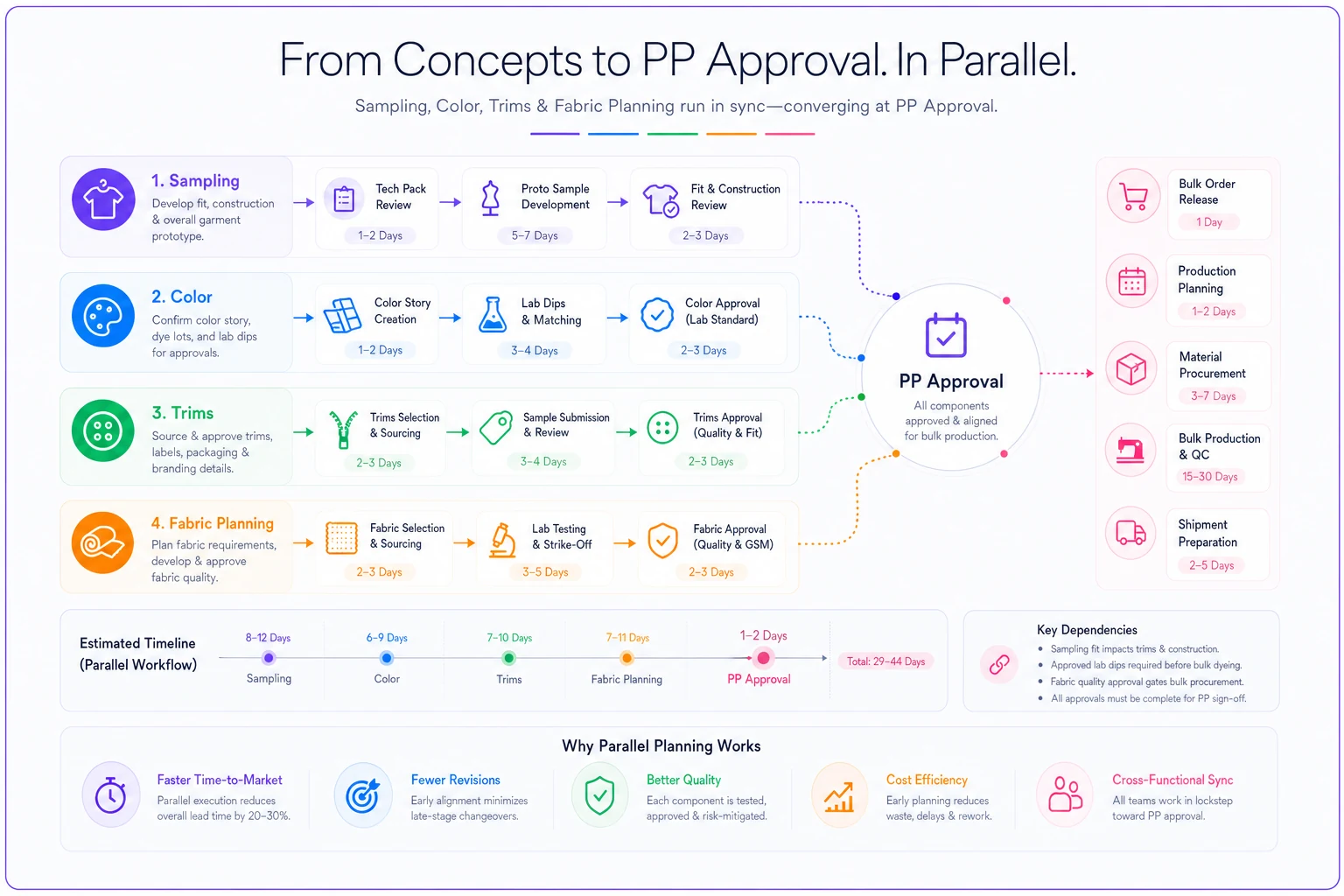
Coordinating across four parallel workstreams is also where AI-assisted operational platforms tend to earn their keep — not by making creative decisions, but by tracking which workstream is falling behind, flagging when a color approval is drifting toward blocking a fabric commitment, and surfacing the dependency before it becomes a delay. The value isn't automation for its own sake; it's that someone doesn't have to manually reconcile four parallel timelines in a spreadsheet every morning.
Remote evidence standards so rounds don't repeat
The most common cause of a repeat sample round in dispersed teams: evidence you can't actually judge. A blurry photo on a wrinkled table, no ruler in frame, no measurement callouts. The reviewer can't approve confidently, so they ask for another sample "to be sure," and you've just spent a week confirming what a proper photo set would have told you.
-
Full garment, front and back, flat on a neutral surface, garment steamed, shot straight-on (not at an angle).
-
Measurement proof — tape measure or ruler in frame for the critical points of measure, not just a claim in a comment.
-
Construction close-ups for any flagged detail
seams, stitching, closures, problem areas from the prior round.
-
Trim and label shots at PP stage, showing actual production components.
-
A short reference callout — style number, size, round number, and date visible in the frame or filename so nobody's guessing which sample they're looking at.
-
Consistent lighting — daylight-balanced, no yellow tungsten cast that misrepresents color.
Name image files with style number, size, round, and date to avoid confusion when multiple samples circulate.
Teams accept bad evidence because rejecting it feels like friction. But accepting a bad photo creates an entire extra round. The friction of demanding a proper photo set is tiny compared to the week you lose to a repeat. Hold the line on evidence and you eliminate a whole category of "let's just resample" decisions.
A sample-cycle calendar you can actually run
Working backwards from a ship date is the only way this holds together. A compressed calendar for a seasonal style, anchored to the day you need bulk production to start:
-
Week 0 Tech pack released. Proto sampling, lab dips, and trim sourcing all kick off the same day.
-
Weeks 1–2 Proto arrives, brand reviews within the 2-day box, comments consolidated. Color and trims progressing in parallel.
-
Weeks 2–3 Fit sample made and shipped. Fabric mill on standby, bulk lead time confirmed.
-
Week 4 Fit reviewed and approved. Bulk fabric committed. Color approved. Trims locked.
-
Weeks 5–6 PP sample made on production materials, reviewed against full acceptance criteria, approved.
-
Week 6 Production cleared to start.
Roughly six weeks from tech pack to production green-light for a style that would take nine or ten weeks run sequentially with open-ended rounds. The compression comes almost entirely from time boxes plus parallel workstreams — not from cutting quality steps.
For this calendar to survive contact with reality, tech pack governance has to be tight. If comments are landing against the wrong version or the factory is working from an outdated file, the whole schedule wobbles. Loose version control is one of those things that feels like a minor admin issue right up until it blows a round.
Who should not run this as-is
A tight time-boxed cycle assumes a few things are already in place: a factory that can hit sample deadlines, a tech pack that's actually complete, and a decision-maker who can commit within the review window. If your tech packs are half-finished at release, boxing the cycle just moves the chaos earlier — you'll blow every proto round because the factory is guessing at missing details.
Very small teams running a handful of styles a season may find the full parallel structure heavier than they need. If you're doing eight styles, you can probably hold four parallel workstreams in your head. At 40+ styles, you cannot, and that's where the discipline — and tooling to track it — stops being optional.
Real scenario
A women's outerwear brand, roughly 35 styles per season, was consistently finishing sampling about three weeks behind plan and covering the gap with air freight — somewhere in the range of $18k–$22k extra per season, plus the stress of near-misses on floor sets.
The diagnosis wasn't a slow factory. It was decision latency and sequential workstreams. Brand review on fit samples was averaging close to a week because comments trickled in one designer at a time, and nobody started trims or color until the relevant round was "done."
They put in the two-day review box, consolidated comments into a single package per round, and moved lab dips and trim sourcing to start alongside proto. They also enforced the remote evidence standard, which cut their repeat rounds noticeably — fewer "resample to confirm" decisions.
Over the next two seasons, sample-to-production dropped from about nine weeks to a little over six on their standard styles. Air freight spend on planned styles fell to near zero, and the near-miss anxiety around floor sets mostly went away. Nothing about the quality bar changed — if anything, the acceptance criteria got stricter, because now they were written down.
The takeaway
Compressing your sample cycle isn't about pushing the factory harder or accepting rougher samples. It's about removing the dead time between rounds, capping scope so cycles actually end, running independent workstreams simultaneously, and refusing to accept evidence you can't judge. Put a clock on the process, define what "approved" means before you start, and the weeks you've been losing to drift come back — without gambling on the quality of what ships.
Ready to tailor your apparel operations?
Join 500+ fashion brands using GoTailo to accelerate product launches, reduce waste, and improve supplier collaboration.