
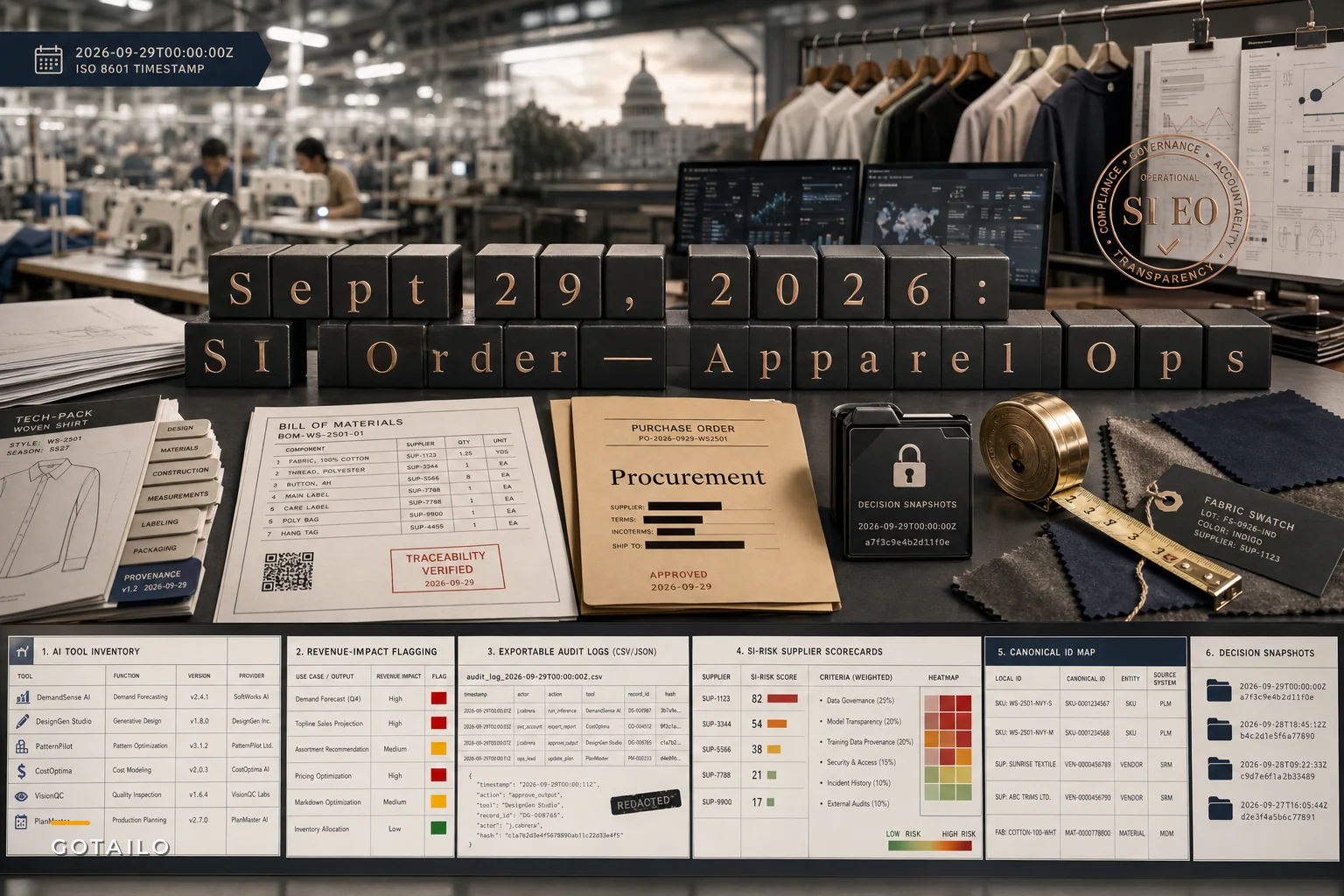

On September 29, 2026, the White House issued Executive Order 14434, "Inaugurating the Era of Super Intelligence," directing federal agencies to adopt "Super Intelligence (SI)" as the working term for advanced AI and giving the Office of Science and Technology Policy 60 days to propose a federal SI definition along with implementation steps. A Nextgov report noted the order landed alongside an industry safety accord signed by several major tech firms.
If your first reaction was "I make dresses, not drones — why do I care," that's fair. But the part that actually hits apparel desks is this: when the federal government standardizes language around SI, procurement rules follow. And procurement rules don't stay inside government agencies. They flow down through prime contractors, through the brands that supply those contractors, and eventually land on the small cut-and-sew shops and material suppliers three tiers down the chain.
That's the real story for apparel. Not the terminology. The paperwork and proof you'll be asked to produce.
Why an AI order quietly becomes a sourcing requirement
The mechanism is boring but worth understanding. Agencies that buy things — uniforms, tactical gear, institutional textiles, government-issued apparel — write contract clauses. When a new executive order lands, those clauses get updated. The full text of the order is focused on definitions and federal adoption, but the downstream effect is predictable from past cybersecurity and supply-chain EOs: vendors get asked to demonstrate controls.
For apparel, the controls that'll matter aren't about building AI models. They're about the AI tools you already use — forecasting software, automated cut planning, AI-generated design variants, demand sensing, vendor-matching platforms. If any of your operations touch public-sector buyers, you'll increasingly be asked questions like:
-
Where did this forecast come from, and can you show the inputs?
-
Is your BOM data traceable back to a source of record?
-
Can you produce an audit log for an automated decision?
-
What SI tools do your vendors use, and what controls do they have?
Most apparel teams can't answer these today. Not because they're careless — the data was just never organized with those questions in mind. That's the gap the order exposes.
The underlying problem isn't AI. It's that your data can't tell a clean story.
A pattern that shows up constantly in small and mid-sized apparel operations: the same style number means three different things in three different systems. The tech-pack calls it STY-4471. The factory PO references it as 4471-B. The warehouse ASN tags it 4471BLK. A human knows these are the same thing. An auditor — or an SI-risk reviewer — does not.
Eliminate delays in your fashion production cycle.
GoTailo helps you manage designs, orders, and inventory effortlessly, keeping production on schedule.
- Centralized order and inventory management
- Real-time supplier communication
- Integrated production scheduling
No credit card required
Now layer automation on top. An AI forecasting tool ingests sales data, generates a buy quantity, and a planner places the order. Six months later someone asks, "Why did we commit to 8,400 units of this?" If you can't reconstruct the inputs that drove that number, you have an unexplainable automated decision. Under emerging SI expectations, that's exactly the kind of thing that fails due diligence.
The deeper issue is that most apparel data was built for getting product out the door, not for proving how decisions were made. Those are different design goals. One optimizes for speed. The other optimizes for traceability. The order is pushing businesses toward the second whether they realize it or not.
A typical example: a 40-person outerwear brand supplying a government-adjacent distributor receives a new vendor questionnaire asking for "data lineage documentation for any AI-assisted planning tools." The ops manager has used an AI demand tool for two seasons. There's no documentation. No log. Just a dashboard that refreshes and overwrites itself. Reconstructing even one season takes about three weeks of digging through emails and spreadsheet exports — and the answer is still incomplete.
What auditable actually means for a production team
"Auditability" sounds like an IT word. In apparel terms it's simpler: for any number that drives a commitment or a payment, you should be able to walk backward to its source without guessing.
Here's what that looks like across the three data flows that matter most:
| Data flow | What breaks traceability | What auditable looks like |
|---|---|---|
| Tech-pack → BOM | Versions with no governance, overwritten files, "finalv3REAL" chaos | One canonical BOM per style, versioned, with sign-off owner and date |
| PO → WIP → ASN | Style codes that mutate at each handoff | A single ID that maps cleanly across all three stages |
| AI forecast → buy decision | Dashboard that overwrites, no stored inputs | Snapshot of inputs + model output stored at decision time |
A dated exported file stored in a shared drive often satisfies basic audit needs.
None of this requires a new AI system. It requires discipline in how existing data is named, stored, and reconciled. The SI order is just what makes that discipline urgent.
The mistake most teams make is assuming they need to rip out their AI tools. The opposite is true — the tools are usually fine. What's missing is the evidence layer around them. The record of what went in and what came out, kept somewhere that doesn't get overwritten next Tuesday.
A procurement and vendor-vetting response you can start now
If you expect any exposure to public-sector buyers over the next 18 months, don't wait for the OSTP definition to land. The direction is clear enough to act on now. Here's a practical sequence.
Here's a practical sequence.
-
Inventory your AI-assisted tools. List every tool that generates an output a human acts on — forecasting, cut optimization, auto-grading, vendor matching, pricing. You can't govern what you haven't listed.
-
Flag which outputs drive money. A forecast that drives a fabric commitment matters more than an AI tool that suggests color names. Rank by financial consequence.
-
Check whether each tool exposes logs. Can you export the inputs and outputs for a given decision? If the answer is "no" or "I don't know," that's a procurement risk, not a feature gap.
-
Add SI-risk criteria to your vendor scorecards. When onboarding a software vendor or a factory that uses automation, ask directly: do you keep audit logs, can you explain automated outputs, where does your training data come from?
-
Fix your canonical IDs first. Before anything else, make sure one style equals one ID across tech-pack, PO, WIP and ASN. Everything downstream depends on this.
-
Store decision snapshots. When an AI output drives a commitment, save the inputs and the output at that moment. A simple exported file in a dated folder beats a dashboard that refreshes.
A short checklist you can hand to whoever owns vendor onboarding:
-
Does the vendor's tool produce exportable audit logs?
-
Can they explain how an automated output was generated, in plain terms?
-
Is their data provenance documented — where inputs come from?
-
Do they have a named person responsible for model oversight?
-
Will they contractually commit to preserving evidence for a defined period?
-
Have you tested the export process on a real example, not a demo?
That last point gets skipped constantly. A vendor will say "yes, we have logs" — then when you request an actual export, it takes them a week and arrives malformed. Test it before you sign.
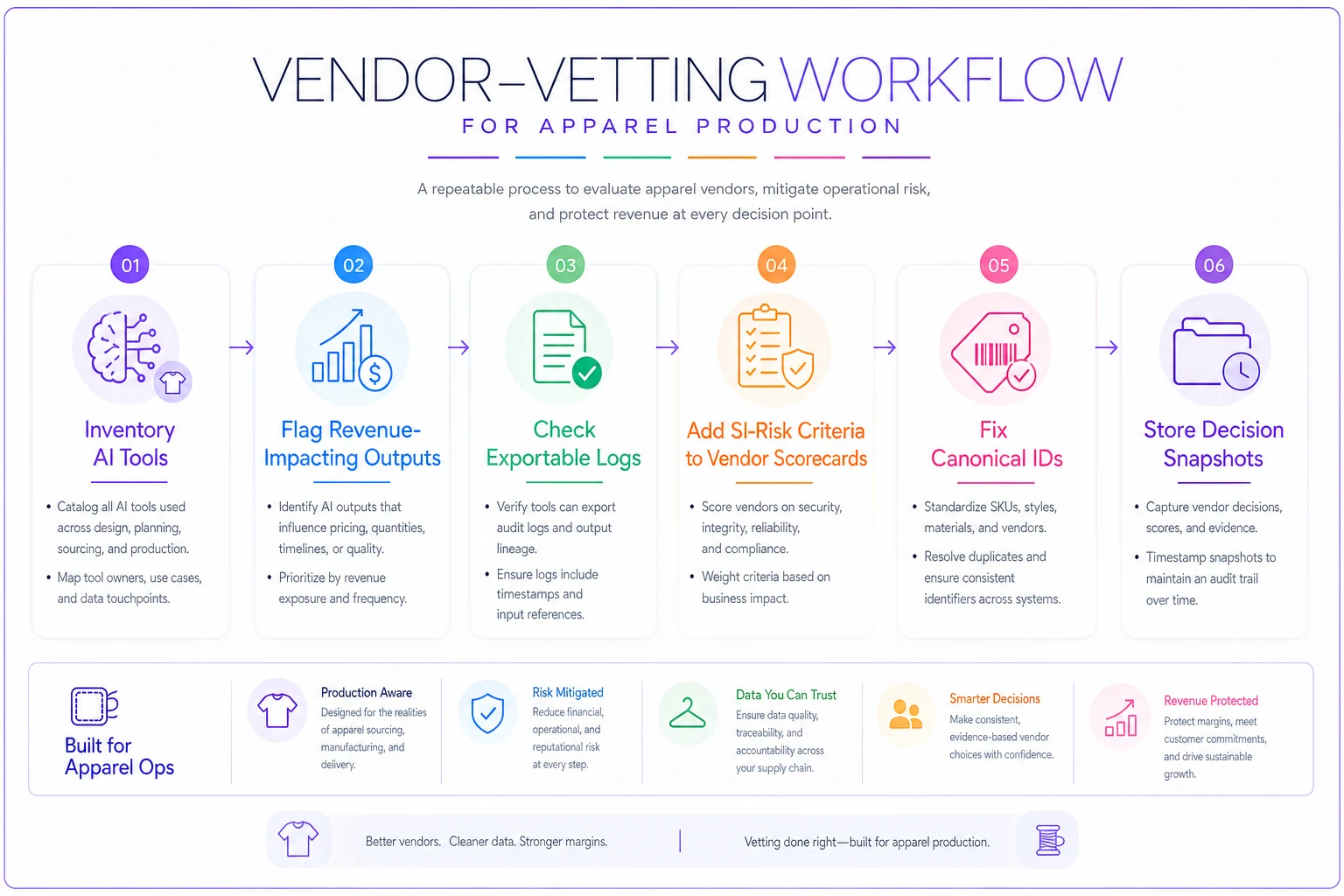
This flow shows the vendor-vetting and procurement steps in sequence.
When this effort actually makes sense — and when it doesn't
Not every apparel business needs to treat this as urgent.
This makes sense if: you sell to government agencies, you supply distributors or primes that hold federal contracts, you make institutional or uniform apparel, or you're actively trying to win that kind of business. For those businesses, SI-driven procurement expectations are a near-term revenue gate.
This is lower priority if: you're a purely DTC brand with no public-sector exposure and no plans to pursue it. Data hygiene is still worth cleaning up — it pays off regardless — but the SI-specific compliance pressure won't hit you the same way.
Who should not overreact: small shops that don't use any AI tools at all. If your planning is still spreadsheets and experience, you don't have unexplainable automated decisions to document. Your work is mostly the canonical-ID cleanup, which was overdue anyway. Don't let anyone scare you into buying compliance software you don't need yet.
A short real scenario
A mid-sized workwear manufacturer — roughly 90 employees, supplying a distributor with government accounts — got pulled into an updated vendor review in early 2026. The distributor wanted assurance around any AI-assisted planning, plus traceable BOM data for the SKUs going into government channels.
Their starting point was rough. Style codes didn't match across systems. Their AI forecasting tool's history wasn't stored anywhere permanent. Pulling together evidence for a single contested order took close to three weeks and still had gaps.
They didn't buy a new platform. They spent about six weeks doing unglamorous cleanup: standardizing one ID per style across tech-pack, PO and ASN; assigning a BOM owner per product category; setting up a routine to snapshot forecast inputs whenever a buy got committed. After that, reconstructing the evidence for a flagged order dropped from weeks to roughly a day. The distributor's follow-up review passed without escalation, and they kept the account — worth somewhere in the low seven figures annually.
The lesson wasn't "AI is risky." It was that their data had never been organized to explain itself, and procurement pressure forced a cleanup they'd been avoiding for years.
Where this connects to the work you should be doing anyway
Strip away the SI terminology and what remains is a demand for disciplined data ownership — clean canonical records, clear owners, and reconciliation routines that hold up when someone asks a hard question. That's not a new requirement invented by an executive order. It's the same foundation that prevents chargebacks, kills version chaos, and keeps forecasts trustworthy.
If you want a structured way to build that foundation, the practical mechanics of owners, audits and reconciliation routines are covered in detail in operational data governance for apparel teams. The SI order just raises the stakes on getting it right.
The teams that'll handle the coming procurement questions easily aren't the ones with the fanciest AI tools. They're the ones who can answer "where did this number come from?" in minutes rather than weeks. That capability is entirely within reach — and most of the work has nothing to do with AI. It has to do with naming things consistently, assigning ownership, and keeping a record that doesn't erase itself.
Start there. The definitions coming out of Washington will sharpen over the next couple of months, but the data discipline underneath them is already clear.
Ready to tailor your apparel operations?
Join 500+ fashion brands using GoTailo to accelerate product launches, reduce waste, and improve supplier collaboration.