

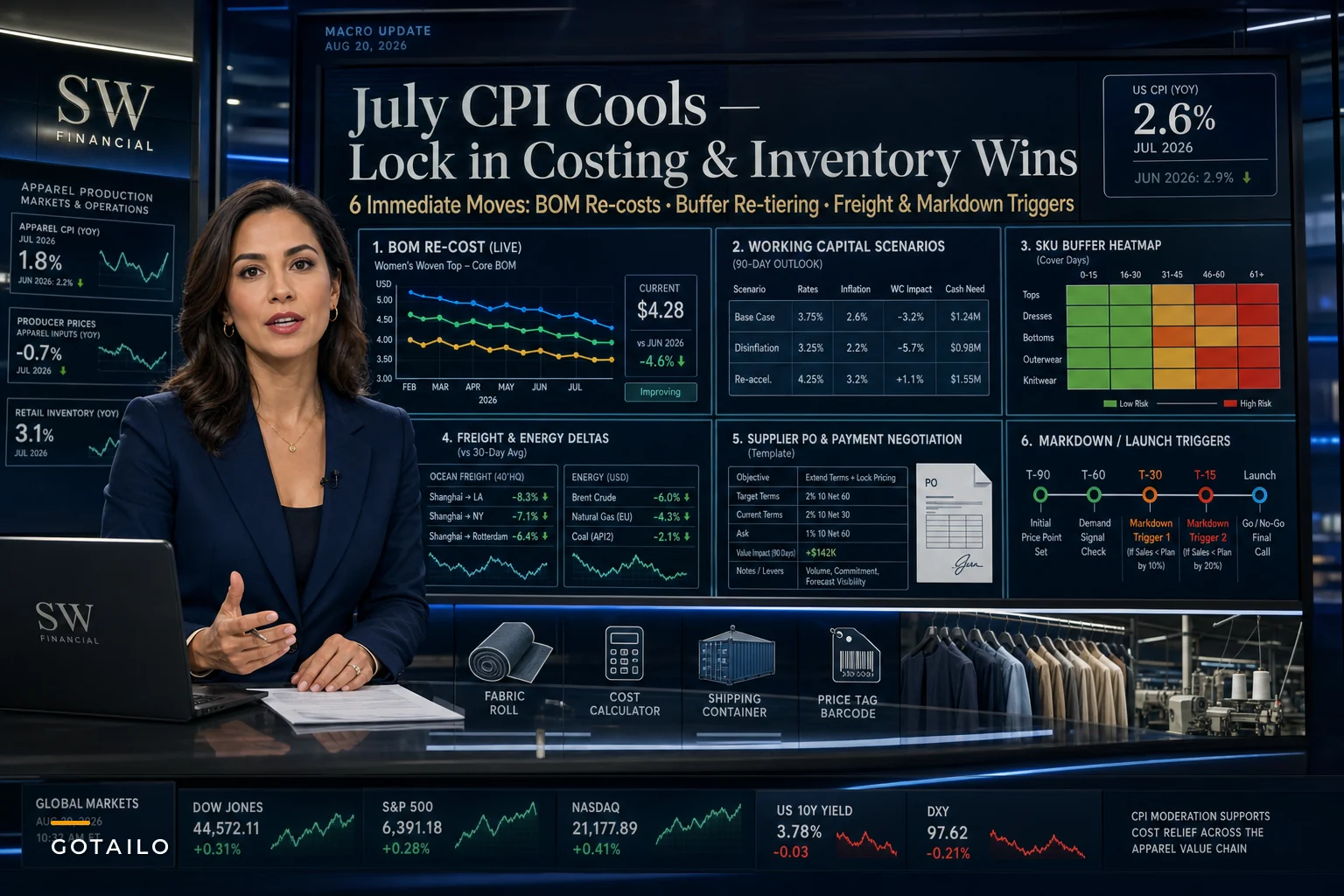

The July numbers came in softer than most desks expected. Headline CPI rose just 0.1% for the month and sits at 3.4% year-over-year, while core CPI ticked up 0.2% monthly and 2.5% annually, according to the Bureau of Labor Statistics release. CNBC framed it as a print that takes near-term pressure off the Fed, which is the part everyone latched onto.
But a cooling aggregate number tells you almost nothing about the specific inputs sitting in your bill of materials. Cotton, synthetics, trims, ocean freight, factory energy costs — they each move on their own schedule. The headline can flatten while your specific fiber blend is getting more expensive. So the real work this week isn't celebrating anything. It's re-checking assumptions you baked into costing sheets six or nine months ago when the inflation picture looked completely different.
Six moves worth making right now, roughly in the order I'd tackle them.
1. Re-cost your BOMs against *component-level* inflation, not the headline
The mistake that keeps showing up: teams update landed cost assumptions once a season using a blanket percentage. They'll say "add 4% across the board" because that felt reasonable at planning time. Then a soft print lands and the reaction is to reverse it — okay, prices are cooling, let's pull that buffer back out.
Both moves are wrong for the same reason. Apparel inputs don't inflate uniformly. A cotton-heavy woven program behaves nothing like a poly-spandex activewear line. Energy-intensive processes — dyeing, finishing, heat-set — carry cost swings that never show up in the shelter-heavy CPI basket driving the headline number.
Pull your top 15–20 BOM components by spend and re-price each one against your actual last three POs, not against a macro figure. You'll almost always find a messy spread — some inputs softened, a couple crept up quietly, and the net effect on any given style is nowhere near the blanket number.
| BOM component | Assumed at planning | Actual last 3 POs | Real direction |
|---|---|---|---|
| Combed cotton jersey | +4% | +1.2% | Softer than planned |
| Recycled poly trim | +4% | +6.5% | Worse than planned |
| YKK zippers | +4% | +0.8% | Softer |
| Dye + finishing (energy-linked) | +4% | +9% | Much worse |
| Ocean freight (per carton) | +4% | –3% | Actually fell |
The style-level margin impact of that spread is completely different from what a single "4%" line would tell you. A cooling headline gives you cover to hold prices — but only after you've confirmed which components are actually behaving.
2. Reset markdown triggers before you reset production volume
The tempting read on a soft inflation print: consumers get relief, demand stabilizes, plan a bit more aggressively. Be careful with that logic. The AP's coverage of the same report noted the economy still isn't clearly out of the woods — annual inflation is still elevated and consumer wallets are fragile even when the monthly number looks calm.
Eliminate delays in your fashion production cycle.
GoTailo helps you manage designs, orders, and inventory effortlessly, keeping production on schedule.
- Centralized order and inventory management
- Real-time supplier communication
- Integrated production scheduling
No credit card required
For apparel, fragile demand shows up first in markdown behavior, not in top-line orders. So before you touch production quantities, revisit the rules that trigger a markdown.
-
Move your first-markdown trigger earlier by one sell-through checkpoint (e.g. from week 6 to week 4 for seasonal styles)
-
Tighten the sell-through threshold that keeps a style at full price — if you were holding at 55%, consider 60–65% in categories where demand feels soft
-
Separate your core carryover SKUs from seasonal risk SKUs so you're not applying one markdown clock to two very different risk profiles
In a soft-demand environment, the cost of holding stale inventory quietly outruns the margin you protect by refusing to discount. Getting the markdown clock right is worth more than shaving a few points off costing.
3. Re-open PO term conversations while you have leverage
When suppliers expect higher inflation, they price defensively — shorter payment windows, price-escalation clauses, surcharges tied to energy or freight. A cooler print changes the negotiating context. It's a reasonable, non-adversarial moment to revisit terms set under a hotter outlook.
The angle that actually works isn't "prices are cooling, give me a discount." Suppliers ignore that. What works is tying specific clauses to specific, now-outdated assumptions:
-
Pull any PO with an inflation-linked escalation clause set in the last 6–9 months.
-
Flag clauses that reference index thresholds the current data no longer supports.
-
Propose a revised trigger, or convert a variable surcharge into a fixed line you can actually forecast.
-
For reliable partners, offer something in return — slightly longer commitment, cleaner forecasts, faster approvals — in exchange for locking a rate.
A predictable fixed cost is often worth more to your planning than a marginally lower variable one. Volatility is the expensive part, not the level.
4. Right-size inventory buffers per SKU tier, not per warehouse
Blanket safety-stock policies are where working capital quietly dies. When input costs were climbing fast, over-buffering felt like insurance. With inflation cooling and demand uncertain, that same buffer becomes trapped cash sitting in slow-moving styles.
The move isn't "cut buffers." It's re-tiering them:
-
Tier A (proven sellers, stable demand) hold buffers, maybe increase slightly if the input is one you've confirmed is still inflating.
-
Tier B (moderate/uncertain) trim to lean, reorder on shorter cycles.
-
Tier C (seasonal, fashion-risk, or aging) minimize buffer entirely, let it run down, accept occasional stockouts over markdown exposure.
Teams almost always over-buffer their Tier C styles because those are the emotionally exciting SKUs — the new prints, the trend pieces. Those are exactly the ones where a soft-demand environment punishes excess stock hardest.
5. Isolate energy and logistics as their own watch items
The reason the headline can mislead apparel teams: your cost base is unusually exposed to two things that swing harder than the aggregate — factory energy and freight. Dyeing, finishing, and pressing are energy-hungry, and a lot of that cost is embedded in your cut-make price without a visible line item.
Set up a simple monthly watch — not a full model, just a tracked delta:
-
Freight cost per carton on your main lanes
-
Any energy or utility surcharges passed through by your CMT factories
-
Dye-house or finishing surcharges, which often ride energy indexes
Track freight cost per carton and energy surcharges monthly to catch deltas early.
The point of watching these separately is that they can move against a cooling headline. You want to catch a dye-house surcharge in month one, not discover it three seasons later when you finally audit why a style's margin drifted.
A short real scenario
A small contemporary womenswear brand — roughly a 40-SKU seasonal line — had been carrying a flat +5% input assumption across every style since spring planning. After the July print, instead of reversing the buffer wholesale, they re-costed their top 18 components against actual POs.
What they found was messy and useful: cotton and zippers had softened, but their signature garment-dye process had picked up close to 9% on energy pass-throughs, and one recycled-poly trim was up over 6%. Net, three of their "safe margin" styles were running about 4–6 points thinner than the costing sheet claimed, while two "risky" styles were actually healthier than assumed. They repriced two styles, pulled one from the reorder plan, and moved their markdown trigger a week earlier on the seasonal group. Nothing dramatic — but it turned a vague "prices are cooling, we're fine" into concrete decisions, and it protected a few thousand dollars of margin per style over the season that would've leaked quietly otherwise.
6. Lock the whole thing into a repeatable review, not a one-off scramble
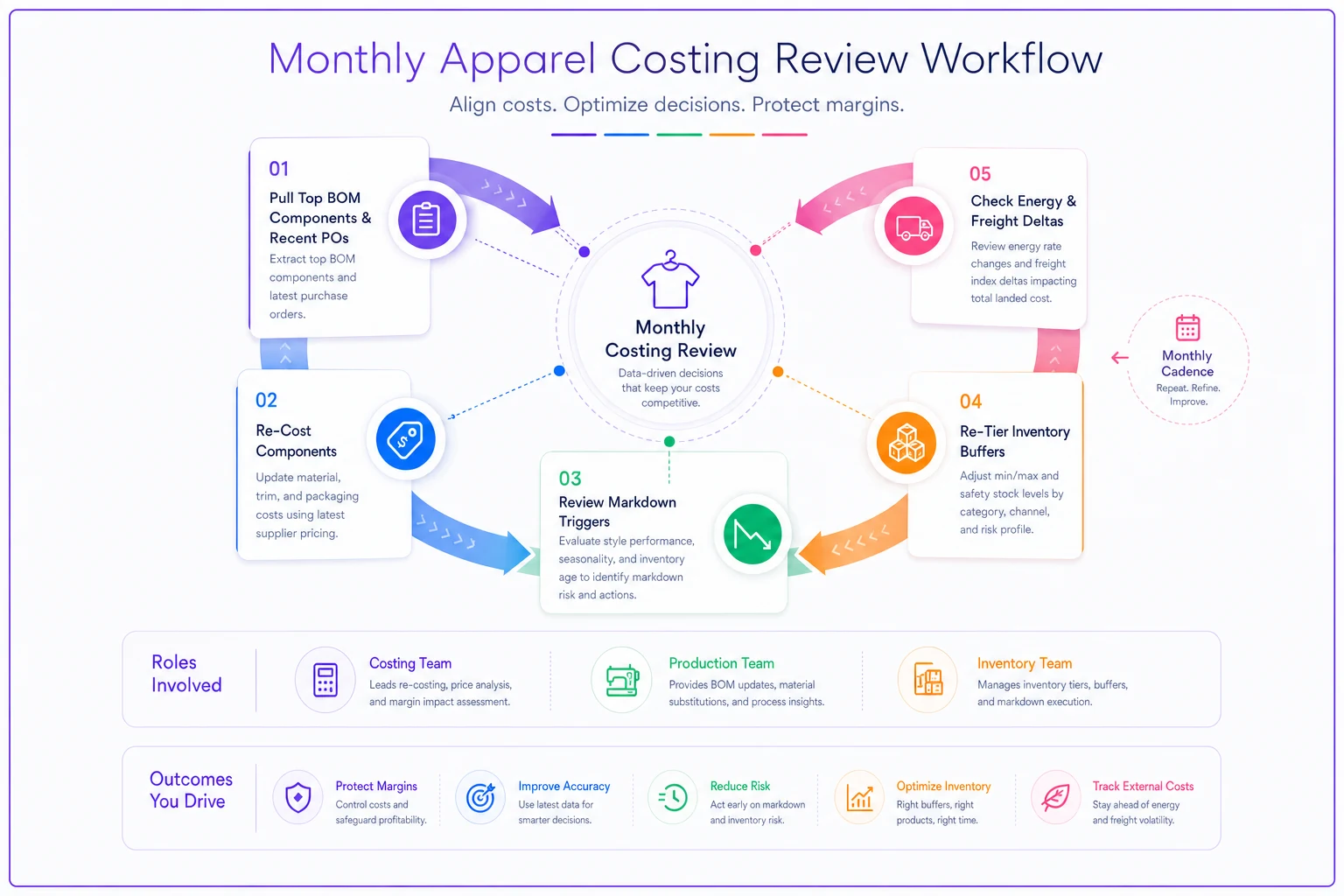
The trap after any CPI release is treating it as a single event — react this week, forget it until the next headline rattles someone. The teams that stay ahead treat macro prints as scheduled triggers for a standing review: re-cost, re-check markdown rules, re-tier buffers, glance at the energy and freight deltas.
This is where centralized operational data earns its keep. If your BOMs, PO history, and sell-through numbers live in five spreadsheets owned by four people, a "quick re-cost" turns into a two-week reconciliation project — and by the time you finish, the picture has already shifted. Teams running their costing, PO, and inventory data on a connected platform can re-run component-level re-costs and buffer scenarios in an afternoon instead of a fortnight, which is the difference between actually reacting and just being busy.
A quick monthly checklist teams can run:
If you want the fuller playbook on how these costing, production, and inventory moves fit together across a rate cycle, we walked through it in more depth in our breakdown of what apparel teams should do after the Fed held rates. Most of that framework applies directly here — this July print is just a fresh reason to run it.
Where this leaves you
A soft CPI print is not a signal to relax your costing discipline. It's a signal to re-verify it, because a calm headline can hide inputs moving in opposite directions underneath. The apparel teams that come out of this quarter healthy won't be the ones who read the number and shrugged. They'll be the ones who pulled their real POs, checked their components one by one, reset the markdown clock for a fragile-demand environment, and used the moment of reduced pressure to renegotiate terms while the leverage was there.
None of this requires forecasting the next Fed decision. It just requires knowing your own numbers well enough to act on them faster than the macro story changes again.
Ready to tailor your apparel operations?
Join 500+ fashion brands using GoTailo to accelerate product launches, reduce waste, and improve supplier collaboration.