

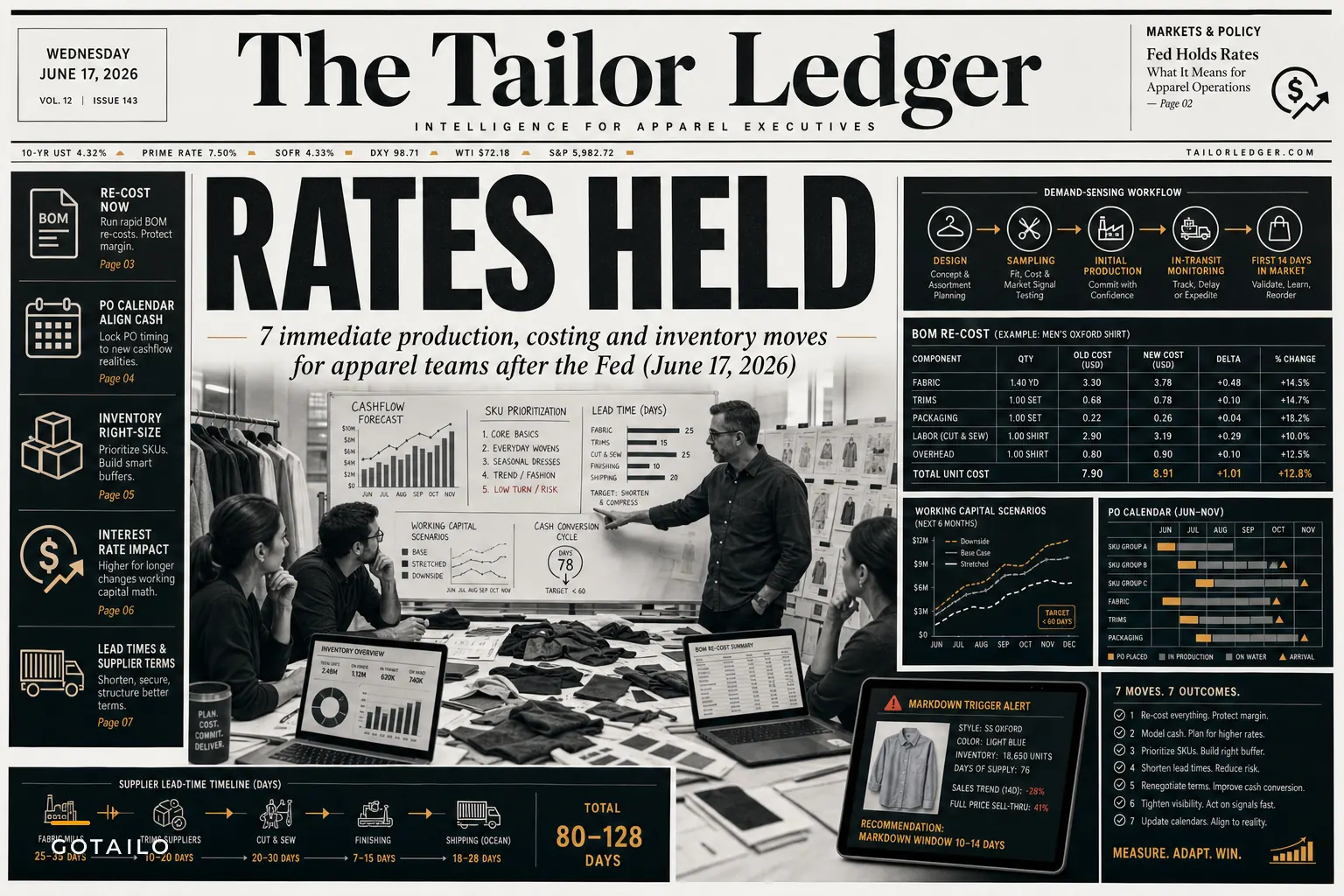

The Federal Reserve's June 17 decision to hold rates at 3.50%-3.75% wasn't surprising. What caught a lot of apparel teams off guard was Kevin Warsh signaling another potential hike later this year. For fashion designers and production managers already juggling supplier payment terms and inventory financing, this shifts the math on everything from fabric purchasing to markdown timing.
Most apparel businesses carry inventory for 90-120 days. At current financing rates, that's costing brands an extra 1.2-1.5% on working capital compared to eighteen months ago. Sounds small until you realize that's roughly half your net margin if you're running a typical 3-4% profit operation.
The real squeeze happens in the middle of your production cycle. You've already committed to purchase orders, fabric is somewhere between Vietnam and Long Beach, and now your line of credit costs more while consumer demand softens. This is where operational decisions separate surviving brands from those heading toward liquidation.
Move 1: Recalculate your true carrying cost per SKU
Every apparel team thinks they know their inventory costs. Most are off by 30-40%.
Your actual carrying cost includes warehouse space, insurance, opportunity cost of capital, plus the financing rate on whatever credit facility you're using. With interest rates where they are, that financing component just became your second-largest expense after physical storage.
-
Storage cost per unit per month
-
Insurance and shrinkage allocation
-
Financing cost at your current rate
-
Opportunity cost (what that capital could earn elsewhere)
Now do the same for your slowest movers. That limited-edition print dress sitting for 180 days? It's costing you roughly 18-22% of its wholesale value just to hold it. Most brands discover their slow-moving inventory is actively destroying margin.
The operational shift here is brutal but necessary: kill SKUs that don't turn in 60 days. With elevated interest rates, variety becomes expensive. Better to stock deep on winners than spread thin across hopeful experiments.
Move 2: Restructure supplier payment terms (before they restructure you)
Your suppliers are feeling the same rate pressure. They're going to ask for shorter payment windows or COD terms soon. Beat them to it with a structured proposal.
Eliminate delays in your fashion production cycle.
GoTailo helps you manage designs, orders, and inventory effortlessly, keeping production on schedule.
- Centralized order and inventory management
- Real-time supplier communication
- Integrated production scheduling
No credit card required
Map out your supplier relationships by volume and criticality. For your top three fabric suppliers who represent 60% of your materials cost, propose:
-
15-day payment for 3% discount
-
30-day standard terms
-
45-day with 1.5% premium
| Term | Condition |
|---|---|
| 15-day payment | 3% discount |
| 30-day | standard terms |
| 45-day | 1.5% premium |
This seems counterintuitive—why pay faster when cash is expensive? Because that 3% early payment discount beats your 8-9% annual financing cost when annualized. It also builds goodwill for when you actually need extended terms during seasonal peaks.
The suppliers you should push for longer terms? Trim, labels, packaging—anything easily substitutable. These vendors have less negotiating leverage and switching costs are minimal. Push these to 60-90 day terms even if it costs a small premium.
Move 3: Implement staged production commits
Traditional apparel production means committing to full runs upfront. You order 5,000 units, pay deposits, then hope demand materializes. With financing costs elevated, this model breaks.
Structure your production in three stages instead:
-
Initial run
30% of projected demand
-
Reorder point
45% of projected (triggered by sell-through)
-
Final commit
Remaining 25% only if velocity holds
Yes, your unit costs go up roughly 8-12% with smaller runs. But you're saving 15-20% in carrying costs and nearly eliminating clearance losses. The math works even before you factor in reduced markdown risk.
Getting suppliers to accept staged commits is the hard part. Frame it as guaranteed business with upside rather than uncertain large orders. Show them how consistent smaller orders reduce their working capital needs too—most suppliers will engage with that conversation if you approach it right.
Move 4: Adjust your costing models for rate reality
Pull up your standard costing template. Notice how it probably uses a flat 5-6% for financing costs? That assumption is quietly destroying your actual margins.
Your costing framework needs updating to reflect:
-
Current financing rates plus 100 basis points (for rate uncertainty)
-
Extended payment terms costs
-
Opportunity cost at current treasury rates
-
Currency hedging costs (these spike with rate volatility)
Run your existing SKUs through this updated model. You'll find that complex, slow-turning items suddenly show negative contribution margins. That elaborate beaded jacket with a 180-day lead time? It's costing you money even at full price.
The fix isn't just raising prices. It's redesigning your line for speed and simplicity. Reduce component counts, standardize fabrics across styles, eliminate custom hardware. Every day you shave off production and every component you cut drops your financing burden.
Move 5: Create an inventory aging acceleration trigger
Most brands wait too long to markdown slow-moving inventory. With elevated interest rates, waiting becomes exponentially expensive.
Track your markdown cadence weekly.
Build triggers based on days-in-stock:
-
30 days
Full price
-
45 days
15% markdown to loyalty members only
-
60 days
25% public markdown
-
75 days
40% markdown plus bundling options
-
90 days
50% off or wholesale liquidation
At current rates, holding inventory past 90 days costs more than taking a 50% markdown at day 60. The math is harsh but hard to argue with.
Track your markdown cadence weekly. Plot actual sell-through against your triggers. Most brands discover they're consistently 2-3 weeks behind optimal markdown timing, which quietly costs them 4-6% of gross margin every year.
Move 6: Renegotiate or consolidate your financing facilities
According to CNBC's coverage of the Fed decision, markets now expect rates to stay elevated through 2027. If you're still operating on financing terms from 2024, you're probably overpaying by 150-200 basis points.
Start by auditing your current facilities:
-
Working capital lines
-
Inventory financing
-
Purchase order financing
-
Equipment loans
-
Credit cards (yes, many brands still use these for quick purchases)
Then approach alternative lenders. Fintech players focusing on apparel often beat traditional bank rates by 100-150 basis points because they actually understand inventory turnover and can better assess risk. They'll also offer more flexible terms based on sales velocity rather than static collateral.
Consider factoring for your wholesale receivables. Yes, it costs 2-3% of invoice value, but you get cash in 48 hours instead of 60-90 days. At current rates, that acceleration often pays for itself.
Move 7: Build demand-sensing checkpoints earlier in your cycle
Traditional apparel planning assumes you'll know demand 6-9 months out. With rate uncertainty affecting consumer spending, that assumption kills profitability.
Insert demand checkpoints throughout your production cycle:
-
Design phase
Social media heat-testing before sampling
-
Sampling
Presell to top accounts for commitment signals
-
Initial production
Start with 20% of planned volume
-
In-transit
Monitor competitive releases and adjust receipt flow
-
First 14 days in market
Daily velocity tracking with reorder decisions by day 10
Each checkpoint gives you a chance to adjust or kill production before sinking more working capital. The brands holding up in this rate environment are the ones willing to walk away from weak performers early, even if it means eating development costs.
This also requires tighter coordination between design, production, and sales—daily standups during launch windows, shared dashboards showing real-time sell-through, alerts when velocity drops below plan. AI-powered operational software helps here by centralizing these signals and flagging decision points automatically, rather than waiting on someone to pull a monthly report that's already three weeks stale.
The workflow below shows checkpoints and decision points across the production timeline.
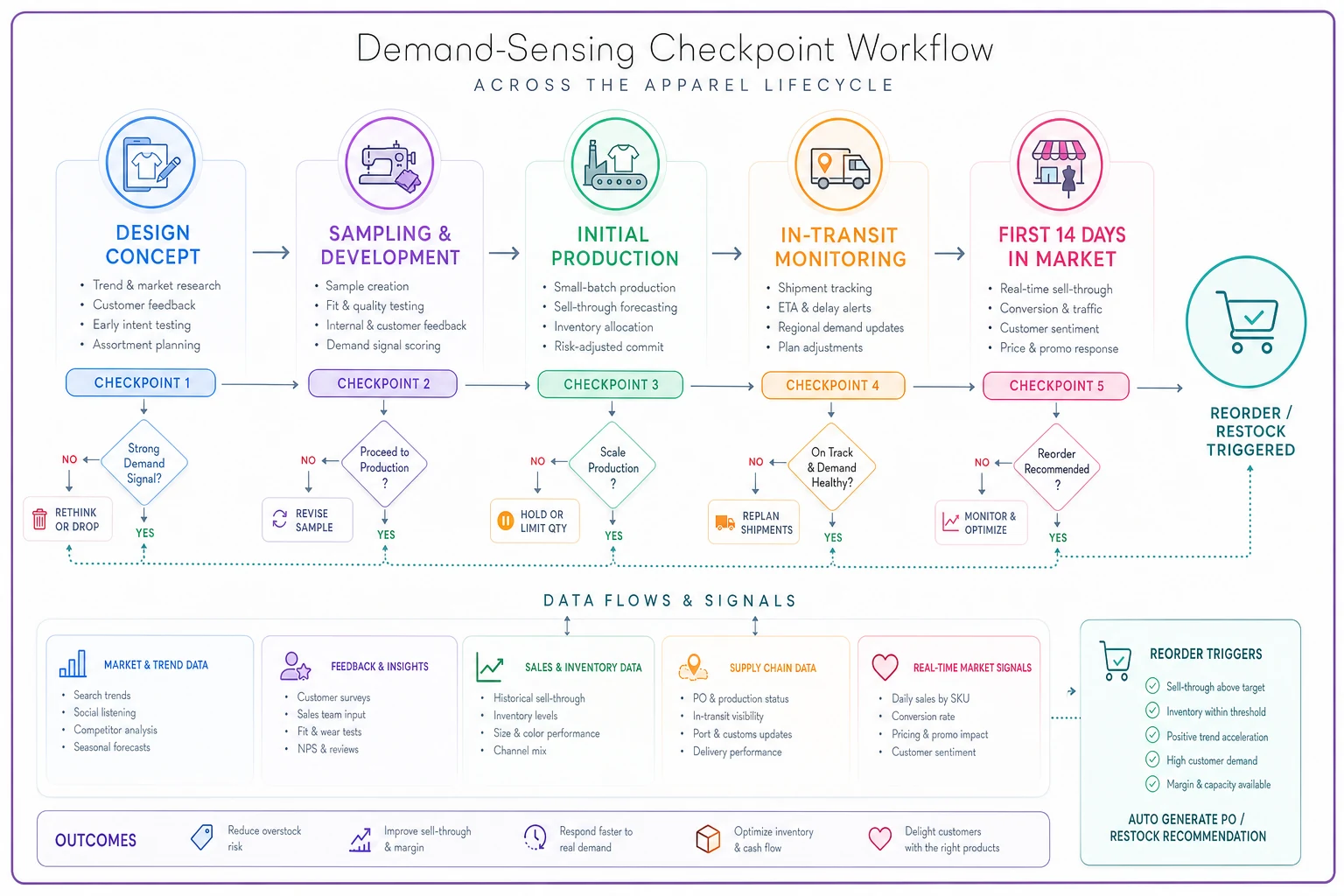
Use the graphic to align teams on decision timing.
The uncomfortable reality of operating in a high-rate environment
The apparel businesses that grew up in the zero-rate environment of 2020-2021 built their operations assuming cheap capital would last. They expanded SKU counts, extended payment terms, and held inventory longer to avoid stockouts.
That playbook is now a liability. With rates elevated and potentially heading higher, the new operational reality demands:
-
Fewer SKUs with deeper stock
-
Faster inventory turns even if it means occasional stockouts
-
Aggressive markdown cadences
-
Simplified production with standardized components
-
Daily cash management rather than monthly check-ins
The brands that adapt will find real opportunity. Competitors who don't adjust will liquidate at desperation prices. Suppliers will offer better terms to reliable partners. Consumers will consolidate purchases around brands that consistently deliver value.
This rate environment is also forcing operational discipline that should have existed anyway. The easy money masked a lot of inefficiency. Now those inefficiencies are existential.
Your next 90 days shape your next two years. Every production decision, every inventory purchase, every payment term negotiation either strengthens your position or weakens it. The Fed has made their stance clear—rates stay high, uncertainty remains. Your response needs to match that clarity: operational intensity, margin protection, cash preservation.
The playbook above isn't comfortable. It means killing SKUs you believe in, tightening terms with suppliers, and accepting stockouts rather than overbuying. But operating as if rates will magically drop leads somewhere predictable—joining the liquidation sales that flood the market whenever credit finally tightens for real.
Start with Move 1 tomorrow morning. Pull your actual carrying costs. The number will do more to clarify your priorities than any Fed announcement ever could.
Ready to tailor your apparel operations?
Join 500+ fashion brands using GoTailo to accelerate product launches, reduce waste, and improve supplier collaboration.