

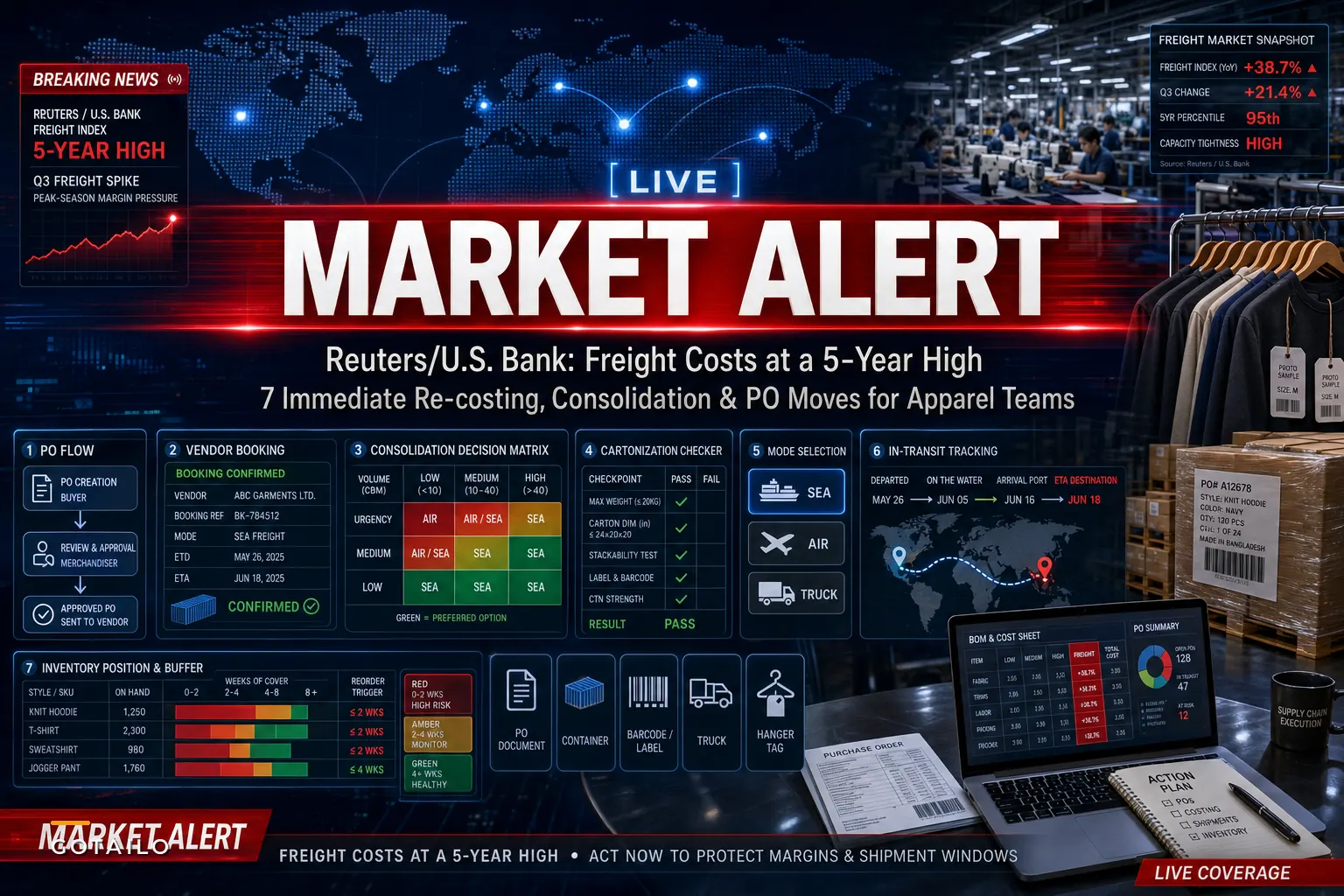

The timing couldn't be worse. Shipper costs just hit a five-year high in Q3 2026, driven mostly by diesel and trucking rates climbing faster than anyone budgeted for. According to Reuters coverage of the U.S. Bank Freight Payment Index, costs rose even as freight demand stalled — which is the part that should make any procurement lead nervous. When rates climb without volume climbing, the increase is structural. It won't relax once demand softens.
For apparel teams, this lands at the worst point in the calendar. Replenishment POs are already cut, peak-season goods are in transit or nearly there, and the holiday window leaves almost no room to renegotiate anything. So rather than walking through the index line by line, this is about what actually needs to happen on your desk this week — the re-costs, consolidation decisions, and PO adjustments that protect margin before goods ship.
The real problem isn't freight — it's that most BOMs treat it as a fixed line
Most apparel costing sheets carry freight as a static per-unit number, locked in weeks or months ago. A knit top gets costed with $0.42 of inbound freight baked in, and nobody revisits it until the invoice lands and the margin's already gone.
That works fine when rates are stable. It falls apart the moment diesel jumps 15–20% mid-season, because the number on your sheet no longer reflects reality — and you don't find out until the PO is closed and the goods are on a truck.
Freight gets treated as an accounting afterthought instead of a live variable. When it's live, you can respond. When it's frozen in a spreadsheet cell from August, you absorb whatever the market throws at you. The seven moves below are about making freight something you actually manage during the one window where small decisions compound fastest.
Move 1: Re-cost your top 20 SKUs by landed cost, not FOB
Start where the money is. Pull your 20 highest-volume SKUs for the season and rebuild their landed cost with current freight assumptions — not the ones from when you originally costed them.
Eliminate delays in your fashion production cycle.
GoTailo helps you manage designs, orders, and inventory effortlessly, keeping production on schedule.
- Centralized order and inventory management
- Real-time supplier communication
- Integrated production scheduling
No credit card required
A typical example: a mid-weight fleece program costed at $11.80 FOB with $0.55 inbound freight. If trucking and diesel push that number to $0.78–$0.85, you've lost roughly $0.25 a unit. On a 40,000-unit buy, that's around $10k of margin that evaporated quietly. Multiply that across your top 20 and you're often looking at $60k–$90k of unplanned erosion before anyone notices.
The mistake teams make here is re-costing everything and running out of time before they can act on any of it. Don't. The top 20 SKUs usually carry the bulk of your freight exposure. Fix those first, then work down only if you have the bandwidth.
Move 2: Separate the SKUs where price can move from the ones where it can't
Not every product can absorb a re-cost the same way. Before touching a single PO, sort your season into three buckets:
-
Price-flexible Direct-to-consumer SKUs or items without locked wholesale terms, where a small retail adjustment can offset the freight hit.
-
Margin-absorb Goods already committed to retailer price lists where you eat the difference.
-
Re-engineer candidates Products where the freight hit is bad enough that cartonization, mode, or order timing needs to change.
| Bucket | Freight response | Effort required | Where to focus |
|---|---|---|---|
| Price-flexible | Small retail/price adjustment | Low | Quick wins, do first |
| Margin-absorb | Consolidation + mode review | High | Most of your time |
| Re-engineer | Cartonization + PO timing changes | Medium-High | Highest-volume items only |
Once you've got the buckets mapped, the sequence of the remaining moves starts to sort itself out naturally.
Move 3: Consolidate shipments that are currently moving separately
This is usually the fastest real savings available, and most teams leave it on the table because nobody owns the decision. When you've got three POs from the same vendor region shipping in a two-week window, splitting them across separate movements is pure waste — you're paying for underfilled containers or LTL runs that could've gone as a single FTL.
Look at everything shipping in the next 30–45 days, group by origin and window, and ask a blunt question: what can wait three days to ride with something else?
Assign a single owner for consolidation decisions and include vendor ship dates in PO metadata to surface overlaps early.
Consolidation usually stalls for one reason — nobody has clean visibility into what's shipping when. POs live in one system, freight bookings in another, and the person who could merge two loads doesn't even know they overlap. If you do one thing from this list, make it this one, and make the consolidation logic explicit. The mechanics are covered in more detail in our cartonization checklist and consolidation rules for apparel batches, and most of those rules apply directly to the current rate environment.
Move 4: Re-run cartonization on anything not yet packed
Freight is priced on either weight or volume, whichever costs the carrier more — and apparel almost always loses on volume. Loose folds, oversized cartons, and air gaps mean you're paying to ship empty space at a five-year-high rate.
A quick example: a vendor packs a woven shirt program at 24 units per carton with roughly 18% air gap. Re-specced to 30 units with tighter folding and a correctly sized carton, the same order drops from 52 cartons to 41. At current rates, that carton reduction can save more per shipment than the entire re-cost exercise in Move 1.
The catch is timing. Once goods are packed, this option disappears. So the filter is simple — anything still in production or not yet cartoned is in scope. Everything already packed is not. Chase the ones you can still touch.
Move 5: Run the mode-and-time tradeoff deliberately, not by default
When rates spike, the instinct is to downgrade mode — air to ocean, expedited to standard — to claw back cost. Sometimes that's right. Sometimes it blows a shipment window and triggers chargebacks or stockouts that cost more than the freight savings ever would have covered.
-
For core replenishment with steady demand, slower and cheaper mode usually wins — a few days late rarely hurts.
-
For peak-season hero SKUs tied to a drop date, protect the window even at higher freight. A stockout on your best seller during peak costs far more than expedited shipping.
-
For anything with a retailer delivery SLA, check the chargeback exposure before you downgrade mode. The penalty often exceeds the savings.
When downgrading mode is a bad idea
If the SKU is tied to a dated launch, a retailer appointment, or has thin on-hand coverage, don't downgrade mode to save on freight. The math almost never works once you factor in lost sales or chargeback risk.
Mode downgrades make sense on deep-stock, low-urgency goods — not on anything time-critical.
Move 6: Reopen PO terms where you still have leverage
You have more room here than it feels like, but only on POs that haven't shipped. A few terms worth revisiting while rates are elevated:
-
Shift Incoterms where it makes sense — moving from FOB to a term where the vendor manages more of the freight can sometimes land you better consolidated rates through their existing carrier relationships.
-
Negotiate ship-window flexibility so you can consolidate (see Move 3) without penalty.
-
Lock freight surcharge language so future increases don't get passed through silently mid-contract.
The mistake is treating a cut PO as untouchable. Vendors are dealing with the same rate environment, and many would rather adjust a ship window or carrier than lose future orders. Ask.
Move 7: Tighten inventory visibility so you don't overcorrect
In a cost panic, procurement trims order quantities to limit freight exposure — then peak demand hits and you're stocked out on your best sellers, which costs far more than freight ever would have. It's a predictable mistake and teams keep making it anyway.
The fix isn't ordering more. It's seeing clearly enough to order right. That means knowing your real on-hand position, your in-transit goods, and your sell-through velocity well enough that you're not guessing when you place the next PO. The U.S. Bank data showing costs rising while demand stalls is a reminder that you can't assume the market bails you out in either direction — you have to manage tightly on your own numbers.
The visual below shows the workflow for centralizing POs, freight bookings, in-transit status, and inventory to speed consolidation and re-cost decisions.
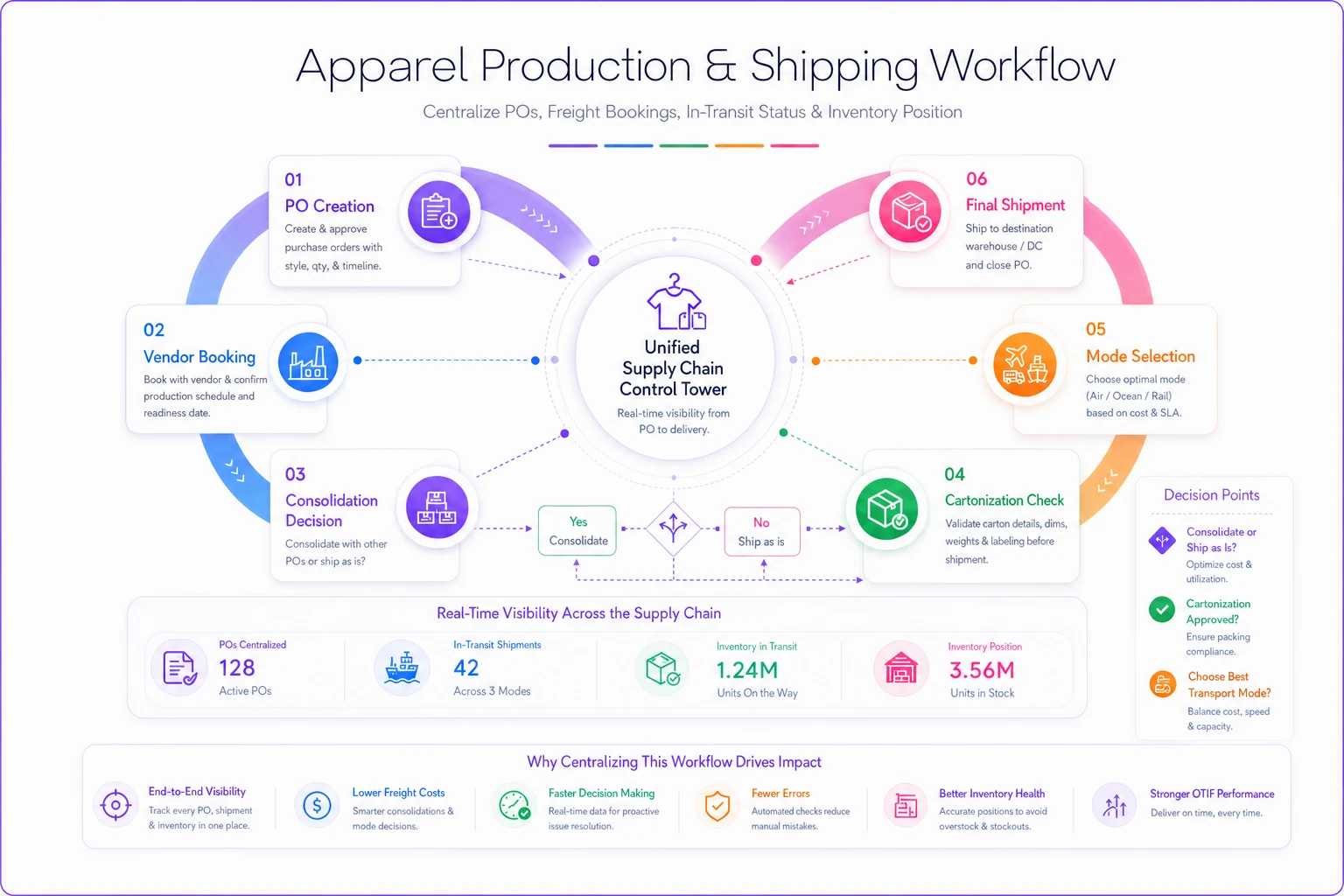
This is where centralized operational data earns its keep. When POs, freight bookings, in-transit status, and inventory position all live in one connected view, the consolidation and re-cost decisions above take minutes instead of days of spreadsheet reconciliation. Platforms that pull these signals together with AI-assisted flagging — surfacing which POs overlap, which SKUs lost margin, which shipments can still be merged — turn a fire drill into a routine review. The goal isn't automation for its own sake; it's that the right decision becomes obvious fast enough to act on before goods ship.
A real scenario: a mid-size outerwear brand, mid-season
A brand running roughly 180 SKUs across a fall outerwear line got hit mid-season. Their freight was costed back in July at rates that were already outdated by October. When they re-ran landed cost on their top SKUs, they found they'd been quietly absorbing somewhere around $0.30–$0.40 a unit across their highest-volume programs — about $50k–$65k of margin exposure across the season.
They didn't fix all of it. By consolidating four overlapping POs from one origin region into two movements, re-cartonizing two programs still in production, and protecting mode only on their three hero SKUs while downgrading the slow movers, they recovered enough to bring the season's margin back within a point or so of plan.
The part that stuck with the team wasn't the savings number. It was realizing how much of the problem had been invisible simply because freight, POs, and inventory lived in three different places.
Who should not spend time on all seven
If you're a small brand with a handful of SKUs and a single freight lane, skip the full triage matrix. Focus on Move 1 (re-cost your main products), Move 4 (cartonization), and Move 7 (don't over-trim your orders).
The consolidation and PO-term moves pay off most when you've got real volume and multiple overlapping shipments — below a certain scale, the effort outweighs the recovery.
The takeaway for this week
Rising freight costs aren't a one-quarter event you wait out — the fact that rates climbed while demand didn't tells you this is baked into the environment heading into peak. The teams that hold margin won't be the ones who found a cheaper carrier. They'll be the ones who treated freight as a live variable, re-costed fast, consolidated what they could still touch, and kept enough visibility to order right instead of ordering scared.
None of these seven moves are complicated. The hard part is just having the information in front of you early enough to act — which is exactly the gap worth closing before the next PO ships.
None of these seven moves are complicated. The hard part is just having the information in front of you early enough to act — which is exactly the gap worth closing before the next PO ships.
Ready to tailor your apparel operations?
Join 500+ fashion brands using GoTailo to accelerate product launches, reduce waste, and improve supplier collaboration.