


When a core supplier drops out two weeks before an in-store date, the thing that kills most teams isn't the decision to switch. It's the forty-five minutes spent hunting for an NDA template, the three hours arguing about who signs off on a 12% cost overage, and the realization at 2 a.m. that nobody saved the approved lab-dip in a format the alternate factory can actually open.
The strategy side of this — deciding whether to failover, which SKUs to protect, how to read the outage — is covered in the 48–72-hour emergency failover checklist for time-critical apparel SKUs. This piece is the other end of it: the paperwork and the clock. The stuff you want sitting in a shared folder, half-filled, so that when the call comes you're executing instead of drafting.
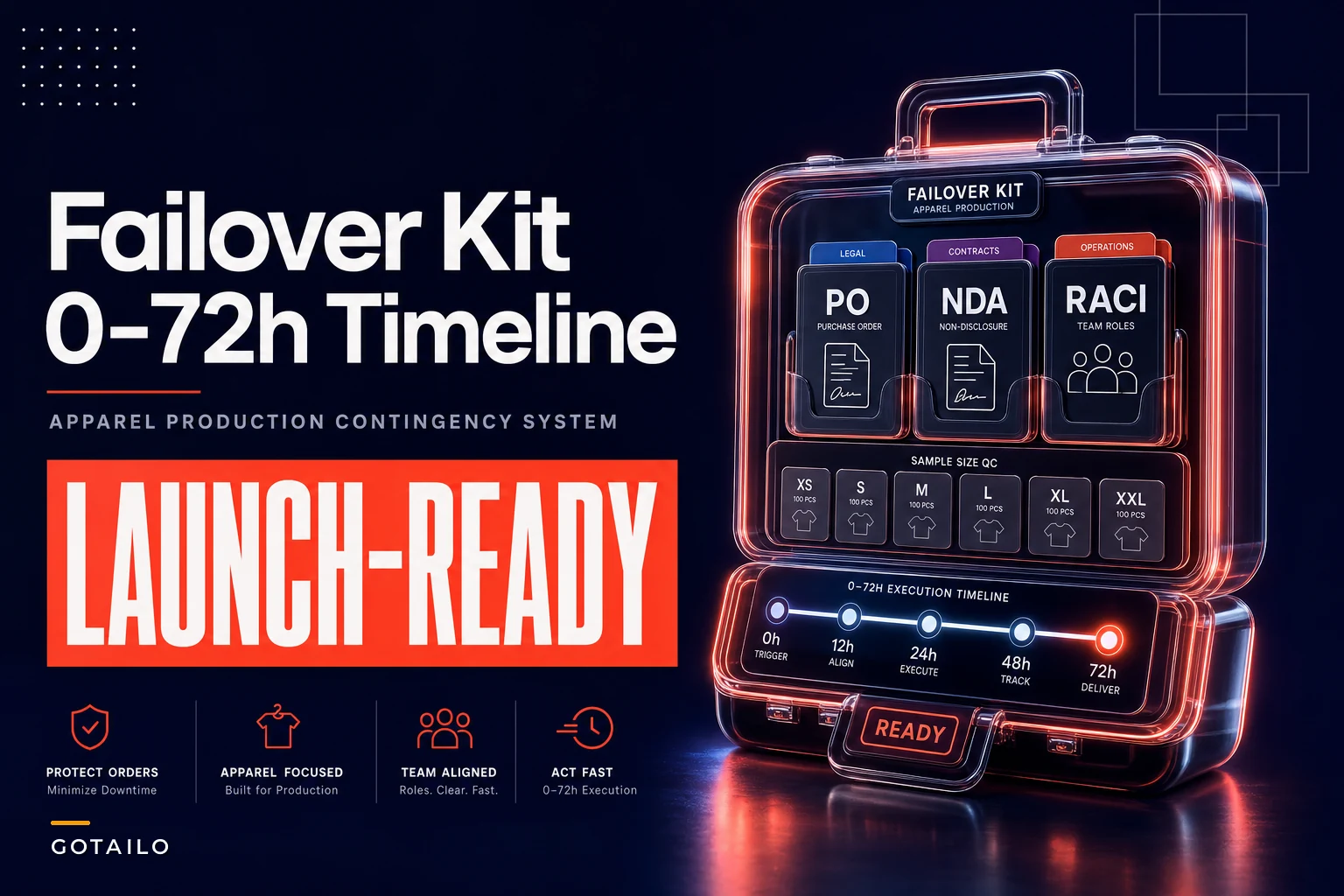
What follows is a deployable 48-72 hour failover templates kit — the actual documents, a minute-by-minute timeline with named owners and SLAs, compressed QC sampling plans with real acceptance numbers, and a file manifest so artifacts don't vanish in the handoff. Build it once. Keep it current. Use it rarely, but use it fast.
Why teams lose the first six hours (and why it's always the same six hours)
The failover decision is rarely the bottleneck. The delay almost always comes from the mechanics around it.
A typical breakdown looks like this: the merchandiser confirms the factory can't deliver by Tuesday morning. By Tuesday afternoon, someone's found two possible alternates. Good. Then everything stalls — because the alternate wants an NDA before they'll quote, procurement doesn't have a PO amendment template that handles a mid-production supplier swap, and nobody's sure whether the $9,400 air-freight premium needs sign-off from the ops lead or the CFO. Each of those is a fifteen-to-forty-minute scramble. Stack four or five of them and you've burned the margin you had to react.
The pattern is consistent: the documents that gate action don't exist yet when action is needed. They get written under pressure, which means they're incomplete, inconsistently named, and missing the one field — lot number, incoterm, cost ceiling — that causes a re-send later.
A ready kit fixes this by pre-answering the boring questions. Who signs. What the ceiling is. What format the tech pack ships in. What "acceptable" means numerically for a compressed inspection. When those decisions are made in advance, the failover becomes a sequence of fill-ins rather than a series of debates.
The documents to pre-build (and the one field most people forget)
The core document set. Each one should live as a fillable template — not a blank page — with fixed language locked and only the situational fields open.
Eliminate delays in your fashion production cycle.
GoTailo helps you manage designs, orders, and inventory effortlessly, keeping production on schedule.
- Centralized order and inventory management
- Real-time supplier communication
- Integrated production scheduling
No credit card required
| Template | What it unblocks | The field teams usually forget |
|---|---|---|
| Emergency PO amendment | Legally moving qty/dates/incoterms to an alternate without voiding the original | Reference to the original PO line and the reason code |
| Mutual NDA / EMA (evaluation & manufacturing agreement) | Getting an alternate to quote and receive your tech pack same-day | Scope limited to the specific style/season, with an auto-expiry |
| Failover RACI / RAD | Killing the "who decides this?" loop | A named backup for every "A" (accountable) role |
| Decision log | Defensible record of why you swapped, at what cost | Timestamp + who was consulted vs. who approved |
| Cost-ceiling authorization | Pre-cleared spend bands so air freight doesn't wait for an email chain | Tiered thresholds, not a single number |
A note on the cost-ceiling auth, because this is where most kits are too simple. Don't build a single approval line — build tiers. Something like: ops lead can approve up to 8% total landed cost overage on the affected PO; between 8% and 15% needs ops lead plus finance; above 15% goes to the brand principal. Pre-agreeing those bands means a $9,400 premium on a $110k PO clears in one message instead of a committee.
The other quietly important one is the decision log. In a failover you're making trade-offs fast, and three weeks later someone — a retailer, a CFO, an auditor — will ask why. A two-line entry per decision ("1420 EDT: approved air freight on SKU 4471, +$9.4k, to hold 11/18 floor-set; approved by J.M., consulted K.R.") saves a reconstruction exercise later and protects the person who made the call.
The 0–72h timeline, with owners and SLAs
This is the backbone. Every row has an owner role and a service-level clock. Assign roles to people at the start of each season, not during the crisis.
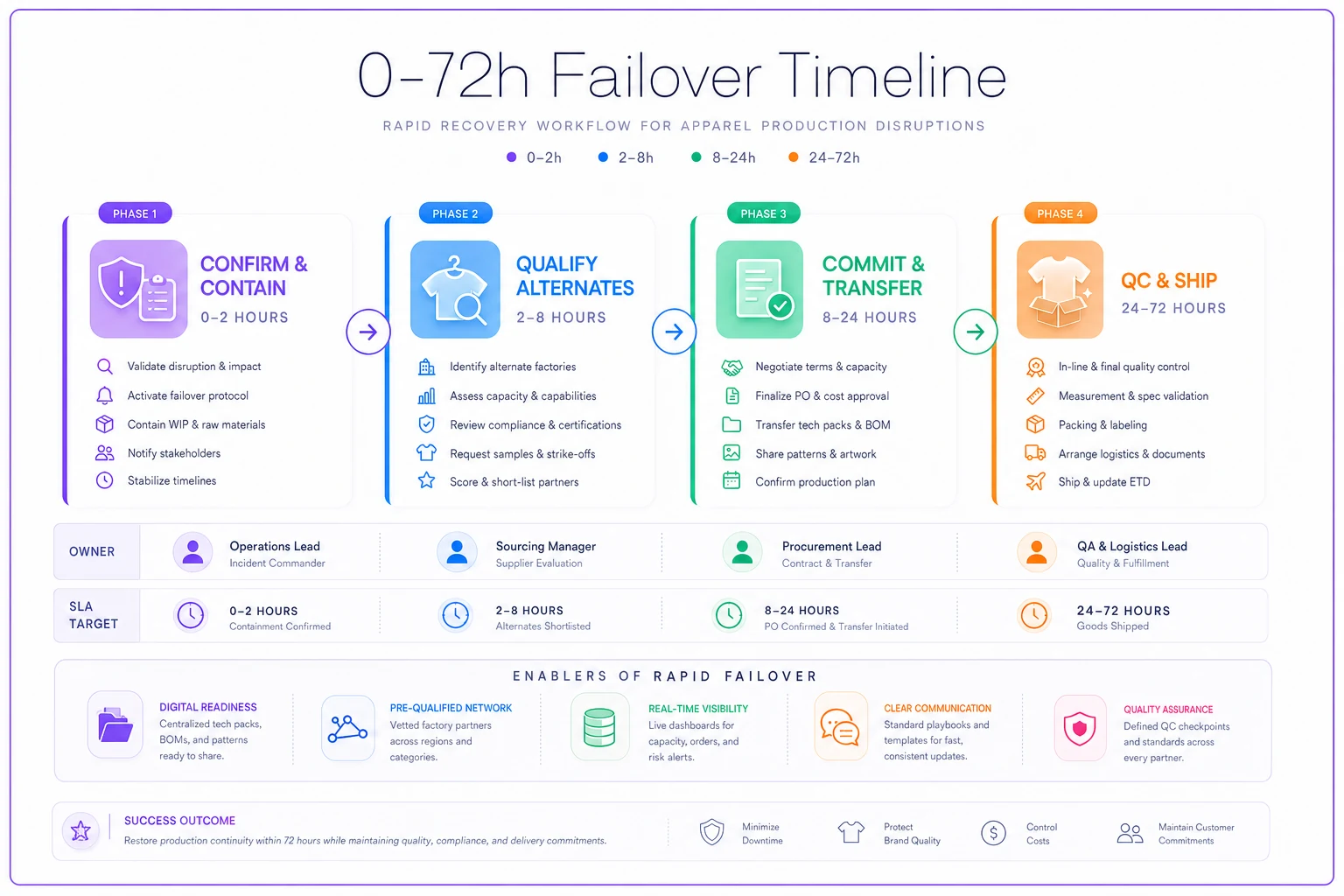
The timeline below breaks each phase into owners and SLA windows.
Hour 0–2: Confirm and contain
-
0
00–0:30
— Incident declared. Ops lead opens the decision log and the failover folder. SLA: 30 min. -
0
30–1:00
— Confirm scope: which SKUs, which quantities, which dates are actually at risk. Don't failover everything; isolate the time-critical lines. Owner: production manager. SLA: 30 min. -
1
00–2:00
— Pull the artifact manifest (see below). Verify the approved tech pack, graded spec, approved lab-dip, and BOM are current and exportable. Owner: tech/PD. SLA: 60 min.
Hour 2–8: Qualify alternates
-
2
00–4:00
— Run the quick-qual rubric on candidate factories. Target two viable alternates, not one. Owner: sourcing. SLA: 2 hr. -
4
00–6:00
— Send mutual NDA/EMA to shortlisted alternates; request capacity confirmation and indicative pricing. Owner: sourcing + procurement. SLA: 2 hr. -
6
00–8:00
— Receive quotes, compare against cost-ceiling bands, pre-draft PO amendment. Owner: procurement. SLA: 2 hr.
Hour 8–24: Commit and transfer
-
8
00–12:00
— Select alternate. Log the decision. Execute PO amendment. Owner: ops lead (approval). SLA: 4 hr. -
12
00–18:00
— Transfer artifact package in agreed formats. Schedule a tech handoff call so the alternate's pattern/QC team can ask questions live. Owner: tech/PD. SLA: 6 hr. -
18
00–24:00
— Confirm materials availability at the alternate (their stock, your consignment, or a split source). Trigger split-shipment playbook if needed. Owner: sourcing. SLA: 6 hr.
Hour 24–48: Protect quality under compression
-
24
00–36:00
— Alternate produces a fast approval sample or first-off. Apply the compressed QC sampling plan (below). Owner: QC. SLA: 12 hr. -
36
00–48:00
— Approve or reject against numeric gates. One re-cut allowed; second failure triggers escalation. Owner: QC + production manager. SLA: 12 hr.
Hour 48–72: Ship and reconcile
-
48
00–60:00
— Production run under inline checks. Pull QC samples per plan. Owner: QC. -
60
00–72:00
— Final inspection, pack per label/carton spec, release to freight. Close the decision log with final landed cost. Owner: logistics + ops lead.
The SLAs matter more than they look. Without them, every step quietly expands to fill available time, and a 72-hour window becomes a 96-hour window — which, for a floor-set date, is the same as a miss.
Compressed QC sampling: numeric gates, not vibes
The dangerous instinct under time pressure is to inspect less because there's no time. The right move is to inspect differently — tighter sampling on defects that actually block a shipment, looser on cosmetic noise.
A workable compressed plan for a failover run (assume a lot of roughly 1,000–1,500 units per SKU):
-
Critical defects (anything that makes the garment unsellable or unsafe — broken needle fragments, wrong care label, seam failure under tension): AQL 0 / acceptance number 0. One critical defect in the sample = hold the lot. No negotiation.
-
Major defects (measurement out of tolerance, visible shading, mislabeled size): sample 50 units, acceptance ≤2. Three or more majors = re-inspect at double sample; still failing = reject.
-
Minor defects (loose thread, slight pressing issue)
same 50-unit sample, acceptance ≤5. These rarely block, but log them.
For measurements specifically, set the tolerance before the sample arrives, not when you're staring at it. A chest measurement at 52.0 cm spec with ±1.0 cm tolerance either passes at 52.8 or it doesn't. Pre-committing the number stops the 1 a.m. "it's probably fine" conversation that comes back as a return rate later.
The compression trick is in the first-off. Spend disproportionate attention on the first good unit off the alternate's line — full measurement set, construction teardown if you can spare one unit, lab-dip comparison under D65. If the first-off clears cleanly, your inline sampling can run lighter. If it doesn't, you've caught it before 1,200 units exist.
The artifact manifest: name things so the handoff doesn't break
More failovers slow down over files than over factories. The alternate can't start because they received a tech pack as a flattened PDF with no graded spec, or three versions of the lab-dip with no indication which one's approved.
Pre-agree a manifest and prioritize it — some artifacts block production start, others can follow.
Blocking (must transfer before the alternate cuts):
-
Approved tech pack — native format and PDF
-
Graded measurement spec — spreadsheet, editable
-
Approved lab-dip reference — with ICC profile or Pantone reference, plus a photo under controlled light
-
BOM with exact trims, suppliers, and substitution notes
-
Pattern files in the alternate's accepted format (confirm this in hour 2, not hour 12)
Follow-on (can transfer within 24h):
-
Carton and label specs
-
Packing list template
-
Inline inspection checklist
Use a naming convention everyone recognizes under stress. Something like:
SKUSEASONARTIFACTvVERSIONSTATUS.ext → 4471FW25TECHPACKv3APPROVED.pdf
The word APPROVED in the filename sounds trivial. It's the single cheapest way to stop an alternate from building off a superseded version. Version chaos in dispersed handoffs is its own recurring failure mode, and a failover is the worst possible time to discover it.
Three communications templates (write them cold, send them hot)
You don't want to be composing careful messages while the clock runs. Pre-write three:
-
Internal incident alert — to leadership and affected functions. States: what failed, which SKUs/dates are at risk, who owns the response, and when the next update lands. Keep it to five lines. The goal is to stop six people from Slacking the ops lead at once.
-
Alternate supplier outreach — paired with the NDA. States the opportunity size, the non-negotiable date, the required capabilities, and the deadline to respond. Specific enough that a factory can say yes or no in an hour instead of asking ten clarifying questions.
-
Customer / retailer heads-up — only if a date actually moves. States the revised commitment, the reason at a professional level of detail, and any mitigation (split shipment, partial early delivery). Honest and short. The instinct to over-explain here creates more questions than it answers.
The instinct to over-explain here creates more questions than it answers.
Split-shipment playbook and escalation triggers
Sometimes the alternate can cover 60% of the quantity on time and the balance a week later. A split shipment can save the floor-set date even if it can't save the full order.
Pre-decide the triggers so this isn't a judgment call made under fatigue:
-
Trigger split when the on-time-deliverable quantity covers ≥60% of the committed units and the delayed balance is ≤7 days behind. Below that, a split usually costs more in freight and chargeback risk than it saves.
-
Escalate to brand principal when total landed cost overage crosses the top tier of the cost ceiling, when a second QC failure occurs on the alternate, or when no viable alternate is qualified by hour 8.
-
Abort the launch window (and shift to the next drop) when neither alternate can deliver the minimum viable quantity within 72 hours and air freight can't close the gap inside the cost ceiling. Having a defined abort condition is what keeps a team from throwing good money at a window that's already gone.
Having a defined abort condition is what keeps a team from throwing good money at a window that's already gone.
Quick-qual rubric: picking an alternate in two hours
Full onboarding isn't possible in a failover. You need a fast, defensible screen. Score each candidate 0–2 on five factors; anything scoring 8+ with no zeros on the first two is workable.
-
Capacity to hold your date (0 = can't, 2 = confirmed with buffer)
-
Capability match — same product class, equipment, finish (0 = stretch, 2 = exact)
-
Material access — has or can source your fabric/trims fast (0 = none, 2 = in stock)
-
Compliance baseline — existing social/quality audit on file (0 = none, 2 = recent and clean)
-
Responsiveness — quoted and confirmed inside the SLA (0 = slow, 2 = immediate)
A zero on capacity or capability is an automatic disqualifier regardless of total — a factory that's responsive and compliant but can't actually make your product is worse than no factory, because it burns hours before failing.
A real scenario
A small womenswear brand running a wholesale program had a knit-top supplier go silent 16 days before a department-store floor set — roughly 1,300 units across three colorways, order value around $112k landed. The original factory had a labor dispute nobody flagged.
Because they had a kit ready, the sequence held to the clock. Alternates qualified by hour 6. NDA and PO amendment executed by hour 10. Artifact package — including the APPROVED lab-dip files — transferred by hour 14. The first-off cleared the compressed QC gates on the first try except for two majors on measurement, which a single pattern tweak fixed.
The alternate covered about 850 units on the original date and the balance four days later — a split that tripped the ≥60% trigger cleanly. Air freight premium came in somewhere around $8k–$9k, which cleared the middle cost-ceiling tier without a committee. The floor set went in on time. Net overage landed near 9% of PO value instead of a blown margin — and more importantly, instead of a chargeback and a lost retailer slot.
The honest read: nothing in that recovery was clever. It was prepared. The team didn't make better decisions under pressure — they made the same decisions they'd pre-agreed, just faster.
When to deploy this kit — and when not to
Deploy it when: a committed, time-boxed delivery (retailer floor set, launch date, event drop) is at genuine risk and the lead time left is shorter than your normal re-sourcing cycle. That's exactly the window where improvising costs more than the premium.
Don't deploy it when: the delay is small and the date has slack. Swapping factories carries real risk — new quality baselines, material re-sourcing, handoff errors. If you can hold the original supplier and recover a few days, that's almost always cheaper and safer than a full failover.
Who should not run this cold: a team with no pre-assigned roles and no current artifact folder. If your tech pack isn't version-controlled and your approved lab-dips aren't findable in under five minutes, build that first. The kit amplifies a prepared team; it doesn't rescue an unprepared one.
Keeping the kit alive
The failure mode of any emergency kit is quiet rot. The NDA goes out of date, the cost-ceiling tiers no longer match this season's margins, the artifact manifest references a file format the new factory doesn't use. A kit built once and never touched is almost as bad as no kit — it gives false confidence.
Review it at the start of each season. Ten minutes to confirm the RACI names are current, the cost bands still make sense, and the manifest matches how your tech packs actually export now. A central operational platform helps here: keeping templates, approved artifacts, and owner assignments in one versioned location means the kit stays current and the "find the approved file" problem mostly disappears. The point isn't the software — it's that the paperwork is ready and the people know their roles before anything breaks.
Review the kit at the start of each season to keep RACI names, cost bands, and manifest formats current.
Pair this operational kit with the higher-level strategy in the 48–72-hour emergency failover checklist, and you've got both halves: the judgment to decide whether to failover, and the machinery to execute it inside the window. Build the kit on a calm day. You'll be glad it's there on the day that isn't.
Pair this operational kit with the higher-level strategy in the 48–72-hour emergency failover checklist, and you've got both halves: the judgment to decide whether to failover, and the machinery to execute it inside the window. Build the kit on a calm day. You'll be glad it's there on the day that isn't.
Ready to tailor your apparel operations?
Join 500+ fashion brands using GoTailo to accelerate product launches, reduce waste, and improve supplier collaboration.