

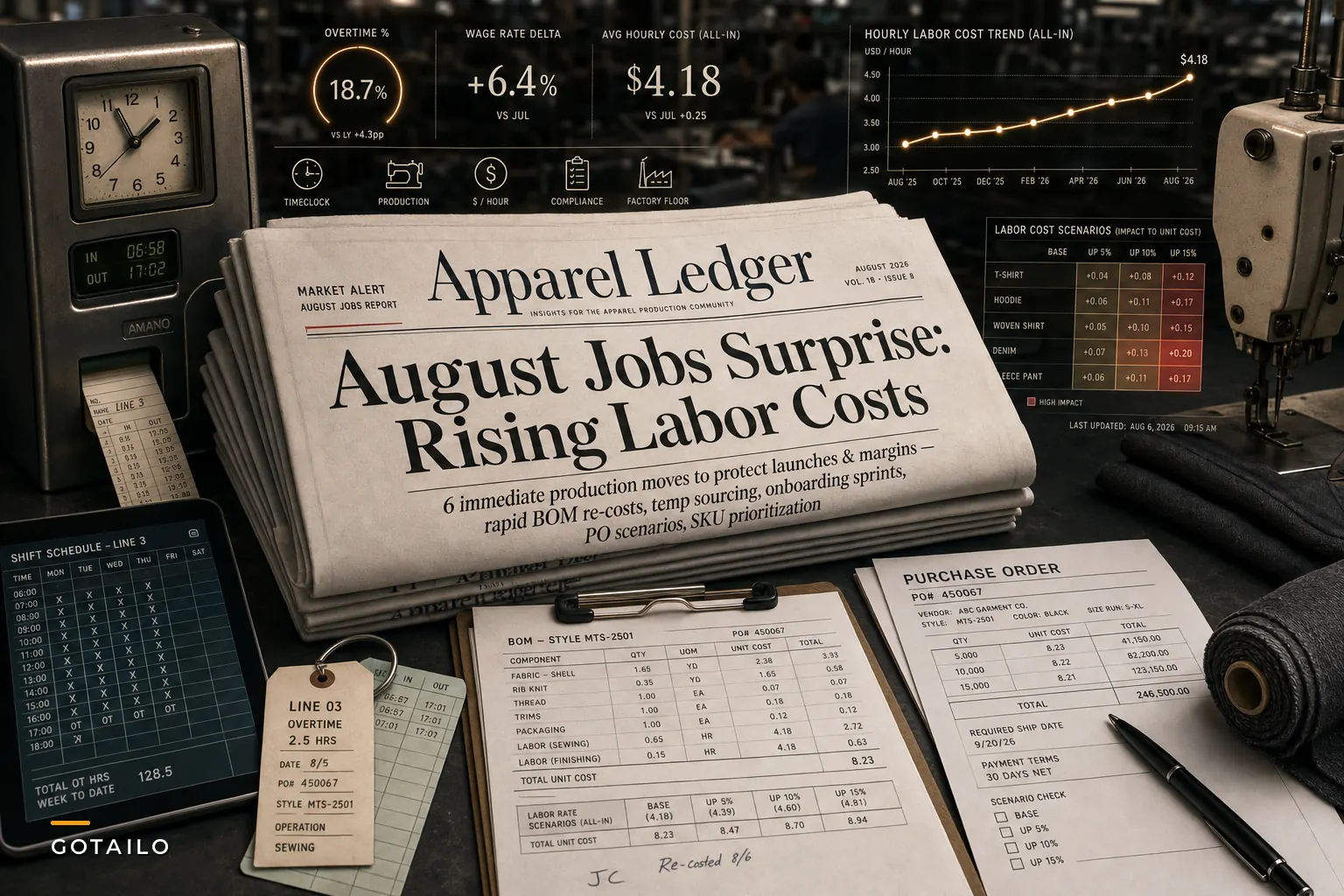

The 162,000 nonfarm payroll gain in August 2026 caught most economists off guard, with the unemployment rate holding at 4.1% according to the BLS employment situation release. Reuters framed it as a clear upside surprise that shifted rate-cut expectations almost immediately.
For most people, that's a headline they skim past. For anyone running an apparel production floor, it's a signal that the labor tightness you've been dealing with all year isn't going anywhere — and that has real consequences for how you staff fall/winter, how you cost your cut/sew, and how much overtime you're about to absorb.
The number itself isn't really the point. What it tells you about the next 90 days of hiring, wage pressure, and financing assumptions — that's what lands on your production schedule. Here's what to actually do about it.
What a "hot" labor print does to a sewing floor
A strong jobs report tightens the labor pool at exactly the level apparel producers feel first: hourly, semi-skilled, seasonal roles filling your cut room and sewing lines. When the broader market is absorbing workers, your seasonal help gets harder to find and more expensive to keep.
The pattern during tight labor stretches is pretty consistent. Apparel labor costs don't spike in one obvious line item — they leak through three channels at once:
-
Wage floor creep — you raise your posted rate $1–$2/hour just to get applicants through the door
-
Overtime dependency — you can't fill the headcount, so your existing operators run 48–52 hour weeks and OT premiums pile up
-
Turnover churn — someone leaves for a warehouse job paying slightly more, and you lose two weeks of trained-operator productivity replacing them
Most production managers only track the first one. The second and third are where the real margin damage happens, because they spread across dozens of small events that never trigger a formal review.
A small domestic cut/sew shop running two lines of around 18 operators budgeted their fall/winter program assuming a straight 40-hour week at their standard rate. Because they couldn't fill four open seats, they leaned on overtime to hit ship dates. That OT — spread across roughly 8–10 weeks — added somewhere in the range of $14k–$18k they hadn't costed into the program. Nobody signed off on that number. It just accumulated, shift by shift.
The deeper problem: your labor cost is invisible until it's already spent
The real issue a hot labor market exposes isn't wages. It's that most apparel teams don't have labor cost visibility at the order level until the season is over.
Eliminate delays in your fashion production cycle.
GoTailo helps you manage designs, orders, and inventory effortlessly, keeping production on schedule.
- Centralized order and inventory management
- Real-time supplier communication
- Integrated production scheduling
No credit card required
You cost a garment with a standard SAM and a standard labor rate. Fine. But when the actual floor is running short-staffed on overtime, or when a new hire is producing at 60% efficiency for their first three weeks, your actual labor-per-unit drifts far from the costed number — and you won't know until you reconcile the whole program.
This typically happens because:
-
Efficiency assumptions get locked at the start of the season and never revisited
-
Overtime gets tracked in payroll but never mapped back to specific styles or POs
-
New-operator ramp curves aren't factored into the standard at all
The gap between costed labor and actual labor is where the margin quietly disappears. A tight labor market widens that gap fast, because you're running more overtime and onboarding more green operators than your standards assume.
Six moves to make in the next 90 days
These are ordered roughly by how fast they pay back. You don't need all six — pick the ones that match where your program is bleeding.
1. Re-baseline your labor standard against actual floor conditions
Pull the last 6–8 weeks of actual output per line and compare it against the SAM-based standard you're costing with. If your actual efficiency is running 8–12 points below standard because of open seats and overtime fatigue, your costed labor is fiction.
Rebuild the standard using realistic conditions for the season you're about to run, not the ideal-state number from a fully staffed line. Cost pessimistically and beat it — that's a much better outcome than optimistically costing and explaining the miss later.
2. Map overtime to styles, not just to pay periods
This is the single highest-leverage change most shops skip. Overtime that lives only in payroll tells you nothing about which programs are dragging. Tag OT hours to the PO or style being run.
Once you do this, you almost always find that a small number of styles — usually the complex ones with high SAM and tight windows — are eating a disproportionate share of your overtime. Those are the styles to reprice, resequence, or rethink before next season.
3. Cross-train before you need to, not during the crunch
Cross-training is cheap when the line is calm and brutally expensive when you're already behind. Identify the two or three operations that become bottlenecks when one person is out, and get at least two backup operators trained on each.
A workable target: every critical operation should have coverage from at least two people who can hit 85%+ of standard. That one rule prevents most of the "one absence stalls the whole line" situations that force emergency overtime.
Prioritize cross-training on the operations that historically cause line stoppages.
4. Lock in seasonal labor earlier and structure retention around the ship window
If seasonal hiring is going to be harder this cycle, move your recruiting timeline forward and build a small completion incentive tied to staying through the ship window. A modest bonus for working through the program's critical weeks is almost always cheaper than the overtime and turnover you'd otherwise absorb.
5. Renegotiate supplier terms while your leverage still exists
If rate expectations shift — and CNBC noted the report immediately moved the Fed conversation — your working-capital carrying costs move with them. Don't wait to find out.
Revisit payment terms with your fabric and trim suppliers now. Even a shift from net-30 to net-45 on your two or three largest material spends changes your cash position meaningfully when financing costs are uncertain. Frame it as a partnership conversation before you're forced into it under pressure.
6. Build labor-cost sensitivity directly into your costing model
Stop costing at a single labor rate. Cost at three:
| Scenario | Labor rate assumption | Efficiency assumption | Use case |
|---|---|---|---|
| Optimistic | Standard rate | Full-staffed, 90%+ efficiency | Best-case margin ceiling |
| Realistic | Standard + modest OT blend | 80–85% efficiency | Planning / commitment number |
| Stressed | Standard + heavy OT + turnover drag | 70–75% efficiency | Downside protection |
Commit your buyer and merchandising decisions against the realistic column, not the optimistic one. The stressed column tells you which programs go underwater if the labor market stays tight — and those are the ones to hedge with earlier bookings or simpler construction.
Here's a quick visual of the workflow for mapping overtime and efficiency into style-level costing.
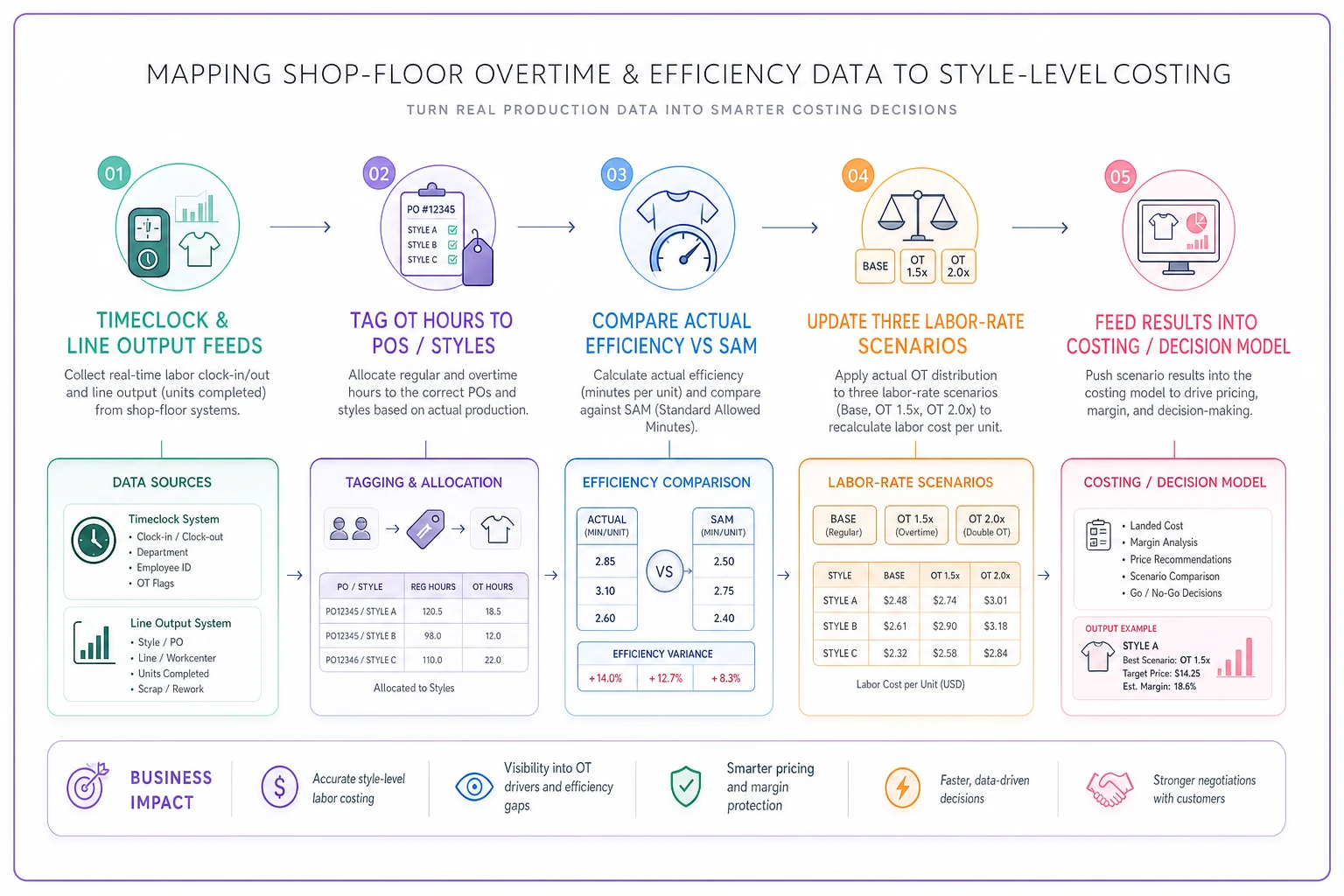
The visual shows how tagged OT and efficiency deltas update costing scenarios so decision-makers can reprice or resequence before margins erode.
When this level of rigor actually makes sense — and when it doesn't
If you're running a handful of styles at low volume with a stable, tenured crew, re-baselining your entire labor standard is probably overkill. Your variance is small, your team knows the work. Focus on move #5.
Where this pays off is the shop running multiple concurrent programs, seasonal headcount swings, and any meaningful mix of new hires. That's where the gap between costed and actual labor gets large enough to swallow a program's margin. If overtime has become your default fill strategy rather than an occasional exception, that's the clearest signal you need the full sensitivity model.
And if you're a design-led brand that outsources all production, most of this lands on your contractor rather than you. But move #6 still matters — a squeezed contractor eventually passes labor pressure back through pricing. Understanding their labor exposure protects your costing.
A short real scenario
A mid-sized private-label manufacturer running three programs at once went into their fall season costing at a single labor rate and full-efficiency assumption. They were carrying four open sewing seats through the ramp.
By week six they were running consistent overtime, two new hires were still climbing toward standard, and actual labor-per-unit had drifted well above the costed figure — enough to compress the margin on their highest-volume program by several points.
The fix wasn't complicated. They tagged overtime to styles, found that one complex jacket program was absorbing most of it, and moved that program's start date earlier the following season so it didn't collide with peak staffing pressure. They also added a completion incentive for seasonal hires. The next cycle, overtime dependency on that program dropped noticeably, and the labor variance that had been invisible became something they could actually manage before the season closed.
Nothing exotic. Just visibility applied at the order level instead of the payroll level.
Where onboarding speed ties this all together
A tight labor market makes one weakness far more expensive: slow ramp. Every week a new operator or a new contractor takes to reach standard is a week of paying full cost for partial output — and when you're already short-staffed, those weeks stack up fast.
That's why the same conditions pushing up apparel labor costs also raise the stakes on getting new capacity productive quickly. If you're bringing on additional sewing capacity or standing up a new contractor to relieve pressure, a structured ramp matters more than usual. Our factory onboarding checklist with a capability matrix and 90-day KPIs walks through how to get new production capacity to standard output faster — which is exactly the lever you want when the labor pool is tight and every slow week costs you.
The takeaway
A strong jobs report isn't good news or bad news for your production floor — it's information. It tells you labor stays tight, wage and overtime pressure stays elevated, and your financing assumptions are still in motion. The apparel teams that come out of fall/winter with intact margins won't be the ones who called the Fed correctly. They'll be the ones who costed their labor realistically, made overtime visible at the style level, and got new capacity productive before the pressure peaked.
Do that work now, in September, and the season's labor surprises stop being surprises.
A strong jobs report isn't good news or bad news for your production floor — it's information. It tells you labor stays tight, wage and overtime pressure stays elevated, and your financing assumptions are still in motion. The apparel teams that come out of fall/winter with intact margins won't be the ones who called the Fed correctly. They'll be the ones who costed their labor realistically, made overtime visible at the style level, and got new capacity productive before the pressure peaked.
Do that work now, in September, and the season's labor surprises stop being surprises.
Ready to tailor your apparel operations?
Join 500+ fashion brands using GoTailo to accelerate product launches, reduce waste, and improve supplier collaboration.