

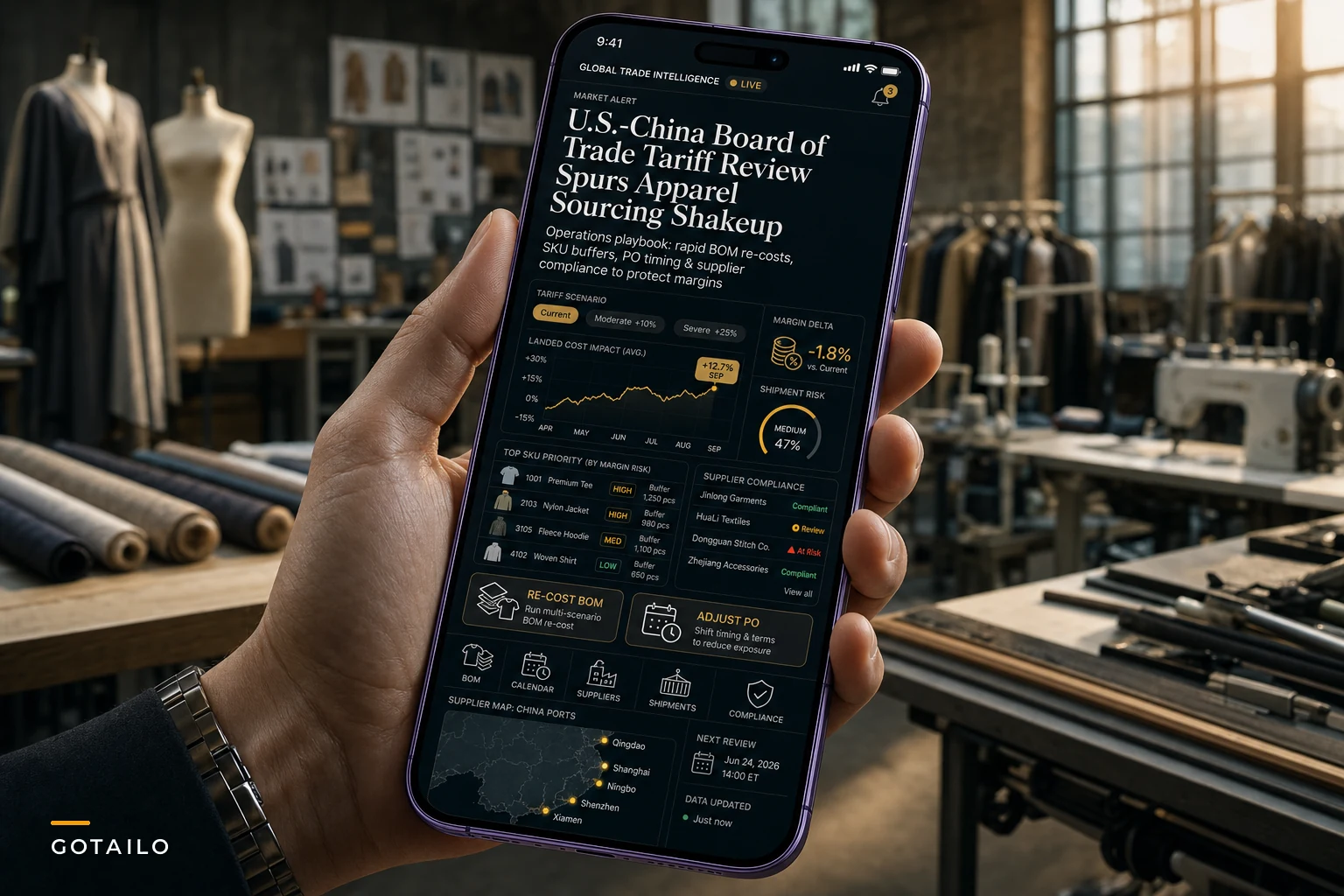
Last week's announcement from the Office of the U.S. Trade Representative about opening public comment on a proposed U.S.-China Board of Trade sent shockwaves through apparel sourcing teams. The comment period closes July 10th, and the potential for tariff modifications on "non-sensitive" Chinese goods has everyone scrambling to figure out what this means for their fall production runs.
Most fashion brands are missing the real operational damage. It's not coming from the tariffs themselves—it's the planning paralysis that hits when you can't nail down landed costs for the next six months.
I spent last Tuesday on calls with three different production managers dealing with variations of the same nightmare. One had already placed fabric orders for September delivery. Another was sitting on confirmed CMT bookings in Guangdong province. The third was halfway through sampling for a private label program that assumed 25% duty rates baked into their pricing structure.
None of them knew whether to hold, pivot, or push forward.
The cascading cost problem nobody talks about
When tariff uncertainty hits China sourcing for apparel, most companies focus on the obvious landed cost question. Will my $12 FOB hoodie stay at $15 landed, or drop back to $13.50 if textiles get exempted?
That's just the entry point to a much messier operational breakdown.
Your BOM costing spreadsheets become worthless overnight. Not because the numbers change—but because you now need parallel scenarios for every SKU. The athletic wear brand I work with discovered their costing team was maintaining three separate BOM versions for each style: current tariff rates, potential reduced rates, and a worst-case escalation scenario. Their product manager was spending four hours a day just reconciling pricing across different wholesale channels.
Lead time buffers get brutal. Say you normally run 120-day cycles from PO to delivery for woven bottoms. Smart money says add another 15-20 days while everyone figures out new compliance documentation. Your Chinese suppliers, spooked by the uncertainty, start front-loading production for their bigger clients. Your 120 days becomes 145 days, but only after you've already communicated ship dates to retail partners.
Then there's the minimum order quantity trap. Chinese factories facing potential order volatility are quietly bumping MOQs by 20-30%. That merino wool blend supplier who used to take 500-piece orders? They want 750 now, cash upfront, no payment terms. Your cash conversion cycle just extended by six weeks minimum.
Breaking down real tariff impact on a basic tee program
What this looked like for a streetwear brand's basic tee program last month:
Eliminate delays in your fashion production cycle.
GoTailo helps you manage designs, orders, and inventory effortlessly, keeping production on schedule.
- Centralized order and inventory management
- Real-time supplier communication
- Integrated production scheduling
No credit card required
| Cost Component | Pre-Uncertainty | Current Reality | Hidden Impact |
|---|---|---|---|
| FOB Price (per unit) | $4.80 | $4.80 | No change yet |
| Current Duty (25%) | $1.20 | $1.20 | Might drop to 10% |
| Freight & Handling | $0.65 | $0.78 | Carriers adding "uncertainty fees" |
| Compliance Documentation | $0.05 | $0.22 | New classification paperwork |
| Buffer Inventory Cost | $0 | $0.31 | Holding extra stock |
| True Landed Cost | $6.70 | $7.31 | +9% before any decision |
Notice how the actual tariff question—whether it stays at 25% or drops—becomes almost secondary to the operational costs of uncertainty itself.
The supplier communication breakdown that kills margins
What typically goes wrong: brands blast generic emails to all suppliers asking about "tariff contingency plans." Suppliers, equally confused, respond with vague reassurances. Nobody adjusts production schedules. Everyone assumes someone else has better information.
-
Current production capacity allocation (what percentage is already booked)
-
Material inventory levels for your specific components
-
Alternative routing options if classifications change
Most brands track none of this systematically. They're flying blind through critical supply chain visibility signals while hoping their WhatsApp messages to factory managers are enough.
Production planning adjustments that work require uncomfortable decisions. You can't wait for perfect information. You have to move based on probability ranges.
Production planning moves that reduce exposure
Smart operators are making three specific adjustments right now, before any tariff decisions come down.
Geographic splitting of similar SKUs. Instead of sourcing all your cotton jerseys from one Guangdong supplier, you split the program. Keep 60% in China for styles where the landed cost math still works even at current rates. Move 40% to Vietnam or Bangladesh for margin-sensitive pieces. Yes, this creates complexity. Yes, you'll have color-matching issues. But it beats getting stuck with unsellable inventory if rates spike further.
Accelerate anything with sub-12-month selling seasons. If you're planning holiday basics or seasonal items that won't carry into next year, place those POs now at current known rates. The 2-3% you might save if tariffs drop isn't worth the risk of missing your selling window entirely. One women's contemporary brand pulled forward $800K in holiday orders last week, eating the current rates but guaranteeing October delivery.
Renegotiate payment terms aggressively. Your suppliers are as nervous as you are. They want confirmed orders, even if margins are thinner. Push for net-60 or even net-90 terms in exchange for firm commitments at current pricing. This gives you breathing room to see how tariff modifications actually play out while keeping production slots locked.
The BOM revision framework nobody teaches you
Your bill of materials needs a complete structural overhaul when tariff classifications are in flux. Most brands maintain BOMs as static documents—a catastrophic mistake when every component might get reclassified.
Start with component-level tariff tracking. Each material in your BOM needs its own HTS code and current duty rate, not just the finished good classification. That poly-cotton blend fabric might stay at 25%, while your YKK zippers could drop to 10%. Without granular tracking, you can't model scenarios accurately.
Build three-scenario costing into your standard BOM template. Baseline, optimistic, and defensive scenarios need to live in the same document, updated simultaneously.
A kids' apparel brand implemented this last month, discovering their fleece program had 40% cost variance between scenarios, while their woven cotton line only showed 8% variance. Guess which program they're prioritizing for production right now?
The revision process itself needs new approval gates. Previously, BOM updates might flow through design, then sourcing, then finance. Now you need a tariff-impact checkpoint between each stage. The sourcing team validates current rates. Finance models the three scenarios. Only then does design get final approval to proceed.
This sounds bureaucratic until you realize the alternative is commissioning $200K in samples for products that become unmarketable if rates shift 5%.
When to actually pull the trigger on alternative sourcing
Everyone's talking about moving production out of China, but the math rarely works unless you're playing a longer game. Setup costs for new suppliers typically run $30K-50K minimum for a small program. New pattern makers, new sample rooms, new quality standards, new logistics relationships.
The breakeven only makes sense if you're committing to 18+ months of production with significant volume. Otherwise, you're just trading tariff risk for execution risk.
The decision framework that actually works:
Move immediately if: your landed cost increase exceeds 35% of wholesale price, you have existing supplier relationships in alternative countries, and your product allows for 15-20% quality variance without customer impact.
Stay in China if: your current suppliers own unique technical capabilities, you're under 200K units annually, or your lead times can't absorb an extra 30-45 days for new supplier onboarding.
The hybrid approach: Keep core production in China but move trim and packaging elsewhere. A denim brand saved 7% on landed costs just by sourcing hangtags, labels, and poly bags from Vietnam while keeping the actual garment production in China. The compliance is more complex, but the savings are immediate.
The inventory hedge that small brands can actually execute
Large brands can use financial instruments to hedge currency and tariff risk. You probably can't. But you can execute an operational hedge that's nearly as effective.
The concept is simple: selective inventory building on stable, high-turn SKUs. The execution requires discipline most brands lack.
Identify your "evergreen" styles—the ones that sell consistently regardless of season. For most brands, this is 15-20% of SKUs generating 40-50% of revenue. These are your hedge candidates.
Calculate your current turn rate on these SKUs. If you're turning inventory 4x annually, you're holding roughly 3 months of stock. Increase this to 4.5 months—but only for these proven sellers. The carrying cost (usually 20-25% annually) is your insurance premium against tariff spikes.
A contemporary women's brand executed this with eight core styles, investing an extra $120K in inventory. When tariffs held steady, they paid roughly $2K monthly in additional carrying costs. But they protected $450K in annual margin if rates had increased.
Resist the temptation to hedge everything. Hedge only what you know sells. Let trendy, unproven styles run lean.
Software infrastructure for tariff scenario planning
Most apparel brands are trying to manage tariff scenarios in Excel, and it's a disaster. Not because Excel can't handle the math—it can. But because version control falls apart the moment you have multiple people updating different scenarios.
Centralized BOM management with scenario modeling. Every SKU needs three cost scenarios visible in real-time. When your sourcing manager updates a fabric cost, it should cascade through all three models instantly. This isn't complex technology—it's basic database design—but almost nobody has it properly implemented.
Supplier communication tracking. Not just email threads, but structured data collection. When you ask suppliers about capacity, material inventory, or alternative routings, their responses need to feed directly into your planning system. Otherwise, you're making million-dollar decisions based on whoever remembers last week's WeChat conversation.
Automated alert systems for threshold breaches. Set tolerance bands for each SKU's landed cost. If the optimistic scenario drops below your target margin, you get an alert. If the pessimistic scenario makes the product unsellable, you get an alert. This prevents the slow-motion disaster of gradually accepting worse margins until you're underwater.
The AI automation layer that makes this useful isn't about complex algorithms. It's about simple pattern recognition: flagging when suppliers' responses don't match their historical patterns, identifying which SKUs are most sensitive to specific tariff changes, and suggesting which production orders to accelerate or defer based on your risk tolerance.
A kids' swimwear brand built this system in eight weeks using mostly off-the-shelf tools plus some custom integration.
Visualize this workflow of BOM management, supplier tracking, and automated alerts interacting across planning cycles.
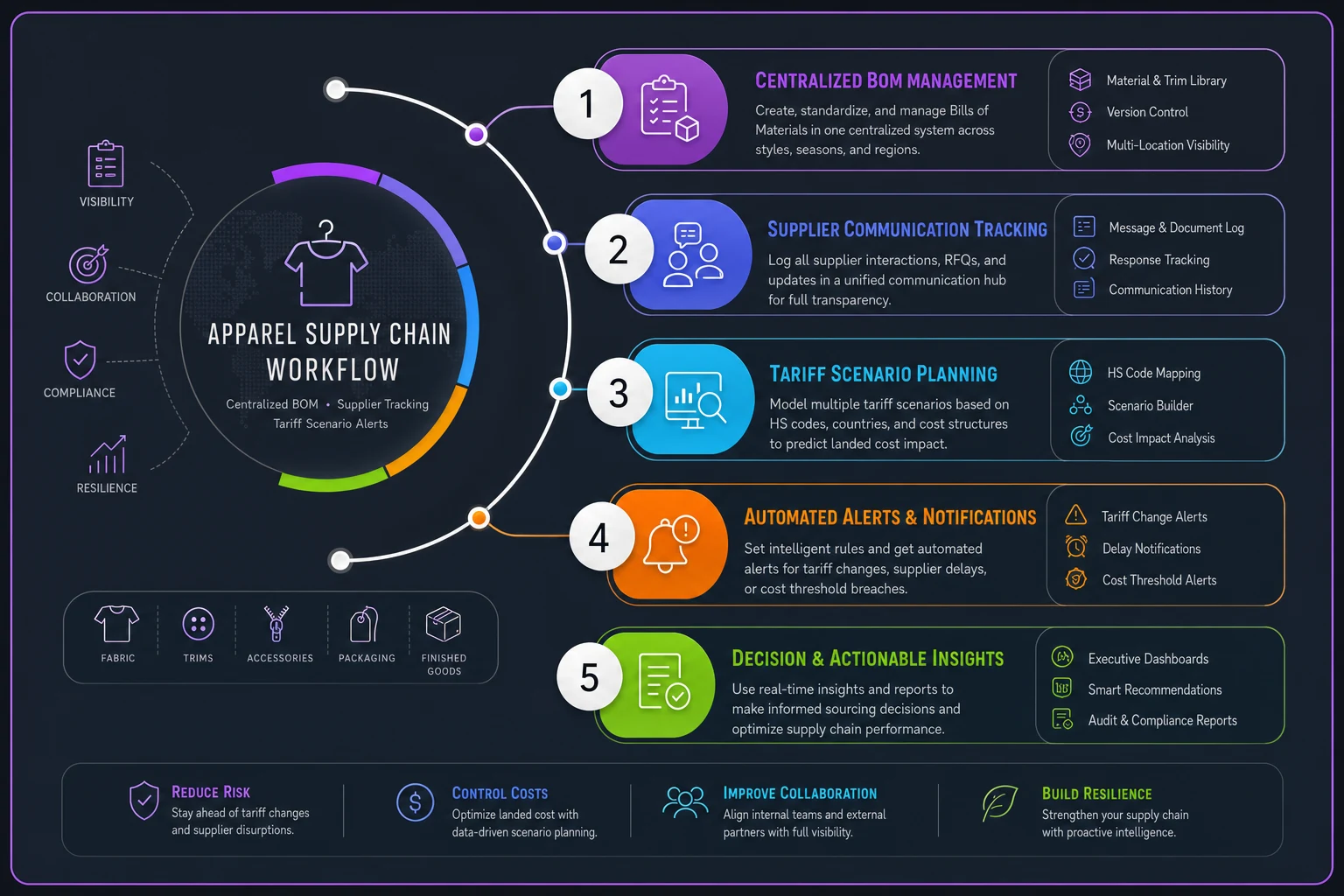
Their planning accuracy improved by roughly 30%, but more importantly, their reaction time to tariff news dropped from days to hours.
The coordination reality check
All these frameworks and systems mean nothing if your team can't execute together under uncertainty. Most apparel brands completely fall apart here.
Your design team is still sketching Spring 2027 styles assuming current cost structures. Your sourcing team is negotiating Fall 2026 production assuming tariffs will drop. Your finance team is modeling cashflow assuming tariffs will spike. Nobody's aligned.
The fix isn't more meetings. It's structured decision rights with clear escalation triggers.
Design owns aesthetic and technical decisions until landed cost variance exceeds 15%. Then sourcing takes over with veto power on materials and construction methods. If variance exceeds 25%, finance owns the final call on whether to proceed or kill the style.
This sounds draconian, but ambiguity kills margin during uncertainty. A private label manufacturer implemented these triggers last month. They killed three programs early that would have been margin disasters, and accelerated two programs that had favorable cost structures. No lengthy debates, no analysis paralysis.
What happens next
The public comment period for China tariff modifications closes soon. But regardless of what changes come through, the operational patterns stay the same. Brands that can model scenarios, adjust quickly, and maintain supplier relationships through uncertainty will capture market share from those paralyzed by analysis.
The teams winning right now aren't necessarily the ones with perfect information. They're the ones with clear processes for making decisions with imperfect information. They've accepted that some bets will be wrong, but paralysis is always wrong.
Your BOM structures, sourcing relationships, and planning systems need to assume permanent volatility, not temporary disruption. The tariff question isn't going away—it's just going to keep shapeshifting every 18-24 months.
The brands that build operational flexibility now won't need to panic the next time trade policy shifts. They'll already have the infrastructure to model, adjust, and execute while their competitors are still updating Excel sheets and hoping for the best.
Start with the three-scenario BOM model. Add the supplier visibility tracking. Build the inventory hedge on proven sellers. These aren't revolutionary concepts—they're just disciplined operations. But disciplined operations, systematically executed, is what separates profitable brands from everyone else scrambling to interpret the latest trade announcement.
Ready to tailor your apparel operations?
Join 500+ fashion brands using GoTailo to accelerate product launches, reduce waste, and improve supplier collaboration.